

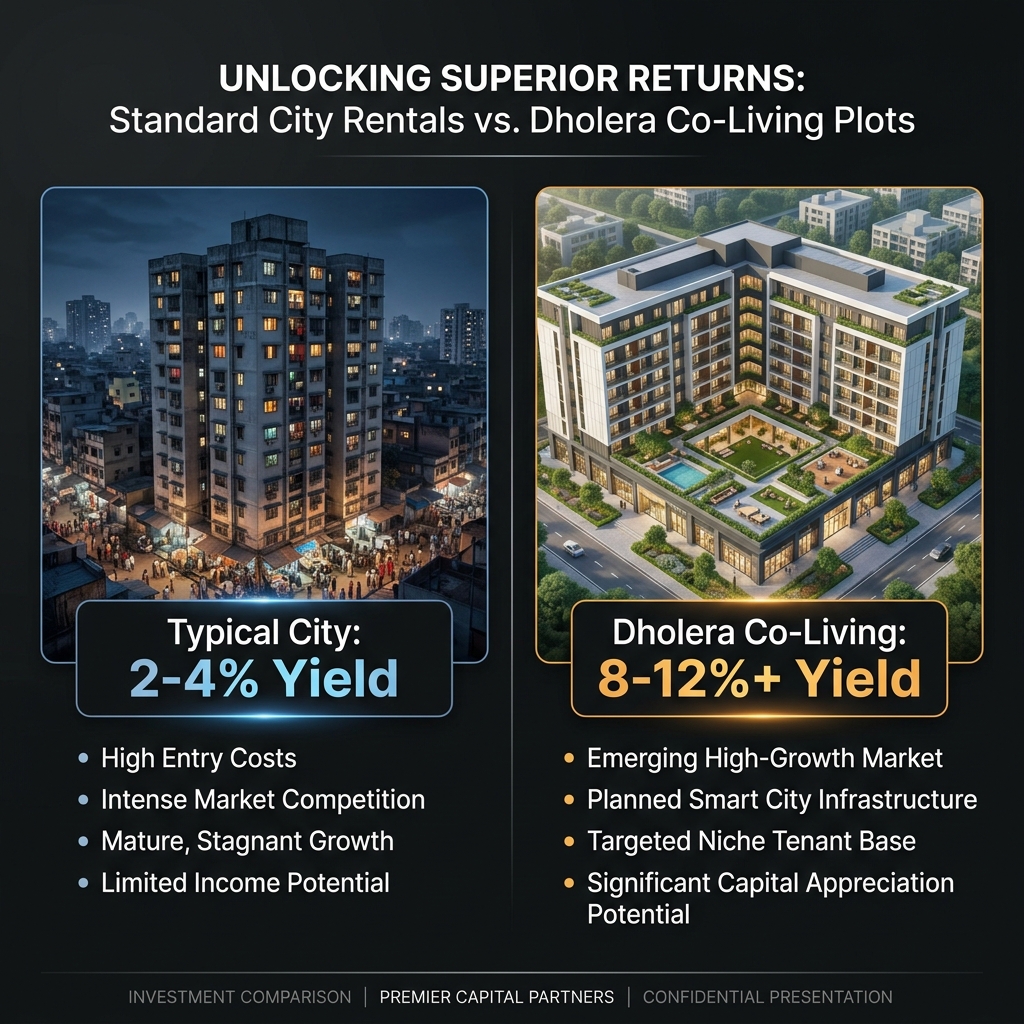
For decades, real estate investing in major Indian cities has relied almost entirely on capital appreciation, as rental yields have remained stagnant. With residential property prices sky-rocketing in cities like Mumbai, Pune, and Bangalore, the annual returns from rental income are among the lowest globally.
This article analyzes the typical residential rental yields in Indian metros and compares them to the emerging high-yield co-living and workforce housing opportunities in Dholera Special Investment Region (SIR), compiled by Dholera Acres.
1. Typical Residential Rental Yield in India (City Comparison)
Rental yield is defined as the annual rental income generated by a property expressed as a percentage of its total market value. In major Indian metropolitan areas, this metric is consistently low, hovering between 2% and 4%.
Below is a structured comparative table showing typical yields and entry budgets across top Indian investment hubs versus Dholera SIR co-living properties:
| Metro City / Region | Average Entry Price (2BHK / Plot) | Typical Monthly Rent (2BHK / Unit) | Typical Rental Yield (Annual) | Projected 5-Year Capital Growth |
|---|---|---|---|---|
| **Mumbai (Suburbs)** | ₹1.5 Crore – ₹2.5 Crore | ₹30,000 – ₹50,000 | **2.0% – 2.5%** | 5% – 7% p.a. |
| **Bangalore (IT Corridor)** | ₹80 Lakhs – ₹1.5 Crore | ₹22,000 – ₹38,000 | **2.8% – 3.2%** | 6% – 8% p.a. |
| **Pune (Hinjewadi)** | ₹70 Lakhs – ₹1.2 Crore | ₹18,000 – ₹28,000 | **3.0% – 3.5%** | 6% – 8% p.a. |
| **Delhi NCR (Gurgaon)** | ₹1.2 Crore – ₹2.2 Crore | ₹28,000 – ₹45,000 | **2.5% – 3.0%** | 7% – 9% p.a. |
| **Dholera SIR (Co-Living)** | ₹40 Lakhs – ₹60 Lakhs (Land + G+2 Construction) | ₹4,500 – ₹6,000 (Per Bed sharing / PG model) | **6.0% – 9.0%** | 12% – 15% p.a. |
Note: Dholera SIR figures are based on co-living operator models designed for workforce housing in TP1 and TP2.

2. Why Dholera Co-Living Yields Outperform Indian Metros
The high rental yields in Dholera SIR are driven by three fundamental real estate dynamics:
A. The Semiconductor Workforce Influx
The Tata Electronics semiconductor fab in TP1 is India’s first commercial chip fab. At peak operation, it will employ over 20,000 engineers, technicians, and construction personnel. Since Dholera is a greenfield development, the immediate demand for ready-to-move-in, furnished employee accommodation is immense.
B. High Tenant Density (Co-Living Model)
Traditional rental properties are leased to single families. Co-living spaces, however, operate on a per-bed sharing basis. A single 3BHK flat converted into an executive co-living space can host 6 to 8 professionals, generating double the aggregate rental income of a standard family lease.
C. Low Capital Entry Barriers
Land prices in Dholera SIR remain highly accessible compared to metro cities. An investor can acquire a residential plot in TP1 or TP2 for ₹12 Lakhs to ₹20 Lakhs, construct a multi-room co-living structure for ₹28 Lakhs to ₹35 Lakhs, and secure a 6% to 9% yield profile that is impossible to replicate in mature metro suburbs.
FAQ Accordion
Why are rental yields in India so low compared to other countries?
The typical residential rental yield in India (2-4%) is low because property acquisition costs (capital values) have grown at a much faster rate than average household rental budgets. Stagnant corporate salaries in metros, coupled with high interest rates on home loans, prevent rental rates from rising proportionally to property valuations.
How can I invest in the co-living segment in Dholera SIR?
Investors can buy residential plots in Town Planning Scheme 1 (TP1) or Town Planning Scheme 2 (TP2) with high FSI limits. Once NA NOC permissions are verified, you can construct a multi-room co-living layout and partner with professional facility operators who manage the corporate leasing and maintenance.
What is the FSI limit for residential plots in Dholera TP1 and TP2?
Residential plots in Dholera SIR typically have an FSI (Floor Space Index) ranging from 1.6 to 2.0 depending on the plot size and road access width. This allows you to construct multiple floors (typically G+2 or G+3) to maximize room count for rental returns.
Local Authority References & Resources
- National Market Data: RBI Residential Asset Price Index Reports
- Building Approvals & FSI Rules: DSIRDA Building Bye-Laws
- For co-living land listings and construction costs: Visit the Dholera Acres Advisory Hub
Download Dholera SIR 2026 Investor’s Kit
Get instant access to the official planning documents: Dholera Investment Handbook (PDF), 2026 Land Price List, TP Zone & Village Map, and the NRI Buying Guide.

Join The Discussion