

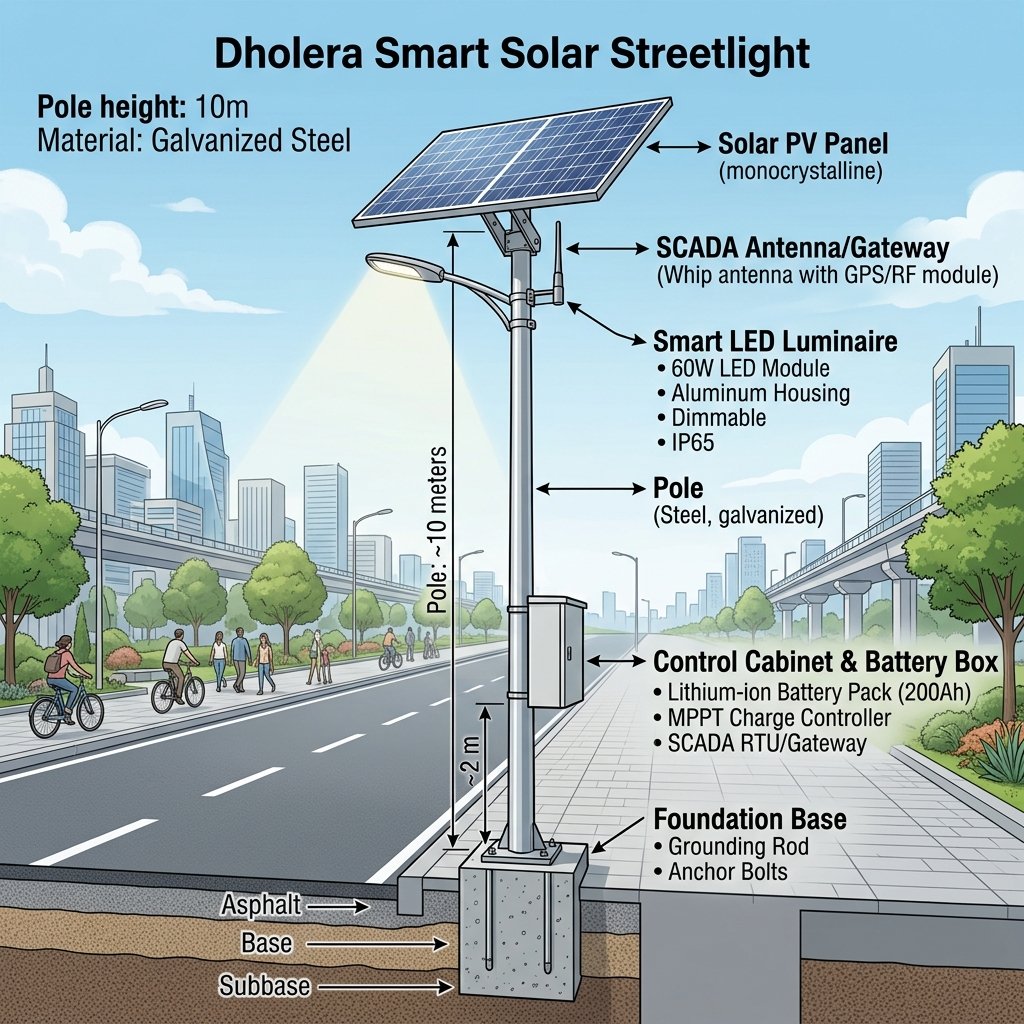
1. Solar PV & Battery Autonomy Mandates
To maintain continuous illumination even during prolonged overcast weather, Dholera’s public lighting infrastructure enforces strict energy storage reserves:
- 48-Hour Battery Autonomy: Solar streetlights must incorporate lithium iron phosphate ($\text{LiFePO}_4$) battery packs sized to sustain 48 hours (2 consecutive nights) of uninterrupted operation without solar recharge.
- Monocrystalline Solar PV Modules: Top-mounted solar panels must utilize high-efficiency monocrystalline silicon cells (minimum 20% module efficiency) inclined at an optimal tilt angle of 23 degrees south to maximize annual solar irradiance.
- MPPT Charge Controllers: Every smart pole must feature a Maximum Power Point Tracking (MPPT) solar charge controller with overcharge, deep-discharge, and thermal protection circuits.
2. Smart Pole Telemetry & SCADA Dimming
Rather than running at fixed wattage throughout the night, Dholera’s streetlights are connected to the ABCD Central Command Center via wireless telemetry:
- SCADA Dimming Profiles: Streetlights automatically operate at 100% luminosity from dusk until 10:00 PM, dynamically dim to 50% luminosity during low-traffic hours (10:00 PM to 4:00 AM), and ramp back to 80% luminosity from 4:00 AM until dawn.
- Remote Fault Telemetry: Smart poles transmit real-time diagnostics (battery voltage, panel current, LED junction temperature, and luminaire status) over DICDL’s municipal cellular/RF mesh network to alert maintenance crews of outages automatically.
- Ingress & Impact Ratings: Luminaires must achieve an IP66 ingress protection rating (dust-tight and protected against high-pressure water jets) and an IK09 mechanical impact rating.
The table below outlines DICDL solar street lighting specifications across road hierarchies:
| Road Hierarchy / Width | Minimum Pole Height | Recommended Luminaire Wattage | Solar PV Panel Capacity | Battery Pack Rating ($\text{LiFePO}_4$) | Pole Spacing Ratio |
|---|---|---|---|---|---|
| **12m Residential / Local Road** | 6.0 Meters | 30W LED (4,500 lm) | 100Wp Monocrystalline | 12.8V / 40Ah | 3.5 × Pole Height (21m) |
| **18m Sub-Arterial Collector** | 8.0 Meters | 60W LED (9,000 lm) | 180Wp Monocrystalline | 12.8V / 80Ah | 3.5 × Pole Height (28m) |
| **30m Main Arterial Road** | 10.0 Meters | 90W LED (13,500 lm) | 260Wp Monocrystalline | 12.8V / 120Ah | 3.2 × Pole Height (32m) |
| **55m Expressway / Freight Way** | 12.0 Meters | 120W LED (18,000 lm) | 350Wp Monocrystalline | 25.6V / 100Ah | 3.0 × Pole Height (36m) |
3. Foundation & Wind Load Engineering
- Galvanized Steel Poles: Poles must be constructed from hot-dip galvanized octagonal tubular steel (minimum coating thickness 86 microns) to resist coastal saline corrosion in Dholera’s environment.
- Wind Speed Design Rating: Poles and solar panel mounting brackets must be structurally engineered to withstand maximum basic wind speeds of 47 m/s (169 km/h) under IS 875 (Part 3) structural codes.
Frequently Asked Questions (FAQ)
#### What is the battery autonomy requirement for solar streetlights in Dholera?
Under DICDL smart city standards, all public solar streetlights must include battery storage capable of providing at least 48 hours (2 full nights) of operational autonomy.
#### How do smart poles communicate with Dholera’s command center?
Dholera smart poles are equipped with SCADA RTU gateways and RF/cellular antennas that transmit battery diagnostics, energy generation data, and fault alerts to the ABCD Building Central Command Center.
#### What is the recommended tilt angle for solar panels on Dholera smart poles?
Solar panels mounted on street poles must be fixed at a tilt angle of 23 degrees facing South to optimize solar energy absorption throughout the year in Gujarat.
Download Dholera SIR 2026 Investor’s Kit
Get instant access to the official planning documents: Dholera Investment Handbook (PDF), 2026 Land Price List, TP Zone & Village Map, and the NRI Buying Guide.

Join The Discussion