

High-Tension (HT) Line Setback Rules & GETCO NOC for Industrial Land in Dholera SIR
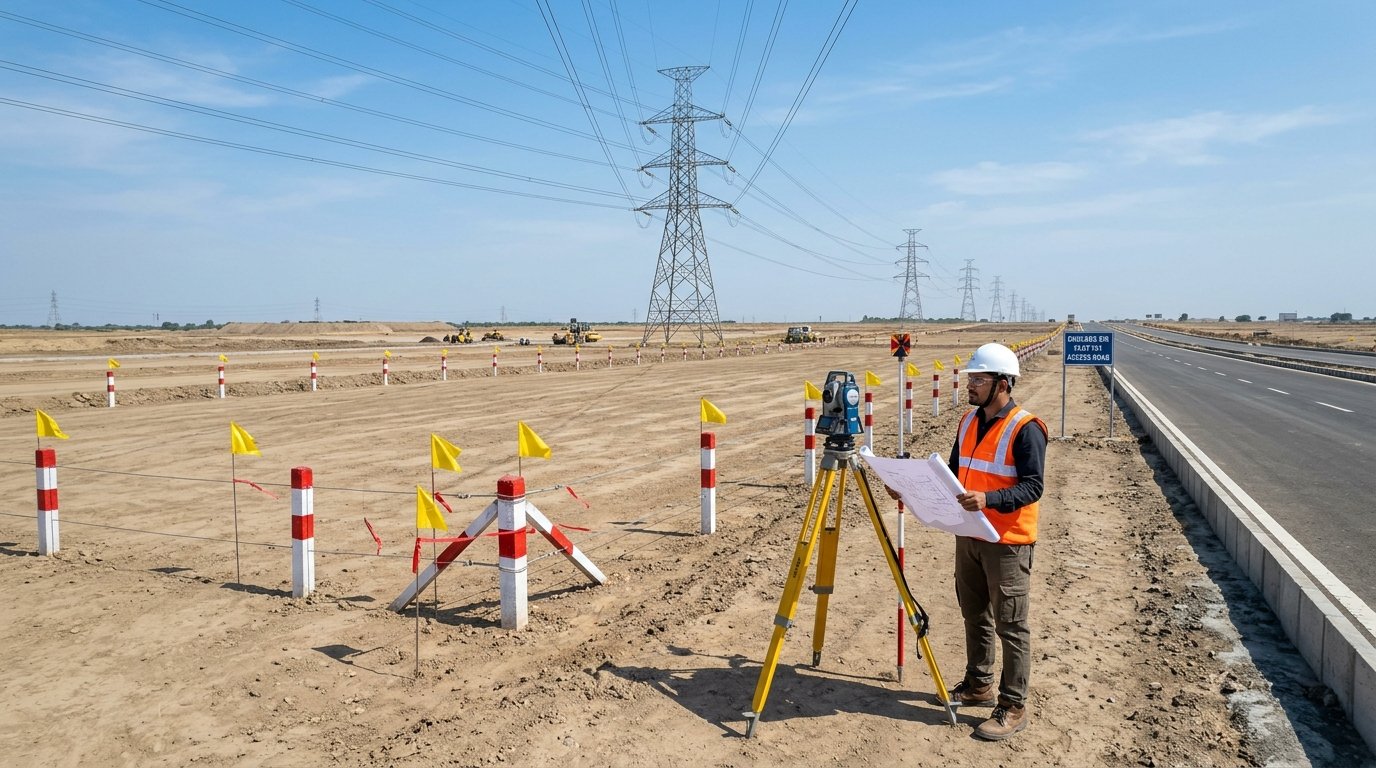
As the massive 5,000 MW Dholera Solar Park and GETCO’s 400kV/220kV Polarpur transmission substations channel electrical power across the region, numerous high-voltage overhead lines traverse industrial and commercial land parcels in Dholera SIR. For manufacturing investors, corporate developers, and warehouse operators, purchasing land encumbered by high-tension (HT) transmission lines without technical due diligence represents a severe financial hazard.
While an un-surveyed parcel may appear geometrically sound on paper, statutory overhead conductor clearances, tower base safety buffers, and electromagnetic interference (EMI) zones often render substantial portions of the acreage unbuildable. This technical guide outlines the exact Indian Electricity Rules, GETCO No Objection Certificate (NOC) protocols, usable FSI math, and layout optimization techniques required when evaluating HT-affected land in Dholera SIR.
What Are the Statutory Right-of-Way (ROW) and Setback Distances for GETCO Power Lines?
Under the Indian Electricity Rules (1956/2010) and GETCO transmission guidelines, the statutory Right-of-Way (ROW) corridor requires an absolute building setback centered on the transmission line: 18 meters for 66kV lines, 27 meters for 132kV lines, 35 meters for 220kV lines, and 52 meters for 400kV lines. No permanent building, factory shed, crane rail, or habitable structure is permitted within this corridor width.
In addition to horizontal corridor setbacks, vertical clearance requirements mandate a minimum height of 6.1 meters (66kV) to 8.84 meters (400kV) between the lowest point of the sagging power conductor at maximum operating temperature and the ground or any vehicular transport passing beneath it.
To inspect zoning classifications, utility reservations, and building control regulations across Town Planning schemes, consult our Dholera SIR TP 1 to TP 6 Master Guide or explore zoned parcels in our Industrial Zone Hub.
How Does an HT Line Corridor Impact Usable Floor Space Index (FSI) and Building Layouts?
While the physical land beneath a GETCO transmission corridor cannot be built upon, DSIRDA General Development Control Regulations (GDCR) allow developers to utilize the unbuilt corridor area as mandatory green open space, surface truck parking, or internal bituminous roadways. However, if the corridor bisects the plot centrally, it creates fragmented building pockets that destroy manufacturing assembly line continuity and escalate structural civil costs.
Crucially, DSIRDA calculates permissible gross Floor Space Index (FSI) on the total plot area, meaning developers can transfer the unbuilt FSI from the corridor buffer to multi-story buildings elsewhere on the parcel, provided front and side road setbacks comply with fire safety norms.
To evaluate how structural setbacks and infrastructure corridors affect property valuations, consult our Dholera SIR Property Rates Master Guide.
What Is the Procedure to Obtain a GETCO Building NOC for Industrial Land in Gujarat?
Obtaining a GETCO building NOC requires submitting a certified DGPS topographical contour survey showing exact transmission tower coordinates, conductor sag profiles, and proposed factory layout plans to the jurisdictional GETCO Executive Engineer (Transmission). Following a physical field inspection and structural clearance verification, GETCO issues a conditional NOC specifying clearance boundaries.
Revenue land records and rights-of-way should be audited on the Gujarat government’s AnyROR Gujarat Portal and verified against registered deed encumbrances via GARVI Gujarat. Developers can review unencumbered, title-clear industrial parcels in our Properties Catalog.
Technical Benchmark: GETCO High-Tension Transmission Corridor Setback Standards
| Transmission Voltage Level | Total Right-of-Way (ROW) Width | Setback from Center Line | Minimum Vertical Clearance |
|---|---|---|---|
| 66 kV (Single / Double Circuit) | 18.0 Meters | 9.0 Meters each side | 6.10 Meters |
| 132 kV (Sub-Transmission) | 27.0 Meters | 13.5 Meters each side | 6.70 Meters |
| 220 kV (Regional Transmission) | 35.0 Meters | 17.5 Meters each side | 7.00 Meters |
| 400 kV (Extra High Voltage / Solar) | 52.0 Meters | 26.0 Meters each side | 8.84 Meters |
| Permitted Uses Within Corridor | Surface Parking, Lawn, Open Road | Open Truck Parking & Green Buffer | Permitted only for ground-level landscaping |
| Prohibited Uses | Permanent Walls, Factory Sheds | Any building structure or inflammable storage | All structures, cranes, overhead cranes, towers |
Worked Math Example: Usable Footprint Loss on a 10-Acre Industrial Parcel Bisected by 220kV Line
To calculate the financial and spatial impact of an overhead transmission line, consider a standard 10-acre industrial plot in Dholera SIR TP 2A bisected diagonally by a GETCO 220kV double-circuit line:
1. Total Land Area & Parcel Dimensions:
Area = 10 Acres = 48,400 square yards (40,468 m²).
Plot Dimensions = 200 meters width × 202.3 meters length.
Acquisition Rate = ₹3,800/sq. yd. = ₹18,39,20,000 (₹18.39 Crores).
2. High-Tension Corridor Area Calculation:
Transmission Line Voltage = 220 kV $\rightarrow$ Statutory ROW Width = 35.0 meters.
Corridor length cutting across plot = 220.0 meters.
Corridor Buffer Area = 220 meters × 35 meters = 7,700 m² (9,209 sq. yds.).
Percentage of Unbuildable Land = (7,700 / 40,468) × 100 = 19.03%.
3. Financial Impact & Effective Land Cost:
Unbuildable Land Value = 9,209 sq. yds. × ₹3,800 = ₹3,49,94,200 (₹3.50 Crores).
Effective Net Usable Area = 48,400 − 9,209 = 39,191 sq. yds.
Real Landed Cost of Buildable Area = ₹18,39,20,000 / 39,191 = ₹4,693 per sq. yd. (A 23.5% premium over nominal purchase price).
Strategic Mitigation: By designating the 9,209 sq. yds. corridor for mandatory 10% statutory open green space and surface truck parking bays, the developer successfully recovers the unbuilt FSI for the main plant building, avoiding dead capital loss.
Statutory approvals for industrial construction are submitted through the DSIRDA Online Single Window and coordinated through the National Single Window System (NSWS).
Frequently Asked Questions (FAQs)
Can a factory owner pay GETCO to shift a high-tension power line in Dholera?
Yes, but line shifting is subject to technical feasibility, availability of alternative public right-of-way, and prohibitive capital costs. The applicant must deposit 100% of the estimated rerouting expenses (typically ₹1.5 to ₹4.0 Crores per kilometer for 66kV/132kV lines) as determined by GETCO.
Can an HT line buffer corridor be used for rooftop solar installations?
No. Ground-mounted or elevated solar panels cannot be installed directly underneath high-tension power lines because induced electromagnetic currents, arcing risks, and falling conductor hazards violate Central Electricity Authority safety standards.
Does an HT line reduce property tax or Jantri value in Gujarat?
No. The Gujarat Revenue Department assesses stamp duty and annual property taxes on the gross plot area recorded in the 7/12 land records, without granting automatic discounts for overhead power line encumbrances unless formally re-surveyed by the DILR.
What is the minimum clearance required for construction cranes operating near 220kV lines?
Mobile and tower cranes operating on industrial construction sites in Dholera must maintain a minimum safety clearance distance of at least 6.0 meters from live 220kV electrical conductors at all times to prevent fatal flashovers and dielectric breakdown.


Join The Discussion