

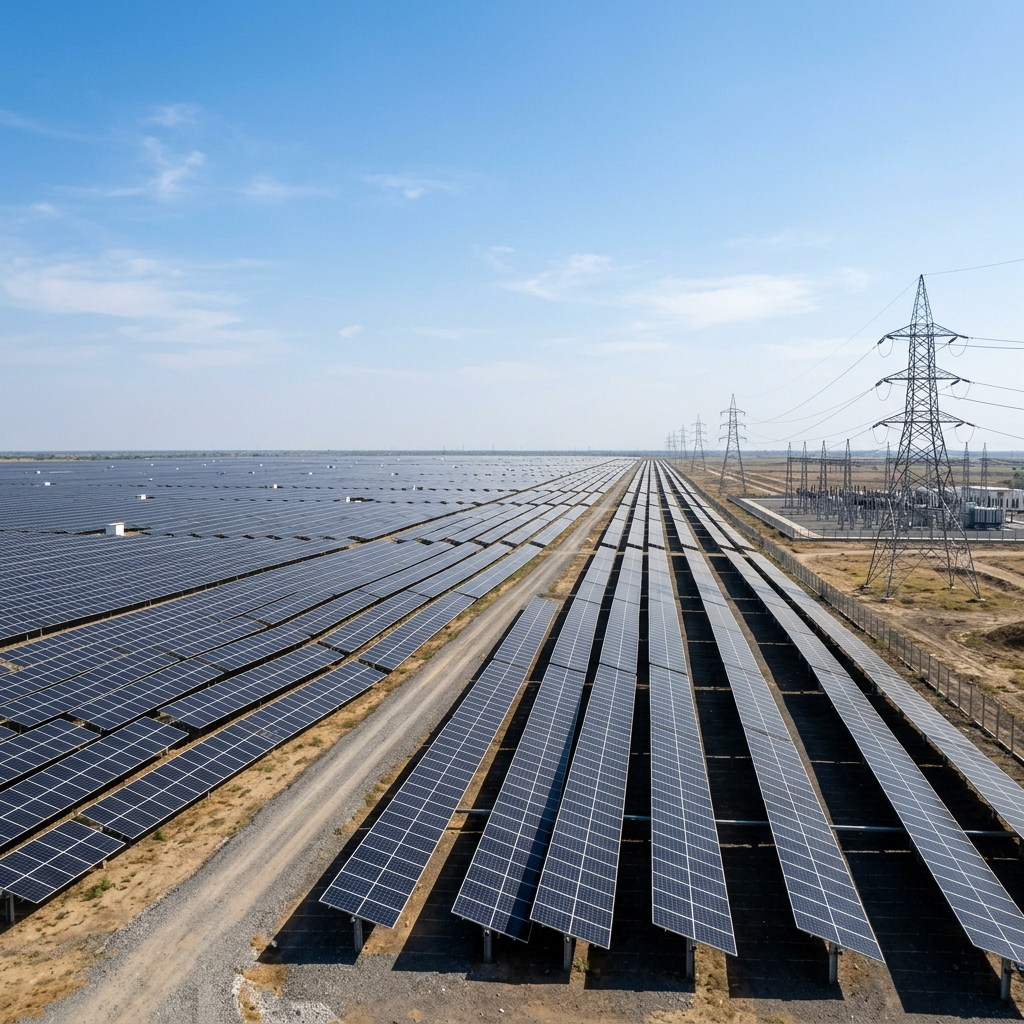
> The Dholera SIR Solar Park is a major renewable energy installation in India, designed for a total capacity of 5,000 MW (5 GW). Developed by the Gujarat Power Corporation Limited (GPCL) across the low-lying mudflats of the Gulf of Khambhat, the solar park provides eco-friendly power directly to the industrial and semiconductor sectors of Dholera SIR. Integrated with Torrent Power’s local smart grid, the park offers stable, green power tariffs to corporate buyers. For real estate and industrial investors, this clean energy availability serves as a strong incentive, particularly for energy-dense projects like semiconductor fabs and data centers.

Technical Infrastructure & Grid Integration
Operating a large solar park adjacent to a high-density smart city requires advanced power transmission and management systems:
- GPCL Phase Allocations: The park is developed in structured phases, with over 1,000 MW already active and connected to the western region’s power transmission grid.
- Subterranean Smart Grid Linkage: Electricity from the solar park is stepped up at high-voltage substations and routed through Torrent Power’s underground transmission grid, ensuring protection from seasonal weather.
- Industrial Power Quality: Power control systems stabilize the grid frequency, ensuring the high-quality power required by cleanroom equipment at the Tata Fab.
Green Electricity Tariffs & Incentives (2026)
Dholera’s renewable energy capacity allows it to offer competitive power rates for industrial operations:
| Consumer Category | Target Operations | Average Tariff (per kWh) | Green Credit Offsets | Primary Power Source |
|---|---|---|---|---|
| High-Tech Industrial | Semiconductor fabs, EV assembly | ₹4.20 – ₹4.80 | Eligible (100% Offset) | Solar + Grid Battery Backup |
| Data Center Hub | Hyperscale data center parks | ₹4.00 – ₹4.50 | Eligible (100% Offset) | Solar + Grid Battery Backup |
| Commercial Retail | Offices, hotels, shopping hubs | ₹5.50 – ₹6.20 | Partial Offset | Solar + Hybrid Grid |
| Residential Smart | Gated townships, apartments | ₹3.80 – ₹4.20 | Standard | Hybrid Grid |
Key Takeaways for Property Investors
- Clean Energy Appeals to Tech Buyers: Industrial and data center developers prioritize sites with access to green energy offsets. Properties in TP5 and TP6 are well-positioned to benefit from this demand.
- Verify Subterranean Grid Connections: Ensure your plotted layouts feature direct utility connection points sanctioned by DSIRDA. Unapproved developments cannot connect to the local smart grid.
- Examine Title Clearances: Verify that your plot has completed the land pooling reconstitution process (Form F check), ensuring clean title ownership before buying.
Frequently Asked Questions (FAQ)
What is the total capacity of the Dholera SIR Solar Park?
The solar park is designed for a total capacity of 5,000 MW (5 GW), making it one of the largest renewable energy installations in western India.
How does the solar park benefit industrial and data center operators?
It provides access to clean, reliable power with competitive green tariffs, allowing operators to achieve their carbon neutrality and sustainability goals.
Free Investor Resource
Download Dholera SIR 2026 Investor’s Kit
Get instant access to the official planning documents: Dholera Investment Handbook (PDF), 2026 Land Price List, TP Zone & Village Map, and the NRI Buying Guide.

Join The Discussion