

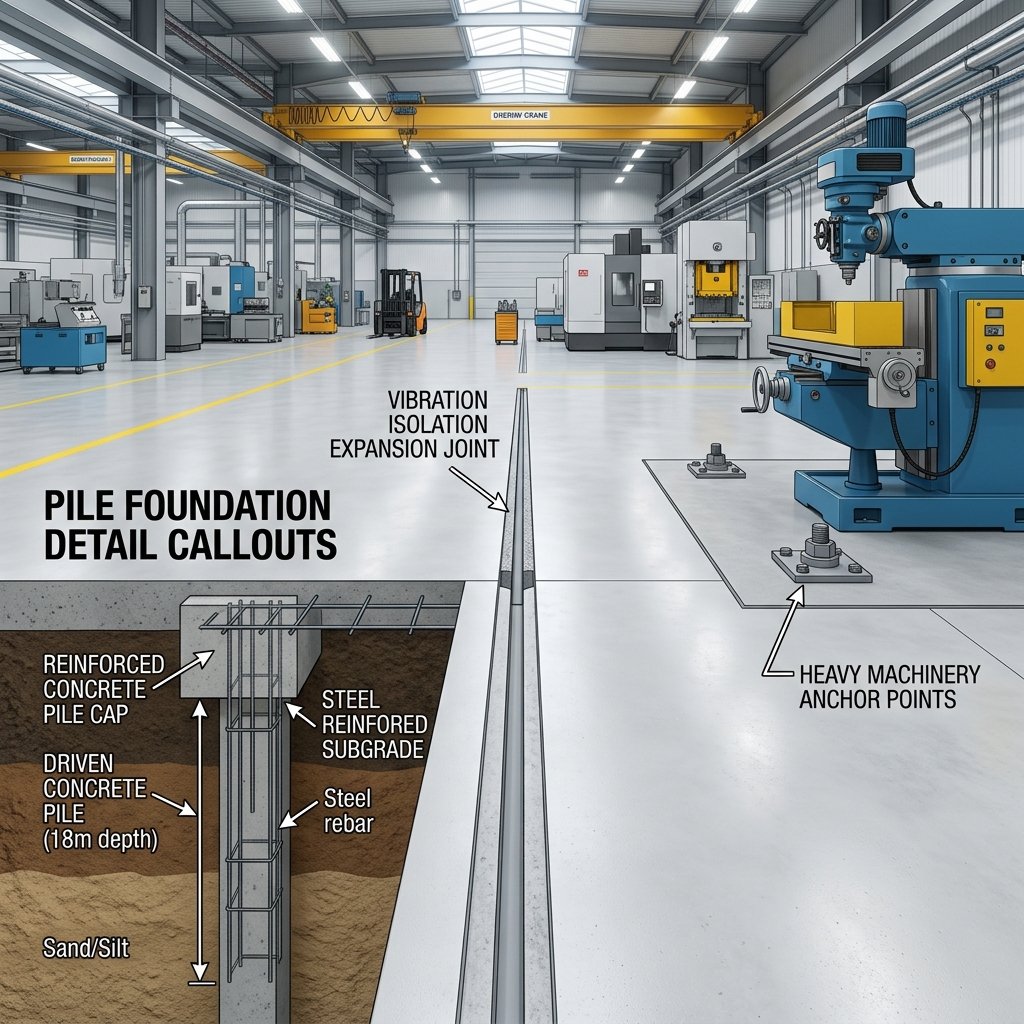
1. Minimum Live Load Capacity Ratings
To support machinery and equipment, factory floors must be engineered to meet minimum structural load capacity requirements:
- Light Manufacturing & Assembly Zones: Floor slabs must be designed for a minimum live load capacity of 10 to 15 kN/m² (Kilonewtons per square meter).
- General Industrial & Heavy Assembly Bays: Slabs must support a minimum live load of 15 to 20 kN/m².
- Heavy Machinery & Chemical Fab Rooms (Semiconductor Cleanrooms): Floor slabs must support at least 25 to 50 kN/m² to accommodate heavy process machinery and chemical tanks.
- Warehouse Floor Slabs: Storage zones require a minimum capacity of 30 kN/m² to support high-bay pallet racking loads.
2. Deep Pile Foundations in Marine Clay
Due to Dholera’s soft soil profile, industrial structures cannot rely on standard spread footings:
- Bored Cast-in-Situ Piles: Heavy industrial structures must use bored concrete pile foundations driven 18 to 30 meters deep to bypass the soft upper clay and anchor into the stable, load-bearing sand and gravel strata below.
- Slab-on-Grade (SOG) Design: Ground-level factory floors must feature structural concrete slabs-on-grade (minimum thickness 200mm to 300mm) reinforced with dual-layer steel rebar mesh and high-strength concrete (grade M30 or M35).
- Differential Settlement Limits: Foundations must be engineered to restrict differential settlement to less than 25mm across the entire building footprint, preventing structural cracking in sensitive cleanrooms.
The table below outlines factory floor load standards in Dholera SIR:
| Industrial Zone Category | Minimum Live Load Rating | Concrete Strength Grade | Minimum Slab Thickness | Foundation Type Required |
|---|---|---|---|---|
| **Light Assembly / Cleanrooms** | 10 – 15 kN/m² | M30 Concrete | 200 mm | Bored concrete piles (18m depth) |
| **General Manufacturing** | 15 – 20 kN/m² | M35 Concrete | 250 mm | Bored concrete piles (24m depth) |
| **Heavy Machinery / Fabs** | 25 – 50 kN/m² | M40 Concrete | 300 mm+ | Deep pile caps (30m depth) |
| **Logistics Warehousing** | 30 – 45 kN/m² | M35 Concrete | 250 mm | Bored concrete piles (20m depth) |
3. Vibration Isolation Joints
Industrial plants housing high-precision machinery (such as semiconductor lithography tools or high-speed printing presses) must manage structural vibrations:
- Vibration Isolation Joints: Slabs under high-vibration machinery must be structurally isolated from the main factory floor slab using open expansion joints filled with elastomeric dampening materials (such as neoprene or high-density polyurethane).
- Independent Machine Pedestals: Heavy CNC machines or compressors must be mounted on independent concrete pedestals anchored directly to dedicated pile caps, ensuring vibrations do not travel through the floor to affect surrounding cleanroom metrology equipment.
Frequently Asked Questions (FAQ)
#### What is the standard floor load capacity for a factory in Dholera SIR?
Under DSIRDA codes, general manufacturing floors must support at least 15 to 20 kN/m², while heavy machinery zones require capacities ranging from 25 to 50 kN/m².
#### Why are deep pile foundations mandatory for Dholera factories?
Dholera’s subsurface soil consists of soft marine clay. Deep pile foundations driven 18 to 30 meters deep are necessary to transfer building and machinery loads to stable sand layers.
#### What are vibration isolation joints?
These are expansion joints filled with elastomeric materials that isolate high-vibration machinery foundations from the surrounding factory floor, preventing vibrations from disturbing sensitive equipment.
Download Dholera SIR 2026 Investor’s Kit
Get instant access to the official planning documents: Dholera Investment Handbook (PDF), 2026 Land Price List, TP Zone & Village Map, and the NRI Buying Guide.


Join The Discussion