

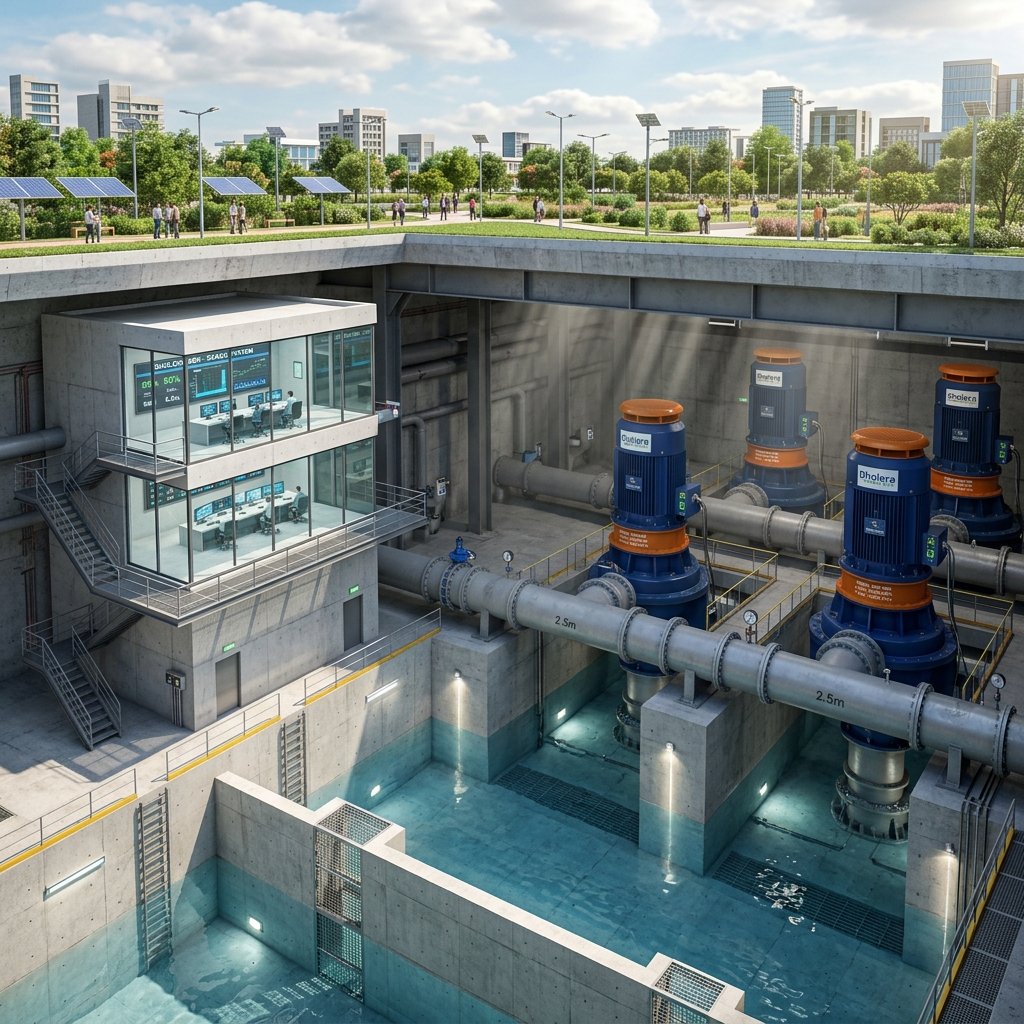

1. Master Water Storage Hierarchy in Dholera SIR
The water distribution grid across Town Planning (TP) schemes 1 and 2 is structured into three integrated containment tiers:
| Infrastructure Facility | Functional Role | Total Storage Capacity | Hydraulic Retention Time | Construction Engineering |
|---|---|---|---|---|
| **Kanatal WTP Clear Water Reservoir** | Primary raw-water treatment buffer | 45 Million Liters (ML) | 7.2 Hours | Reinforced Cement Concrete (RCC) with crystalline waterproofing |
| **Central Master Balancing Reservoir (MBR)** | City-level strategic reserve & hydraulic equalization | 90 Million Liters (ML) | 24.0 Hours | Multi-compartment underground RCC reservoir with anti-sulfate cement |
| **TP1 Underground Service Reservoir (UGSR 1)** | Activation Area distribution & pressure boosting | 28 Million Liters (ML) | 16.0 Hours | Dual-cell underground RCC tank with automated level sensors |
| **TP2 Underground Service Reservoir (UGSR 2)** | Industrial corridor & HAC supply | 35 Million Liters (ML) | 18.0 Hours | Subterranean compartmentalized reservoir with dual suction headers |
| **Individual Plot Water Storage (Mandatory)** | On-site private factory/building reserve | Sized per DSIRDA GDCR | 48.0 Hours (Industrial) / 24.0 Hours (Residential) | On-site underground sump + overhead service tank |
2. DICDL Underground Reservoir Design Criteria
Every public and large-scale industrial underground reservoir constructed in Dholera SIR must comply with stringent civil engineering standards due to the high water table and saline soil chemistry:
- Sulfate-Resistant Concrete: All underground reservoir structures must be cast using Sulfate Resistant Portland Cement (SRPC) or fly-ash blended concrete (Grade M35 or higher) in compliance with IS 456 and IS 3370 (Code of Practice for Concrete Structures for the Storage of Liquids).
- Dual-Compartment Redundancy: Every underground service reservoir must feature at least two independent compartments. This design permits full isolation, desiltation, and structural maintenance of one cell while the adjacent cell maintains continuous pressurized supply to the municipal mains.
- Anti-Buoyancy Anchoring: Due to seasonal flooding risks and saturated marine clay soils, underground reservoirs must incorporate RCC base pressure-relief valves and continuous perimeter shear keys to prevent uplift or flotation during empty maintenance cycles when external groundwater is elevated.
- Internal Non-Toxic Coating: The interior walls and floor of potable water reservoirs must be lined with food-grade, solvent-free epoxy coating or crystalline waterproofing slurry certified non-toxic under IS 9845.
3. On-Site Plot Storage Capacity Calculations
Under DSIRDA GDCR Section 10.7, industrial, commercial, and residential plots connecting to the DICDL municipal water supply cannot draw water directly from the main into internal plumbing networks. They must discharge into an approved on-site Underground Water Sump (UGWT):
A. Industrial Plots (Manufacturing & Warehousing)
Industrial manufacturing units must maintain a minimum on-site potable water storage capacity calculated as:
$$\text{Plot Underground Storage } (V_{\text{ind}}) = (\text{Peak Daily Demand} \times 2) + \text{Static Fire Reserve}$$
Where: * Peak Daily Demand is calculated at 45 liters per employee/shift plus specific process cooling water requirements approved in the factory layout sanction. * Static Fire Reserve must provide a dedicated minimum of 100,000 to 200,000 Liters reserved exclusively for the industrial hydrant system, isolated via physical suction dip pipes.
B. Residential and Commercial Townships
For multi-story residential buildings and commercial complexes: * Underground reservoir capacity must equal 100% of the total 24-hour domestic water demand (calculated at 135 liters per capita per day, LPCD). * Overhead tank (OHT) capacity must provide at least 50% of the daily domestic demand, replenished via automated float-switch transfer pumps.
4. Telemetry and SCADA Level Monitoring
All municipal and bulk industrial underground reservoirs in Dholera SIR are monitored 24/7 through the DICDL Smart Water SCADA network:
- Level Measurement: Multi-redundant hydrostatic pressure transmitters and non-contact ultrasonic radar sensors monitor reservoir liquid levels to within ±2 mm accuracy.
- Water Quality Probes: Submerged electrochemical probes continuously stream real-time metrics, including Free Residual Chlorine (maintained between 0.5 and 1.5 mg/L), pH (6.5 to 8.5), Turbidity (< 1 NTU), and Total Dissolved Solids (TDS < 300 ppm).
- Automated Leak Detection: Inflow and outflow flowmeters (magnetic type) execute mass-balance algorithms every 60 seconds. Any volumetric discrepancy exceeding 1.5% triggers automatic isolation valves via remote SCADA control.
Frequently Asked Questions (FAQ)
What is the total capacity of Dholera’s Master Balancing Reservoir (MBR)?
The central Master Balancing Reservoir (MBR) in Dholera SIR has a designed capacity of 90 Million Liters (ML), providing a full 24-hour emergency buffer for the smart city’s core activation zones in case of pipeline maintenance from the Kanatal water treatment works.Can industries extract groundwater instead of relying on underground municipal reservoirs?
No. Groundwater extraction in Dholera SIR is strictly prohibited by DSIRDA and GPCB. The local subterranean aquifer is highly saline, and extraction would accelerate soil subsidence. All industries must connect to the DICDL pressurized potable and recycled water grid.What is the mandatory fire storage capacity in industrial plot reservoirs?
Industrial plots in Dholera SIR must maintain a dedicated static fire storage reserve of 100,000 to 200,000 liters within their on-site underground reservoir, independent of domestic and manufacturing process water volumes.What concrete grade is required for underground water reservoirs in Dholera?
Due to the corrosive coastal marine clay and high sulfate concentrations in Dholera’s subgrade, all underground water reservoirs must be cast using Grade M35 or higher concrete blended with Sulfate Resistant Portland Cement (SRPC) adhering to IS 3370 specifications.How does DICDL monitor water levels and quality in the reservoirs?
DICDL uses ultrasonic level sensors, hydrostatic transmitters, and inline chlorine/pH probes linked to the central Integrated Command and Control Center (ICCC) in the ABCD Building. Any abnormal drops in pressure or water quality trigger immediate automated valve adjustments.Download Dholera SIR 2026 Investor’s Kit
Get instant access to the official planning documents: Dholera Investment Handbook (PDF), 2026 Land Price List, TP Zone & Village Map, and the NRI Buying Guide.

Join The Discussion