

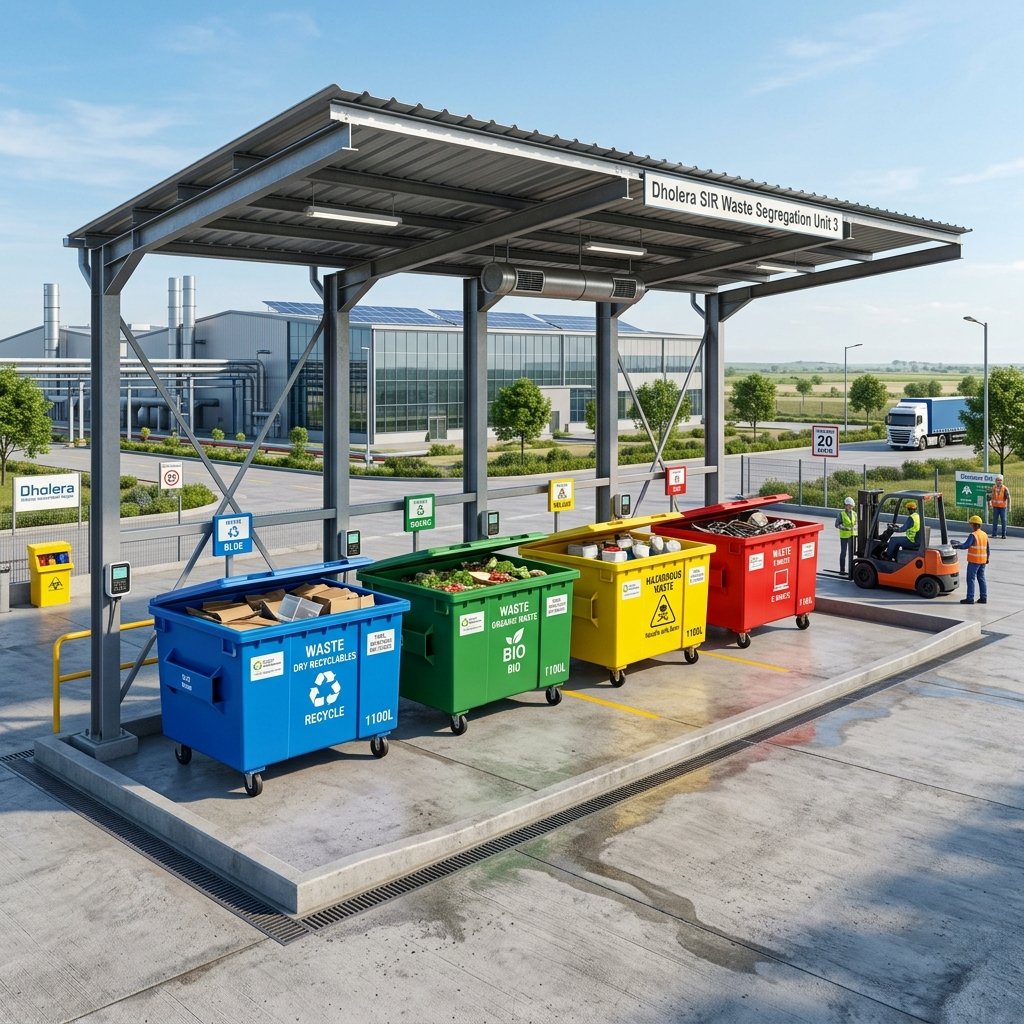

1. Statutory 4-Stream Industrial Waste Segregation Hierarchy
Under GPCB regulations and national waste management laws, industrial waste must be strictly categorized and segregated at the point of origin:
| Container Stream / Color Code | Standard Bin Capacity Range | Prescribed Waste Material Types | Statutory Management & Destination |
|---|---|---|---|
| **BLUE BIN (Dry Recyclables)** | 240L, 660L, 1,100L (EN 840) | Packaging cartons, non-contaminated plastics, clean metal scrap, wooden pallets, shrink wrap. | Collected by DICDL smart compactor trucks; routed to Materials Recovery Facility (MRF). |
| **GREEN BIN (Wet / Organic Waste)** | 120L, 240L (EN 840) | Worker canteen food waste, agricultural/horticultural prunings, pantry organic bio-waste. | Diverted to on-site biomethanation composters or DICDL municipal anaerobic digestion plant. |
| **YELLOW BIN (Industrial Hazardous Waste)** | 240L, 1,100L Steel/HDPE | Oily rags, chemical packaging drums, spent filter cartridges, paint sludges, contaminated personal protective equipment (PPE). | Manifested under GPCB Form 10; transferred exclusively to authorized Common Hazardous Waste TSDF (Treatment, Storage, Disposal Facility). |
| **RED BIN (Toxic & Electronic Waste)** | 120L, 240L Rigid Polymer | Damaged circuit boards (PCBs), lithium-ion/lead-acid batteries, mercury fluorescent lamps, electronic components. | Regulated under E-Waste Rules 2022; dispatched to government-authorized EPR recyclers. |
2. Mechanical Construction Standards for Industrial Containers
Due to heavy daily handling, corrosive chemicals, and high solar UV radiation in Dholera (surface temperatures exceeding 50°C), waste containers must satisfy international structural standards:
| Container Component | Engineering Material Standard | Durability & Performance Metric in Dholera SIR |
|---|---|---|
| **Body & Lid Polymer** | High-Density Polyethylene (HDPE), High Molecular Weight | Virgin injection-molded resin; UV-stabilized with carbon black or hindered amine light stabilizers (HALS). |
| **Structural Testing Standard** | **EN 840 (Parts 1 to 6)** & IS 16944 | Drop tested from 3.0 meters at -20°C; certified resistant to chemical acids, alkalis, and oils. |
| **Wheel Assemblies** | Heavy-Duty Solid Rubber Tyres with Steel Rims | Minimum 200 mm diameter wheels; fitted with dual foot-operated directional brakes on front casters. |
| **Lid Seal & Ergonomics** | Continuous Interlocking Lip with Foot-Pedal Lift | Hermetically seals against odors, flies, and desert dust ingress; hands-free pedal opening for factory workers. |
| **Comb Lifting Flange** | Reinforced Multi-Ribbed Front Lifting Apron | Compatible with DIN/EN standard lifting tippers on DICDL automated municipal compactor trucks. |
3. Smart City Telemetry: RFID Tags & Ultrasonic Fill Sensors
Dholera’s municipal solid waste billing and collection logistics operate on a dynamic, automated IoT infrastructure:
“` +———————————————————————————–+ | SMART INDUSTRIAL RECYCLING TELEMETRY (DICDL & SWM 2016 INTEGRATION) | +———————————————————————————–+
| v | |
| [ Low-Power WAN (LoRaWAN) ] -> Transmits live fill-level % to ABCD Command Center | |
| v | |
| (Bin Fill Level >= 80%: Automated Collection Dispatch Triggered) | |
| v | |
| [ Smart Compactor Truck ] —> Scans UHF RFID Tag (EPC Gen2 860-960 MHz) | |
| Records: Plot ID, Tare Weight, Gross Weight, Date |
+———————————————————————————–+ “`
- Passive UHF RFID Chips: Every bin is embedded with a high-durability epoxy-encapsulated RFID microchip (conforming to ISO 18000-6C). When lifted by the municipal collection tipper, on-board load cells weigh the bin and match its GPS location to the factory account for automated transparent billing.
- Ultrasonic Level Telemetry: High-capacity $1,100\text{L}$ containers feature battery-powered ultrasonic transceivers mounted inside the lid. When container capacity reaches $80\%$, an automated LoRaWAN dispatch signal alerts the fleet management system to schedule immediate pick-up, eliminating overflow.
4. On-Site Sheltered Waste Storage Compound Architecture
Under GPCB statutory hazardous waste guidelines, industrial units cannot store accumulated waste bins in open unpaved yards:
| Design Parameter | Statutory Engineering Specification | Functional Objective in Dholera Industrial Plots |
|---|---|---|
| **Compound Location & Setback** | Minimum **10.0 meters** from plot property boundaries | Ensures spatial firebreak buffer and convenient access for 20-tonne municipal collection vehicles. |
| **Roof Canopy & Enclosure** | Prefabricated Color-Coated Galvanized Steel Canopy | Shields waste bins from direct solar heat, preventing chemical decomposition and odor generation. |
| **Impermeable Concrete Floor** | M30 Grade Reinforced Concrete with Epoxy Coating | Prevents leachate and chemical drip seepage into Dholera’s underlying marine soil and saline water table. |
| **Secondary Containment Bunding** | 150 mm High Surrounding Perimeter Concrete Dyke | Contains accidental barrel or bin leaks ($V_{containment} \ge 110\%$ of largest liquid container). |
| **Hazardous Storage Time Limit** | **Strictly Maximum 90 Days** from generation date | Mandates periodic off-site dispatch under GPCB Hazardous Waste Form 10 manifests. |
| **Emergency Safety Equipment** | Combination Eyewash/Drench Shower + ABC Dry Powder Fire Extinguisher | Located within 10 meters of hazardous waste staging area with clear, unobstructed access. |
Frequently Asked Questions (FAQ)
What are the statutory color codes for industrial waste bins in Dholera SIR?
Under national SWM Rules and DICDL standards, the 4-stream color code is: Blue for dry recyclables (paper, plastic, metal), Green for wet organic/canteen food waste, Yellow for industrial hazardous and chemical-contaminated waste, and Red for toxic e-waste and batteries.Why are RFID tags mandatory on waste containers in Dholera?
RFID tags (EPC Gen2 standard) uniquely identify each industrial plot. When municipal compactor trucks lift the container, integrated load cells record the exact weight and type of waste, automating billing under DICDL’s “Polluter Pays” principle.What is the maximum on-site storage period for hazardous waste in Dholera?
Under GPCB Hazardous Waste Rules, industrial facilities may store accumulated hazardous waste on-site for a maximum of 90 days. All transfers must be accompanied by computerized Form 10 manifests to authorized TSDF facilities.What material standard is required for heavy industrial waste bins?
Bins must be manufactured from virgin high-density polyethylene (HDPE) with UV stabilizers conforming to European Standard EN 840 (Parts 1–6) or IS 16944, featuring foot pedals, rubber wheels, and front comb lifting bars.Can industrial hazardous waste bins be stored on unpaved open ground?
No. Hazardous waste containers must be stored within a designated sheltered yard featuring an impermeable M30 concrete floor, epoxy anti-acid coating, and a 150 mm peripheral bund wall to prevent soil and groundwater contamination.Download Dholera SIR 2026 Investor’s Kit
Get instant access to the official planning documents: Dholera Investment Handbook (PDF), 2026 Land Price List, TP Zone & Village Map, and the NRI Buying Guide.

Join The Discussion