

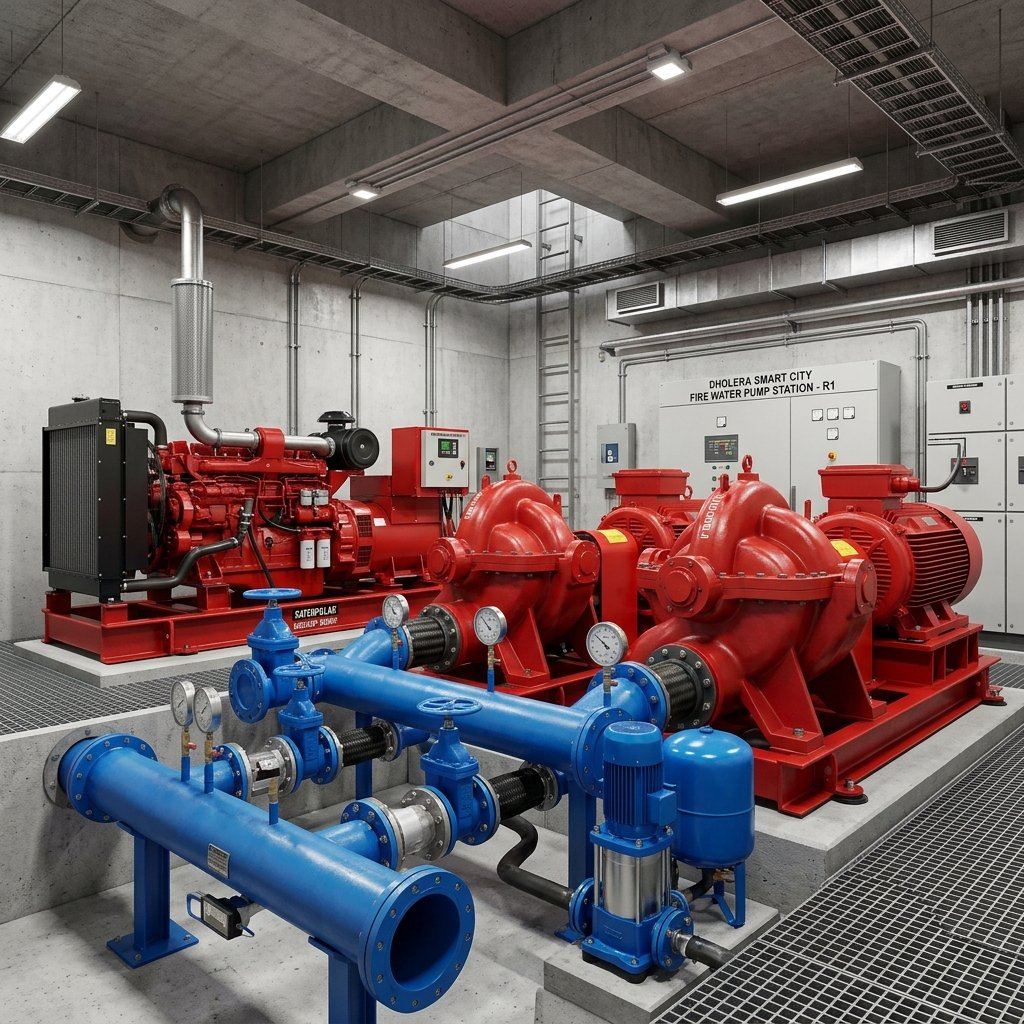

1. Statutory Fire Pump Configuration & Redundancy
Under NBC 2016 Part 4 (Table 7) and Gujarat Fire Prevention and Life Safety Measures Act regulations, the minimum equipment line-up for an industrial fire pump house comprises four distinct pumping units operating on positive suction head:
| Pump Designation | Prime Mover Type | Standard Flow Capacity Range | Operating Pressure Head | Functional Role in Dholera Industrial Plots |
|---|---|---|---|---|
| **Main Hydrant Pump** | 3-Phase Electric Motor (EFF2 / IE3) | 2,850 to 4,500 LPM (625 to 1,000 GPM) | 7.0 to 10.5 bar ($70\text{ to }105\text{ m}$) | Primary water delivery for external yard hydrants and internal wet risers during initial fire response. |
| **Main Automatic Sprinkler Pump** | 3-Phase Electric Motor (EFF2 / IE3) | 2,850 to 4,500 LPM (625 to 1,000 GPM) | 7.0 to 9.0 bar ($70\text{ to }90\text{ m}$) | Dedicated supply feeding factory ceiling sprinkler bulb networks; activates upon sudden system pressure drop. |
| **Standby Emergency Fire Pump** | Industrial Compression-Ignition Diesel Engine | 2,850 to 4,500 LPM (100% Main Pump Match) | 7.0 to 10.5 bar ($70\text{ to }105\text{ m}$) | Automated fail-safe backup; triggers within 15 seconds if utility grid power fails during an emergency. |
| **Jockey Pressure Pump** | Fractional HP Electric Motor (IE3) | 180 to 300 LPM (40 to 65 GPM) | 7.5 to 11.0 bar (0.5 bar above main) | Compensates for thermal contraction and minor valve packing seepage to prevent nuisance starting of main pumps. |
2. Dedicated Underground Fire Sump Hydraulic Calculations
Static water storage reservoirs cannot be shared with domestic water networks unless an automatic physical weir separation guarantees that the dedicated fire water reserve cannot be drawn down by factory sanitary consumption.
Calculation of Net Effective Fire Storage Capacity ($V_{fire}$):
Under NBC 2016 Part 4 for industrial hazardous occupancies (Group G and H), fire reserves must sustain continuous full-capacity delivery for a minimum duration of 3 to 4 hours:
$$V_{fire} = Q_{rated} \times T_{duration} \times 60$$
Where: * $Q_{rated}$ = Combined design flow demand of the most demanding fire scenario ($LPM$). For an industrial factory operating yard hydrants and ceiling deluge sprinklers simultaneously, design flow is typically $4,500\text{ LPM} + 2,850\text{ LPM} = 7,350\text{ LPM}$. * $T_{duration}$ = Statutory operational firefighting duration ($240\text{ minutes}$ for high-hazard industrial units).
$$\text{Example Sump Capacity: } V_{fire} = 7,350 \times 240 = 1,764,000\text{ Liters} = 1,764\text{ m}^3$$
Freeboard & Sump Geometry:
- Effective Water Depth: The storage volume must exist entirely between the low-level suction strainer anti-vortex plate and the overflow pipe lip.
- Anti-Vortex Plates: Suction pipe inlets must feature horizontal circular or square plates sized at least 2 times the suction pipe diameter ($2D$) located at a minimum clearance of $D/2$ above the sump floor to prevent air entrainment under high pump drawdown velocity.
- Compartmentalization: All static underground sumps exceeding $200\text{ m}^3$ must be split into at least two structurally independent RCC compartments to allow periodic cleaning, desilting, and structural inspection without taking the fire protection system off-line.
3. Diesel Engine Autonomy & Pump Room Civil Architecture
The diesel backup pump is the critical line of defense during grid transformer isolation or catastrophic plant electrical outages.
“` +———————————————————————————–+ | UNDERGROUND FIRE PUMP ROOM (NBC 2016 / NFPA 20) | +———————————————————————————–+
| Underground Static | ====================================> | Main Electric | ||||
| Water Sump (M35) | Hydrant Pump | |||||
| +——————–+ +—————–+ | ||||||
| Flooded Suction Line | ||||||
| \/ \/ | ||||||
| +——————–+ +—————–+ | ||||||
| Diesel Emergency | <--- Fuel Line --- +---------------+ | Discharge Ring | ||||
| Engine Pump Unit | 8-Hour Day | Main Header | ||||
| +——————–+ | Tank (Diesel) | (>= 200 mm DI) | ||||
| +—————+ +—————–+ | ||||||
| Exhaust Pipe | ||||||
| \/ \/ | ||||||
| Exhaust Silencer & Stack (Discharge 3m above ground) Yard Hydrants & Deluge |
+———————————————————————————–+ “`
Diesel Engine Specifications:
- Fuel Storage Autonomy: NFPA 20 mandates a dedicated daily service fuel tank sized to supply the diesel engine at 100% rated continuous load for at least 8 continuous hours (minimum 5.07 liters per kW of rated engine output, plus a 5% expansion volume).
- Starting System: Engine starting must utilize dual independent 24V DC battery banks with dedicated trickle chargers, capable of completing at least 6 consecutive automated crank cycles (15 seconds crank, 15 seconds rest).
- Exhaust Routing: Silencers must be industrial residential-grade with exhaust flues insulated with ceramic wool and clad in aluminum sheeting, routed directly to exterior ambient air terminating at least 3 meters above the pump house roof level.
Civil & Structural Pump Room Rules:
- Direct Ground Access: The pump house must feature an independent exterior doorway leading directly to open ground, with minimum doorway dimensions of 2.0 m width $\times$ 2.4 m height for heavy equipment maneuvering.
- Fire Rating: Pump house perimeter walls, floor slabs, and ceilings must possess a minimum 2-hour fire-resistance rating under IS 1642.
- Positive Suction (Flooded Suction): In Dholera industrial designs, fire pumps must be situated in a sunken pump room below the static water level to ensure permanent flooded gravity suction, eliminating the failure risks associated with foot valves and priming tanks.
4. Automated SCADA & Pressure Switch Staging
Fire pumps in Dholera SIR must operate automatically via calibrated pressure transmitters and hydraulic diaphragm pressure switches installed on the discharge sensing line:
| System Status / Event | Pressure Setpoint in Fire Ring Main | Automated Control Response |
|---|---|---|
| **Normal System Standby** | **7.5 to 8.0 bar** ($110\text{ to }116\text{ psi}$) | All pumps idle; green healthy status on local and ABCD SCADA telemetry. |
| **Minor Valve Seepage / Thermal Drop** | Drops to **7.0 bar** ($100\text{ psi}$) | **Jockey Pump starts automatically**; runs until pressure restores to 7.8 bar, then stops. |
| **Yard Hydrant Valve Opened** | Drops to **6.0 bar** ($87\text{ psi}$) | **Main Electric Hydrant Pump starts**; Jockey pump continues running; audio-visual sirens activate. |
| **Sprinkler Deluge / High Demand** | Drops to **5.0 bar** ($72\text{ psi}$) | **Main Sprinkler Pump starts**; emergency fire alarm transmitted to factory control room. |
| **Power Outage or Overload Trip** | Drops below **4.5 bar** ($65\text{ psi}$) | **Diesel Emergency Engine starts automatically** within 15 seconds; latches on until manual stop. |
Under NFPA 20 and NBC rules, once a main fire pump or diesel backup engine starts during an emergency event, it is strictly prohibited from stopping automatically on pressure restoration. It must latch in running mode and can only be shut down manually by an authorized fire engineer after the fire event is verified controlled.
Frequently Asked Questions (FAQ)
What is the statutory operational duration for industrial fire water sumps in Dholera?
Under NBC 2016 Part 4 and Gujarat fire regulations for industrial manufacturing and hazardous occupancies, on-site fire water reservoirs must provide at least 3 to 4 hours of continuous water supply calculated at the combined maximum flow demand of the hydrant and sprinkler networks.Why is a diesel fire pump mandatory alongside electric motor-driven pumps?
Industrial electrical grids or plot substations are frequently isolated or suffer short-circuit trips during a major structural fire. The diesel engine provides 100% mechanical backup independent of electrical supply, ensuring high-pressure water delivery even during complete power failure.Can fire pumps stop automatically when ring main pressure is restored?
No. Under NFPA 20 and NBC 2016 standards, once a main electric or diesel fire pump starts, automatic shutdown upon pressure restoration is forbidden. The pump must continue delivering water until manually shut down by an authorized fire safety officer to prevent premature cutoff while firefighters are operating.What is the purpose of anti-vortex plates inside the fire water sump?
When high-capacity fire pumps draw thousands of liters per minute, surface whirlpools (vortices) can form, drawing air into the suction line and causing pump cavitation and loss of prime. Anti-vortex plates break this rotational suction force, ensuring smooth, air-free water ingress.How do Dholera factory pump stations integrate with smart city monitoring?
Plot fire pump control panels feature smart RTUs (Remote Terminal Units) running Modbus/BACnet protocols that transmit live suction sump levels, ring main pressures, pump running/trip alarms, and diesel fuel levels directly to the factory BMS and the Dholera ABCD Central Command Center.Download Dholera SIR 2026 Investor’s Kit
Get instant access to the official planning documents: Dholera Investment Handbook (PDF), 2026 Land Price List, TP Zone & Village Map, and the NRI Buying Guide.

Join The Discussion