

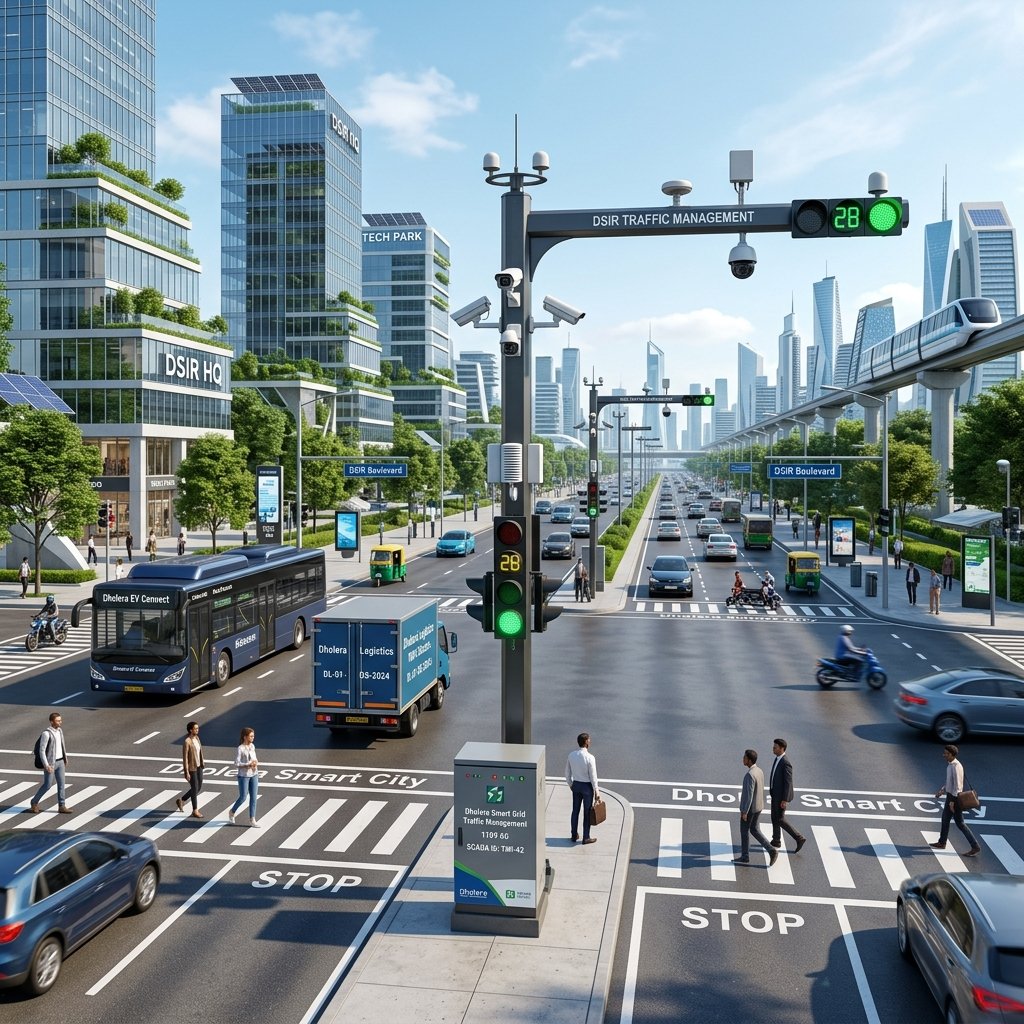

1. Architectural Hierarchy of Dholera’s Smart Signal Network
Dholera’s smart mobility network is organized into four interoperable technology layers adhering to Indian Road Congress (IRC SP:72) and international smart city ITS standards:
| Network Layer | Physical Components | Functional Role | Protocol / Interface |
|---|---|---|---|
| **Field Sensing & Detection** | Multi-lane radar detectors & 4K AI video incident cameras | Real-time vehicle counting, queue length measurement, and speed tracking | GigE Ethernet / RS-485 to Junction Controller |
| **Edge Junction Controller** | Industrial 19-inch rack-mounted Microprocessor (ATCS Controller) | Executes localized adaptive cycle algorithms (SCOOT/SCATS compliant) | NTCIP 1202 / TCP/IP over Optical Fiber |
| **Signal Displays & Signage** | LED countdown timers, acoustic pedestrian push buttons, and VMS boards | High-visibility traffic instruction and variable speed limit broadcast | Solid-State Relays / CAN Bus |
| **Central SCADA Control** | Central Traffic Server at ABCD Building command center | City-wide corridor synchronization, green wave corridors, and analytics | REST API / MQTT / Modbus TCP/IP |
2. Adaptive Traffic Signal Controller Hardware Specifications
Intersection controllers installed across Town Planning (TP) schemes 1 through 6 must meet ruggedized municipal engineering criteria due to Dholera’s coastal temperature extremes:
- Operating Temperature Range: Industrial-grade electronics certified to operate reliably from -10°C to +70°C with 95% non-condensing relative humidity without requiring external air conditioning.
- Enclosure Rating: Roadside controller cabinets must feature double-wall marine-grade aluminum or AISI 316 stainless steel construction rated IP65/IP66 for dust and water ingress, finished with polyester powder coating to withstand saline coastal air.
- Uninterruptible Power Supply (UPS): Every signalized intersection incorporates an integrated LiFePO4 battery backup system providing at least 4 hours of continuous operational autonomy during grid switching events, backed up by the Torrent Power dual-source underground network.
- Conflict Monitor Unit (CMU): A hardware-isolated monitoring card continuously tests signal outputs every 100 milliseconds. If conflicting green signals are detected simultaneously on intersecting approaches, the unit drops the junction into fail-safe flashing amber mode within 450 milliseconds.
3. SCADA Real-Time Adaptive Optimization Algorithms
The central ATCS software platform processes multi-modal sensor inputs to optimize mobility corridors:
A. Dynamic Cycle Time Calculation
Intersection cycle lengths adjust dynamically between 45 seconds (during low-volume nighttime hours) and 150 seconds (during peak industrial shift changes) based on real-time degree of saturation:
$$\text{Optimum Cycle Length } (C_o) = \frac{1.5 L + 5}{1 – Y}$$
Where: * $L$ = Total lost time per cycle (all-red clearance intervals plus yellow change intervals). * $Y$ = Sum of critical lane flow ratios ($\sum q_i / s_i$, where $q_i$ is actual vehicle flow and $s_i$ is saturation flow).
B. Heavy Freight and Emergency Pre-Emption
Dholera’s major avenues connect directly to the Multi-Modal Logistics Park (MMLP) and the upcoming cargo airport. The traffic SCADA system implements automated priority: 1. Emergency Vehicle Priority (EVP): Approaching fire engines, ambulances, and police cruisers equipped with DSRC transponders or detected via Automated Number Plate Recognition (ANPR) cameras trigger automatic signal pre-emption, clearing cross-traffic with yellow lights and granting an immediate green window 300 meters ahead of the vehicle. 2. Freight Corridor Green Waves: Bulk container transport corridors along Town Planning arterial routes utilize offset progression algorithms to maintain synchronized 50 km/h green waves, reducing industrial truck stop-and-go fuel waste by over 30%.
4. Pedestrian and Cyclist Smart Crossing Integration
Under Dholera’s Non-Motorized Transport (NMT) priority charter:
- Smart Pedestrian Actuation: Mid-block and junction crossings feature smart touchless microwave push-buttons and infrared crosswalk occupancy sensors. If a pedestrian takes longer to cross the wide 8-lane boulevards, the SCADA controller dynamically extends the pedestrian clearance phase by up to 8 seconds.
- Audible Tactile Walk Indicators: Sound-emitting signals with dynamic ambient noise sensing adjust acoustic volume automatically between 50 dB and 85 dB to assist visually impaired pedestrians without causing acoustic pollution during quiet hours.
Frequently Asked Questions (FAQ)
What type of traffic signal system is installed in Dholera Smart City?
Dholera SIR utilizes an Adaptive Traffic Control System (ATCS) connected to the Central SCADA network at the ABCD Building command center. It dynamically adjusts signal green times in real time using video analytics and radar sensors rather than fixed countdown clocks.How do smart traffic signals handle emergency vehicles in Dholera?
When emergency vehicles (ambulances, fire tenders) approach a junction, optical ANPR cameras and radio telemetry communicate with the SCADA system to trigger immediate green wave pre-emption, safely halting conflicting traffic until the emergency vehicle clears.What happens to Dholera traffic signals during a power outage?
Every traffic controller cabinet is equipped with high-density LiFePO4 battery backup units providing a minimum of 4 hours of standalone power. Additionally, Dholera’s Torrent Power grid provides dual-source ring main redundancy, making blackouts virtually non-existent.What material and ingress rating are required for roadside signal cabinets?
Due to high atmospheric salinity and summer heat, controller cabinets must be rated IP65/IP66 and fabricated from marine-grade double-walled aluminum or AISI 316 stainless steel with anti-corrosion powder coating.Can Dholera’s traffic signals prioritize industrial cargo trucks?
Yes. Key arterial corridors connecting the Dholera Multi-Modal Logistics Park (MMLP) and expressway interchanges utilize automated freight progression algorithms that coordinate green waves for heavy vehicles traveling at the statutory 50 km/h design speed.Download Dholera SIR 2026 Investor’s Kit
Get instant access to the official planning documents: Dholera Investment Handbook (PDF), 2026 Land Price List, TP Zone & Village Map, and the NRI Buying Guide.

Join The Discussion