

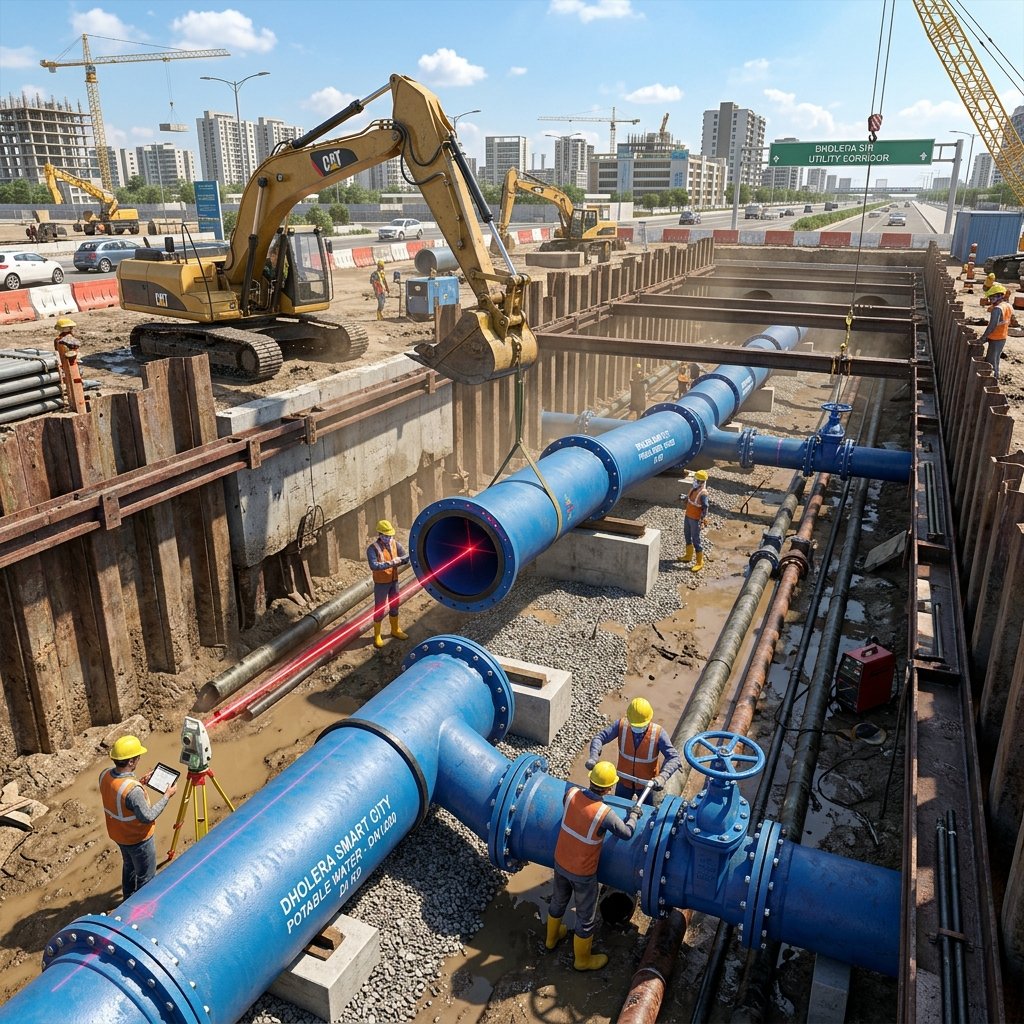

1. DICDL Potable Water Distribution Pipe Sizing Hierarchy
The municipal potable water network originates from the 150 MLD Water Treatment Plant (WTP) at Kanatal and branches across Town Planning (TP) schemes through standardized pipe dimensions:
| Distribution Network Level | Nominal Pipe Diameter (DN) | Pipe Material & Class | Typical Operating Pressure | Hydraulic Function in Master Plan |
|---|---|---|---|---|
| **Primary Trunk Arterial Main** | DN 700 mm to DN 1,000 mm | Ductile Iron (DI) Class K9 | 4.0 to 6.0 Bar | Bulk conveyance between Kanatal WTP, MBR, and TP1/TP2 boundary headers |
| **Secondary Sector Distribution** | DN 400 mm to DN 600 mm | Ductile Iron (DI) Class K9 | 3.5 to 4.5 Bar | Internal arterial road distribution along major 55m and 70m right-of-ways |
| **Tertiary Plot Feeder Loop** | DN 200 mm to DN 300 mm | Ductile Iron (DI) Class K9 | 2.5 to 3.5 Bar | Street-level loops running along 18m, 24m, and 30m factory access roads |
| **Individual Plot Service Tapping** | DN 100 mm to DN 200 mm | DI K9 or High-Density PE (HDPE PN16) | 2.0 to 3.0 Bar (Residual) | Direct connection through DICDL automated smart water meter kiosk |
| **Small Commercial / Residential Tap** | DN 50 mm to DN 80 mm | Electrofusion Welded HDPE PN16 | 2.0 to 2.5 Bar | Domestic intake for commercial plots and plotted residential layouts |
2. Pipe Material Specifications and Internal Coating Standards
Due to the saline, sulfate-rich marine clay soils present across the Gulf of Khambhat basin, DICDL mandates rigorous corrosion-resistant coatings for all buried pipes:
- Internal Lining: All Ductile Iron water supply pipes must be centrifugally lined at the foundry with Portland Cement Mortar (IS 11906 / ISO 4179) enriched with anti-sulfate additives, or polyurethane (PU) barrier lining to prevent internal encrustation and maintain a Hazen-Williams roughness coefficient of $C \ge 140$.
- External Protective Coating: Pipes must receive an external metallic zinc spray coating with a minimum mass of 200 g/m², followed by a heavy finishing layer of bituminous paint or two-pack epoxy coating (minimum 100 microns dry film thickness) in accordance with BS EN 545.
- Joint Flexibility: Buried pipes utilize flexible push-on rubber gasket joints (Tyton-type conforming to IS 5382) that accommodate up to 3° to 5° of angular deflection, ensuring pipe integrity against seasonal ground swelling and settlement in marine clay.
3. Industrial Plot Service Connection Sizing Formula
Factory developers applying for an industrial water connection through the DICDL single-window portal must calculate their required service tap diameter ($d$) based on permissible pipeline flow velocities:
$$Q = A \times v = \frac{\pi \times d^2}{4} \times v$$
Where: * $Q$ = Design volumetric flow rate ($\text{m}^3/\text{sec}$), derived from peak factory consumption plus storage replenishment schedules. * $v$ = Velocity of flow in the connection pipe. DICDL engineering codes restrict connection pipeline velocity to a range of 1.0 m/s to 1.8 m/s to prevent water hammer surges and excessive friction head loss. * $d$ = Inside diameter of the tapping pipe in meters.
Solving for the tapping diameter:
$$d = \sqrt{\frac{4 \times Q}{\pi \times v}}$$
For example, a high-tech manufacturing plant requiring $150\text{ m}^3/\text{hr}$ ($0.0417\text{ m}^3/\text{s}$) at an optimal design velocity of $1.5\text{ m/s}$ requires:
$$d = \sqrt{\frac{4 \times 0.0417}{\pi \times 1.5}} = \sqrt{0.0354} \approx 0.188\text{ meters} \implies \text{DN 200 mm Service Tap}$$
4. Boundary Metering Chamber and Pressure Management
Under DSIRDA building codes, the interface between the DICDL municipal main and the plot interior must feature a standardized Boundary Metering Chamber:
- Chamber Location: The reinforced masonry or RCC meter chamber must be situated within 1.5 meters of the front plot entrance gate, fully accessible to DICDL utility technicians from the road.
- Instrumentation: The chamber houses an isolation butterfly valve, an inline Y-strainer, a dual-chamber air release valve, and a DICDL-approved Automated Meter Reading (AMR) ultrasonic flowmeter transmitting consumption data via NB-IoT or optical fiber to the ABCD Building command center.
- Pressure Sustaining / Reducing Valve (PRV): To protect the factory’s private storage tank from pressure surges, a hydraulic PRV must be installed to regulate downstream pressure to an operating limit of 2.0 to 2.5 bar.
- Air Gap Isolation: Direct boosting from the municipal connection using suction booster pumps is strictly prohibited. The municipal pipeline must discharge freely into an on-site underground sump with an atmospheric air gap of at least 150 mm above the tank overflow weir.
Frequently Asked Questions (FAQ)
What is the standard pipe diameter for industrial water supply in Dholera SIR?
DICDL municipal water distribution mains range from DN 150 mm to DN 300 mm for local feeder loops, up to DN 1,000 mm for primary transmission arterials. Individual factory service taps are typically DN 100 mm, DN 150 mm, or DN 200 mm based on approved peak demand.What pipe material is mandated for underground water mains in Dholera?
Ductile Iron (DI) Class K9 pipes with internal cement mortar lining and external metallic zinc/bitumen coatings are standard for mains DN 150 mm and above. For smaller connections under DN 100 mm, electrofusion-welded HDPE PN16 pipes are permitted.What is the guaranteed water delivery pressure at the plot boundary?
DICDL’s pressurized water distribution grid guarantees a continuous residual delivery pressure between 2.0 bar and 3.0 bar at the plot boundary meter chamber, eliminating the need for suction pumps directly on the street main.Can factory owners connect booster pumps directly to the DICDL water main?
No. Direct suction from municipal water mains is an inspection violation under DSIRDA GDCR Section 10.7. The municipal connection must discharge via an atmospheric air gap into an on-site underground water sump, from which private pumps distribute water internally.How is industrial water consumption metered in Dholera Smart City?
Water consumption is monitored through automated ultrasonic smart meters equipped with remote AMR telemetry. Consumption data is streamed in real time to the Integrated Command and Control Center (ICCC) in the ABCD Building for monthly automated billing.Download Dholera SIR 2026 Investor’s Kit
Get instant access to the official planning documents: Dholera Investment Handbook (PDF), 2026 Land Price List, TP Zone & Village Map, and the NRI Buying Guide.

Join The Discussion