

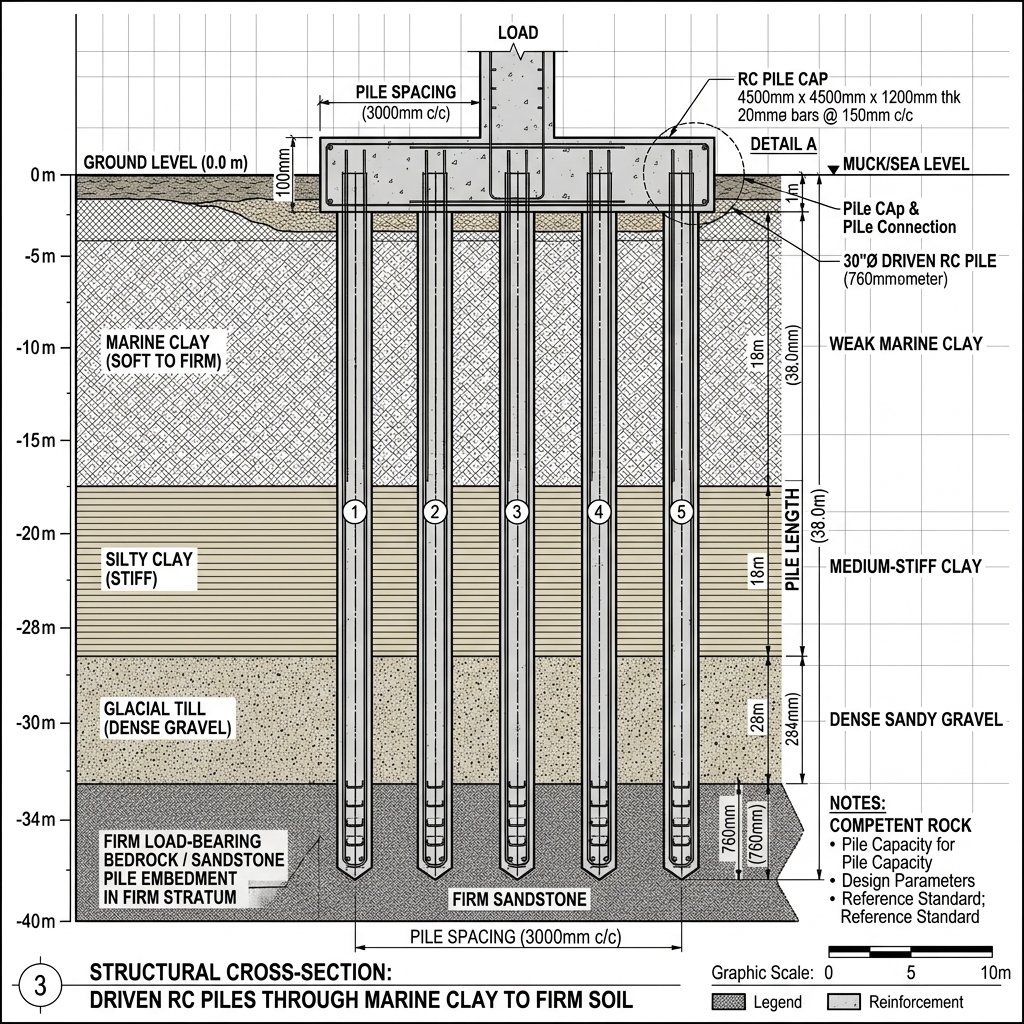
1. Subsurface Soil Profile of Dholera SIR
Civil engineering designs in Dholera must account for the mechanical characteristics of the local soil profile:
- Expansive Marine Clay (0m to 12m Depth): The upper stratum consists of soft, cohesive marine clay with high moisture content. This clay experiences volume changes (swelling during monsoons and shrinking during dry summers), making it unsuitable for direct heavy structural loading.
- Stiff Silty Clay (12m to 25m Depth): The soil transitions into medium-to-stiff silty clay with improved bearing capacity.
- Dense Sand and Gravel Stratum (>25m Depth): Below the clay layers lies a dense sand, gravel, or weathered bedrock stratum. This layer provides the high bearing capacity required to support heavy foundations.
2. DSIRDA Foundation Codes & Guidelines
To prevent structural settlement, tilting, and crack formation, DSIRDA enforces strict foundation guidelines based on the building size and load:
- Raft Foundations: For medium-rise structures (such as Ground+3 residential blocks), a raft foundation (thick concrete slab covering the entire footprint) is often used to distribute the building weight evenly across the soil.
- Deep Pile Foundations: For any building taller than 15 meters or heavy manufacturing units, deep pile foundations are mandatory. Concrete piles (typically 600mm to 1000mm in diameter) must be bored and cast-in-situ, driving down 18 to 35 meters to anchor in the dense sand or gravel layer.
- Pre-Construction Soil Testing: Developers must submit a soil testing report from a government-approved laboratory before receiving a building layout approval. The report must confirm the plot’s specific Safe Bearing Capacity (SBC).
The table below outlines foundation requirements based on soil depth in Dholera:
| Soil Stratum / Depth | Typical Soil Characteristics | Safe Bearing Capacity (SBC) | Recommended Foundation Model |
|---|---|---|---|
| **Shallow Layer (0m – 5m)** | Highly plastic, soft marine clay | 50 – 80 kN/m² | Restricted to light boundary walls and Ground+1 cabins |
| **Intermediate Layer (5m – 15m)** | Medium-stiff silty clay | 80 – 150 kN/m² | Raft foundations for low-rise commercial structures |
| **Deep Anchor Layer (15m – 30m)** | Stiff clay / silty sand mix | 150 – 250 kN/m² | Friction piles or end-bearing piles for multi-story towers |
| **Bedrock / Gravel (>30m)** | Dense gravel and rock layers | >350 kN/m² | End-bearing concrete piles for heavy factory machinery |
3. Soil Stabilization & Ground Improvement Methods
To build roads, utility ducts, and lightweight factory storage pads, contractors utilize soil stabilization techniques to reinforce the marine clay:
- Vertical Band Drains (PVD): Plastic strips are driven into the clay, providing drainage paths that accelerate soil consolidation under pre-loading.
- Lime and Cement Stabilization: Mixing lime or cement into the upper clay layers reduces plasticity and increases soil bearing capacity, creating a stable base for roadways.
- Stone Columns: Vibration methods are used to construct vertical columns of crushed stone through the clay, increasing overall load capacity and reducing settlement risks.
Frequently Asked Questions (FAQ)
#### What is the typical soil bearing capacity in Dholera SIR?
The safe soil bearing capacity at shallow depths (under 5 meters) in Dholera is low, typically measuring between 50 kN/m² and 80 kN/m² due to the presence of soft marine clay.
#### Are pile foundations mandatory in Dholera?
Yes. Under DSIRDA building guidelines, pile foundations are mandatory for high-rise buildings, commercial office towers, and heavy manufacturing plants to anchor structures into stable, deep sand or gravel layers.
#### How is marine clay managed during construction?
For heavy structures, concrete piles are driven through the clay layer to the underlying bedrock. For roads and light pads, soil stabilization techniques—including vertical band drains and lime-cement mixing—are used to improve soil strength.
Download Dholera SIR 2026 Investor’s Kit
Get instant access to the official planning documents: Dholera Investment Handbook (PDF), 2026 Land Price List, TP Zone & Village Map, and the NRI Buying Guide.

Join The Discussion