

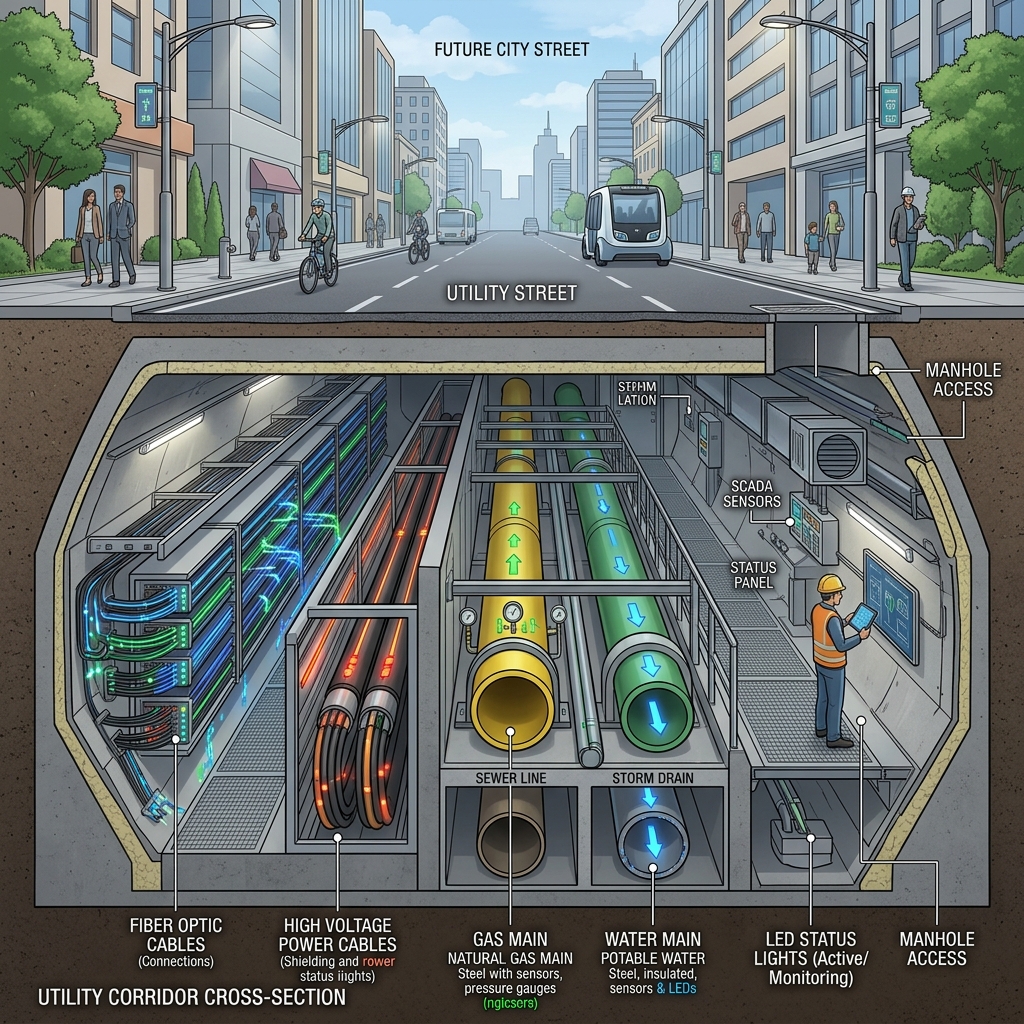

Technical Design: Subterranean Utility Corridors
The subterranean utility trench is a multi-compartment concrete channel running beneath the smart city streets, designed to isolate and protect critical services:
- Integrated Ducts: Separate chambers prevent gas line interactions with high-voltage power conduits, ensuring system safety.
- Plug-and-Play Connectors: Individual plot boundaries feature dedicated access points where water, power, gas, and fiber lines connect directly, eliminating the need to cut public asphalt.
- SCADA Monitoring: The ABCD Building’s command center uses IoT sensors inside the utility trenches to monitor pressure, temperature, and fiber latency, auto-detecting faults within seconds.
Zoning Infrastructure Access Standards
Subterranean corridors are fully deployed inside the Activation Area, with rollout continuing throughout TP1 and TP2:
| Planning Zone | Subterranean Corridor Width | Fiber Optic Backbone | Smart Water Metering | Grid Connection Status |
|---|---|---|---|---|
| TP 1 (Core) | 10.0 to 15.0 Meters | Dual-ring Redundancy | Automated Smart Meters | Fully Operational |
| TP 2 (Corridor) | 12.0 to 18.0 Meters | High-capacity Fiber Trunk | Automated Smart Meters | Under Active Laying |
| TP 5 (Industrial) | 15.0 to 22.0 Meters | Ultra-low Latency | Industrial Flow Meters | Fully Operational |
Key Takeaways for Property Investors
- Select Plotted Developments with Grid Access: Prioritize residential and commercial layouts that feature direct access to the subterranean utility corridor, ensuring a seamless plug-and-play connection.
- Verify DSIRDA Development Permissions: Ensure the developer has obtained formal layout approvals from DSIRDA. Plotted projects lacking these approvals cannot connect to the smart municipal grids.
- Understand Legal Protections: Verify that your plot has completed the land pooling reconstitution process (Form F check), ensuring your coordinates are registered on the official GIDB master map.
Frequently Asked Questions (FAQ)
What is a subterranean utility corridor?
It is an underground concrete trench carrying all municipal services (water, power, fiber, and gas) parallel to roads, allowing maintenance without digging up asphalt.
How does Dholera’s smart grid handle utility faults?
The ABCD Building’s command center uses SCADA systems and IoT sensors inside the corridors to detect leaks, power drops, or fiber cuts, initiating automated repairs or rerouting.
Download Dholera SIR 2026 Investor’s Kit
Get instant access to the official planning documents: Dholera Investment Handbook (PDF), 2026 Land Price List, TP Zone & Village Map, and the NRI Buying Guide.

Join The Discussion