

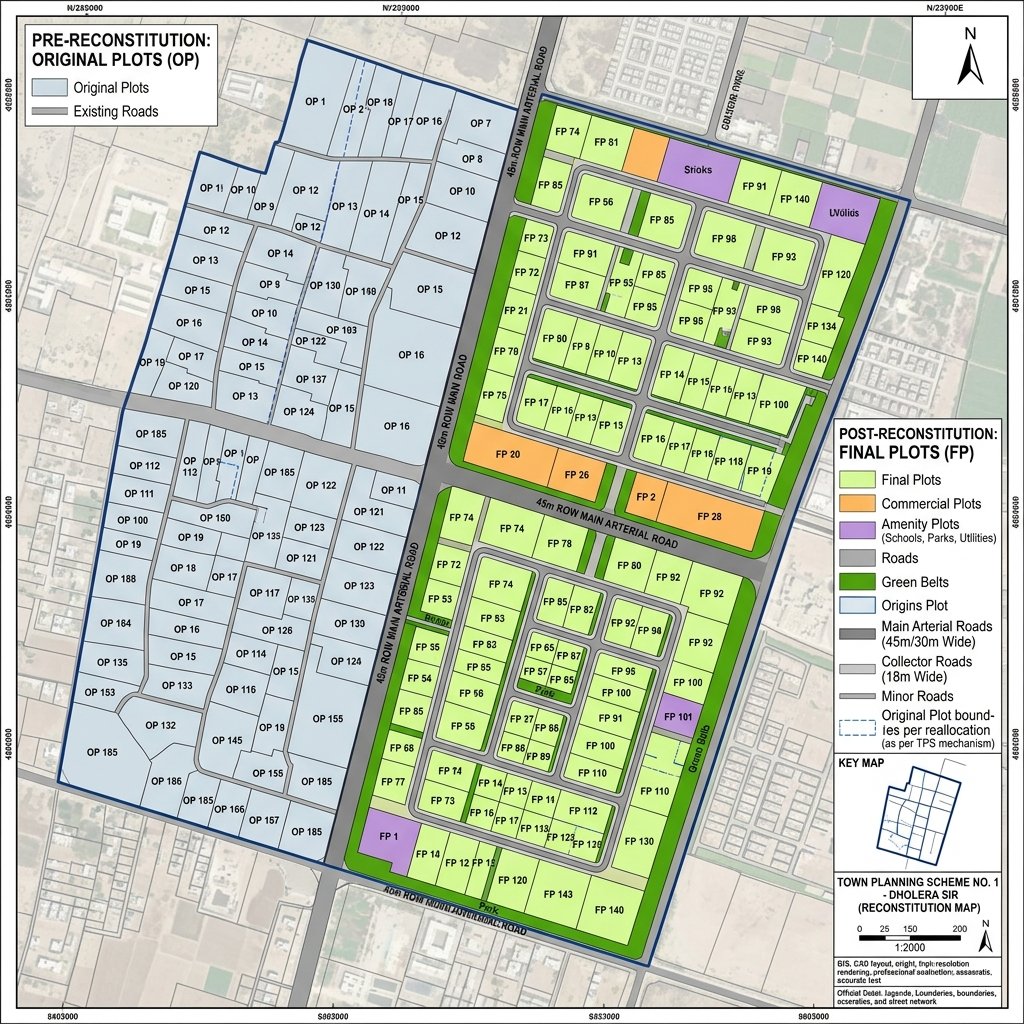
1. The Reconstitution Model: OP vs. FP
Unlike traditional land pooling where owners are permanently displaced, Dholera’s reconstitution model ensures that land owners remain stakeholders in the city’s future growth.
- Original Plot (OP): The agricultural, irregular, unserviced land holding originally held by the owner.
- Final Plot (FP): The reconstituted, rectangular, road-touching plot returned to the owner after development.
- Infrastructure Deduction: To build the city’s smart roads, green spaces, utility ducts, and social infrastructure, DSIRDA deducts a predetermined percentage of land (typically 40% to 50%). The remaining land is returned as a Final Plot.
- Net Valuation Gain: Although the physical area of the plot is reduced, the market value of a fully serviced, non-agricultural (NA) Final Plot with direct road access far exceeds the value of the original agricultural acreage.
2. Step-by-Step Reconstitution Process
The conversion of OPs to FPs follows a structured legal workflow administered by the Town Planning Officer (TPO):
- Declaration of Intention: Government declares a specific sector (e.g., TP1 or TP2) as a Town Planning Scheme.
- Mapping & Surveying: Boundaries of all Original Plots (OP) are verified and logged.
- Draft Reconstitution Plan: The TPO designs the road layouts, utility channels, and assigns new, regular-shaped Final Plots (FP) to each owner.
- The F-Form Release: The F-Form (Valuation and Reconstitution Sheet) is published. It documents the exact area of the OP, the deducted area, the final FP area, and any compensation or incremental contribution charges.
- Objections & Resolution: Landowners can submit grievances, which the TPO addresses.
- Final Sanction & Possession: The Gujarat State Government sanctions the scheme, and physical possession of the Final Plot is handed over to the owner.
| Reconstitution Stage | Key Document | Authority | Impact on Land Owner |
|---|---|---|---|
| **1. Boundary Verification** | Survey Maps | Revenue Dept. | Identifies Original Plot (OP) boundaries |
| **2. Layout Assignment** | Draft TP Map | DSIRDA TPO | Determines the location of the future Final Plot (FP) |
| **3. Deduction Valuation** | **F-Form** | DSIRDA TPO | Specities final square yardage and deduction rates |
| **4. Land Handover** | Possession Receipt | DSIRDA | Physical handover of demarcated, road-touching plot |
3. Legal Safety and Security for Investors
The reconstitution process makes Dholera SIR one of the safest real estate markets in India: * Clear Title: Because the government handles the reconstitution, all Final Plots are issued with clean, undisputed, non-agricultural (NA) titles. * Encroachment Protection: Final Plots are physically demarcated by boundary roads and smart fences, preventing illegal encroaching. * F-Form Due Diligence: Investors can cross-verify any plot purchase by matching the seller’s registration details directly with the official TPO F-Form registry.
Frequently Asked Questions (FAQ)
#### What is an OP and FP in Dholera SIR?
An Original Plot (OP) refers to the initial, agricultural, irregular land parcel owned by a local farmer or investor. A Final Plot (FP) is the reconstituted, regular, road-touching plot returned to the owner after infrastructure deductions.
#### What is the standard land deduction rate in Dholera?
Under the Gujarat Town Planning Act reconstitution model, the standard land deduction rate is typically 40% to 50%. This land is used to build roads, water recycling networks, power grids, and neighborhood green spaces.
#### What is the F-Form in Dholera land transactions?
The F-Form is the official legal document that records the details of land reconstitution. It lists the original plot number (OP), the reconstituted final plot number (FP), the exact areas, and the valuation details. It is a critical document for verifying title clearance.
Download Dholera SIR 2026 Investor’s Kit
Get instant access to the official planning documents: Dholera Investment Handbook (PDF), 2026 Land Price List, TP Zone & Village Map, and the NRI Buying Guide.

Join The Discussion