

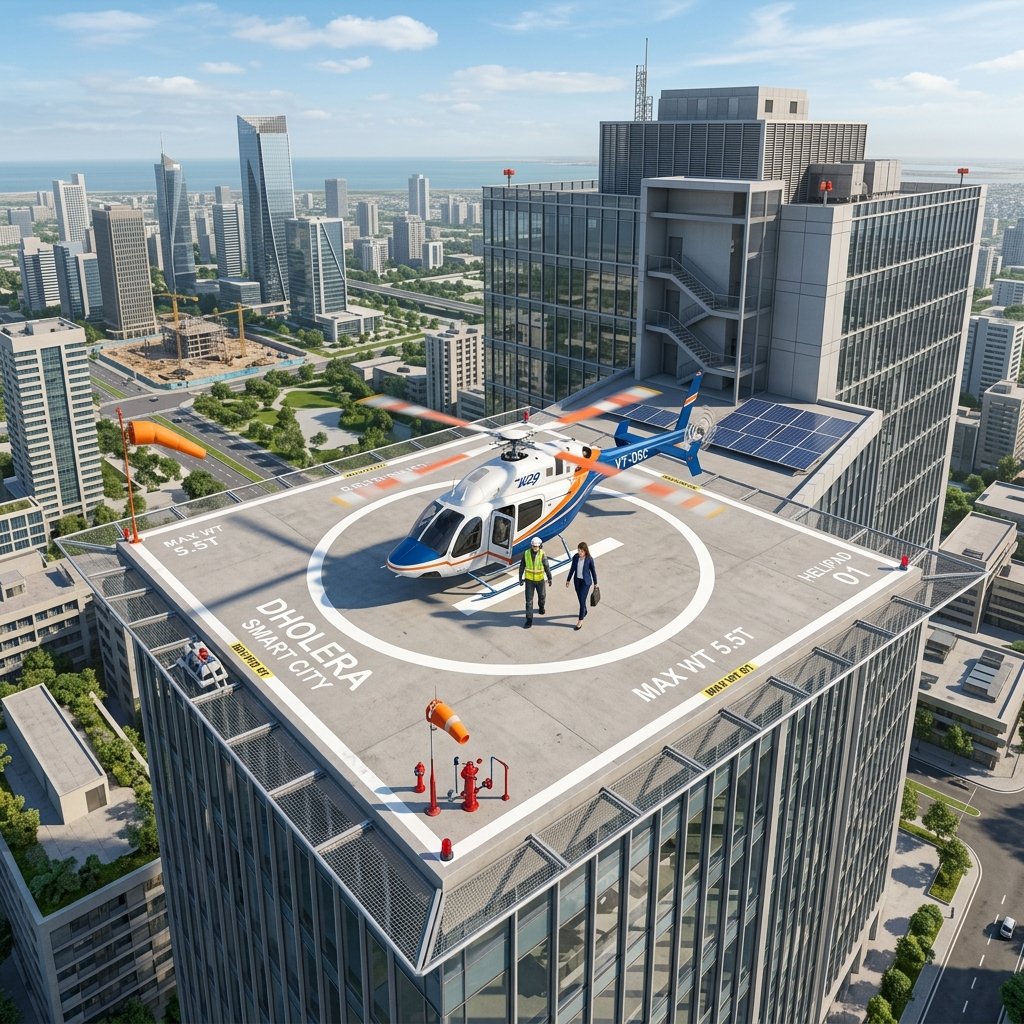
1. Rooftop Helipad Structural Requirements
Under the DSIRDA GDCR, building owners can apply to construct a rooftop landing pad on structures exceeding a height of 45 meters, provided the design complies with structural load standards:
- Dynamic Touchdown Load: The building’s roof slab must be structurally reinforced to bear the dynamic impact of a helicopter landing. This requires reinforcing concrete pillars and installing load-distribution beams under the landing pad.
- Standard Weight Rating: Rooftop helipads are typically rated to support a maximum weight of 5.5 metric tons or 9.0 metric tons (covering medium helicopters like the HAL Dhruv, Bell 412, or Sikorsky S-76).
- Safety Netting: A continuous safety net, measuring at least 1.5 meters in width and angled slightly upward, must project outward from the edge of the helipad deck to protect maintenance personnel.
2. Approach Paths & Obstacle Limitation Surfaces
To ensure safe take-off and landing operations in Dholera’s vertical commercial zones, DGCA guidelines enforce strict air-space clearance rules:
- Approach and Take-Off Funnel: A clear, wedge-shaped air path must be maintained at a slope of 1:8 (8.33% gradient), free of utility poles, mobile towers, and taller adjacent buildings.
- Perimeter Lighting: The landing pad must be equipped with low-intensity green LED lights along the perimeter, illuminated wind cones to indicate wind direction, and a floodlit surface to support night-landing operations.
- Fire Suppression Systems: Rooftop helipads must be fitted with automated foam monitors and dry chemical fire extinguishers, connected to dedicated water lines to address landing fuel fire hazards.
The table below outlines technical requirements for helipad construction in Dholera SIR:
| Design Element | Technical Specification | Regulatory Oversight |
|---|---|---|
| **Minimum Landing Area Size** | 20m x 20m (or circular diameter of 20m) | DGCA Civil Aviation Requirements (CAR) Section 4 |
| **Structural Capacity** | Dynamic load of 5.5 to 9.0 Tons | Certified by DSIRDA-registered Structural Engineer |
| **Edge Safety Netting** | 1.5m wide, steel wire or fire-resistant fiber | Mandatory for all elevated rooftop helipads |
| **Landing Lights** | Green perimeter LEDs & white touchdown lights | Must not cause glare to pilots on approach |
| **Clearance Funnel** | 8.33% slope free of structural obstacles | Verified via Airport Authority of India (AAI) height tool |
3. Licensing & Approvals Checklist
Before a helipad can be used for flights, developers must secure approvals from multiple agencies:
- DSIRDA Building Approval: Confirming the building’s structural plans include the helipad design.
- AAI Height Clearance NOC: Ensuring the helipad location does not interfere with the flight paths of the under-construction Dholera International Airport (DIACL).
- DGCA Operating License: Civil aviation inspectors run on-site safety audits to verify firefighting equipment, pilot visual aids, and wind indicator systems before issuing an operational license.
Frequently Asked Questions (FAQ)
#### Can private developers build rooftop helipads in Dholera SIR?
Yes. Private developers are permitted to build rooftop helipads on buildings taller than 45 meters, subject to structural reinforcement design approvals from DSIRDA and operating licenses from the DGCA.
#### What is the standard load rating for Dholera helipads?
Rooftop helipads in Dholera are typically engineered to support dynamic landing weights of 5.5 tons to 9.0 tons, allowing for the safe operation of standard commercial transport helicopters.
#### Does a rooftop helipad require airport clearance?
Yes. Because Dholera is a planned aviation city, all elevated landing structures must obtain a No Objection Certificate (NOC) from the Airport Authority of India (AAI) to ensure they do not conflict with commercial airport flight paths.
Download Dholera SIR 2026 Investor’s Kit
Get instant access to the official planning documents: Dholera Investment Handbook (PDF), 2026 Land Price List, TP Zone & Village Map, and the NRI Buying Guide.



Join The Discussion