

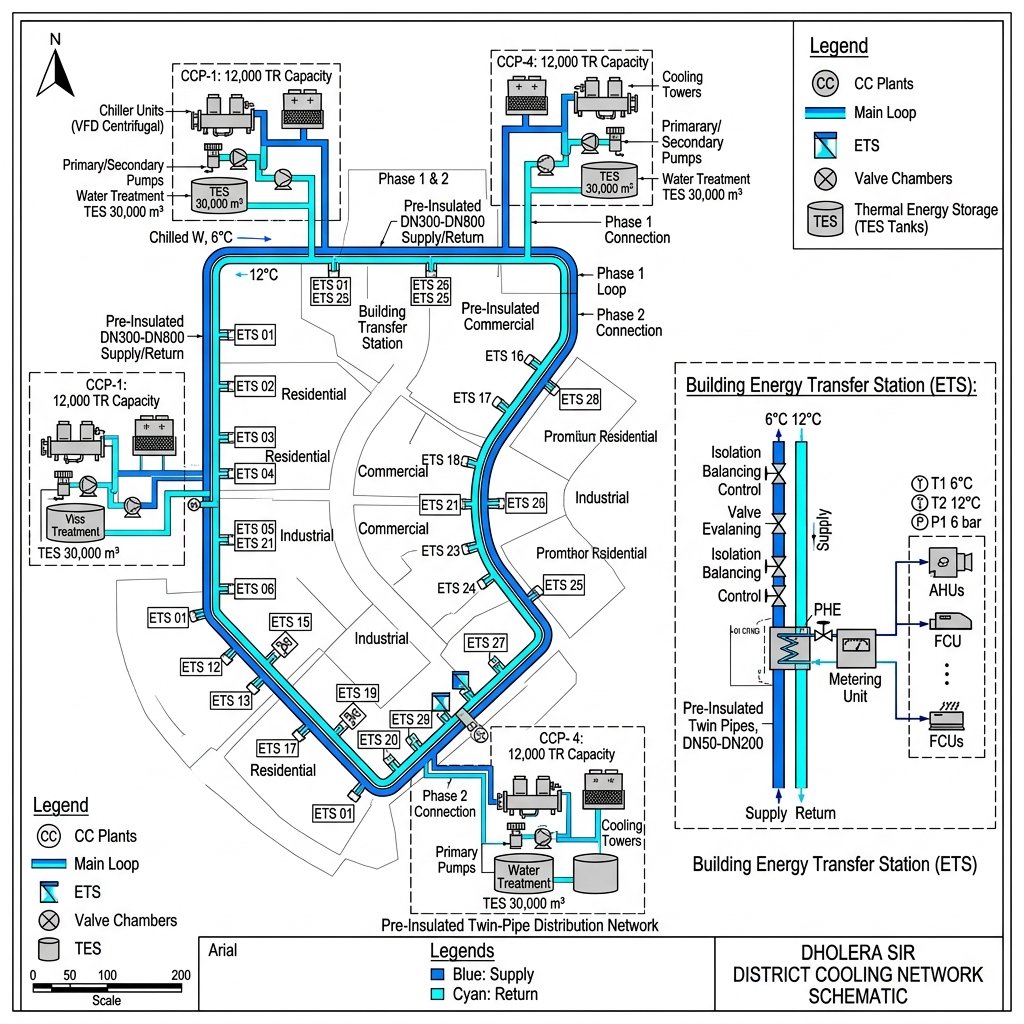
1. Chilled Water Supply Parameters & Thermal Energy Storage (TES)
Centralized cooling plants generate chilled water using high-efficiency variable frequency drive (VFD) centrifugal chillers combined with Thermal Energy Storage:
- Chilled Water Temperatures ($4.5^\circ\text{C}$ Supply / $14.5^\circ\text{C}$ Return): Chilled water is pumped through subterranean distribution loops at a supply temperature of $4.5^\circ\text{C} \pm 0.5^\circ\text{C}$ and returned at $14.5^\circ\text{C}$, maintaining a high $\Delta T$ of $10.0^\circ\text{C}$ to maximize hydraulic thermal capacity.
- Thermal Energy Storage (TES Tanks): Central plants incorporate stratified chilled water storage tanks (capacity 30,000 to 50,000 m³). TES tanks are charged during off-peak night hours when electricity tariffs are low, discharging chilled water during peak afternoon heat demand to shave 35% off city grid power loads.
- High Efficiency Chiller COP ($\ge 6.5$): Central water-cooled centrifugal chillers must achieve an overall Coefficient of Performance of $\text{COP} \ge 6.5$ (equivalent to $\le 0.54\text{ kW/TR}$) under AHRI 550/590 rating conditions.
2. Pre-Insulated Twin-Pipe Distribution Loop
Chilled water is distributed across city zones through heavy-duty subterranean piping networks:
- Pre-Insulated Carbon Steel Conduits: Distribution mains utilize seamless or submerged arc-welded carbon steel pipes (ASTM A53 Grade B) insulated with rigid polyurethane foam (PUR, thermal conductivity $\le 0.026\text{ W/m}\cdot\text{K}$) and jacketed with a high-density polyethylene (HDPE) outer casing.
- Continuous Leak Detection Wire: Embedded inside the polyurethane insulation layer are copper alarm wires connected to DICDL’s SCADA system, pinpointing moisture leaks to within 1 meter accuracy.
- 16 Bar Design Working Pressure: Distribution loops operate at a nominal pressure rating of PN 16 (16 bar) with a minimum test pressure of 24 bar.
The table below outlines DICDL district cooling network technical specifications:
| District Cooling Component | Design Supply / Return Temp | Design Pressure Rating | Pipe / Insulation Material | Interface Equipment | Efficiency Benchmark |
|---|---|---|---|---|---|
| **Central Chiller Plant (CCP)** | $4.5^\circ\text{C} / 14.5^\circ\text{C}$ ($\Delta T 10^\circ\text{C}$) | PN 16 (16 Bar) | Carbon Steel + PUR + HDPE | VFD Pumps & TES Tank | $\text{COP} \ge 6.5$ ($\le 0.54\text{ kW/TR}$) |
| **Subterranean Trunk Loop** | $5.0^\circ\text{C} / 14.5^\circ\text{C}$ | PN 16 (16 Bar) | Pre-Insulated Steel (DN300-DN800) | SCADA Leak Wire | Thermal Loss $< 0.5^\circ\text{C/km}$ |
| **Building ETS Station** | $6.0^\circ\text{C} / 14.0^\circ\text{C}$ (Building Side) | PN 10 (10 Bar) | Stainless Steel Plate Heat Exch. | Ultrasonic Energy Meter | $\Delta T \ge 8.0^\circ\text{C}$ across PHE |
| **Cleanroom / Data Center Branch** | $4.0^\circ\text{C} / 12.0^\circ\text{C}$ | PN 16 (16 Bar) | Dual Redundant Twin-Pipe Loop | N+1 Dedicated PHE Skid | 99.999% Reliability |
3. Building Energy Transfer Stations (ETS)
Instead of installing individual chillers, buildings connect to the district cooling loop via a compact basement ETS room:
- Plate Heat Exchangers (PHE): The primary district cooling loop transfers thermal energy to the building’s secondary HVAC loop through high-efficiency gasketed titanium or 316-stainless steel plate heat exchangers, physically isolating building water from the main municipal grid.
- Ultrasonic BTU Energy Metering: Every ETS room features a certified ultrasonic thermal energy meter measuring instantaneous flow rate and $\Delta T$, billing building owners per kilowatt-hour ($\text{kWh}_{th}$) or Ton-Hour of cooling consumed.
Frequently Asked Questions (FAQ)
#### What is the supply temperature of chilled water in Dholera’s district cooling network?
Chilled water is supplied from central plants at a temperature of $4.5^\circ\text{C}$ and returns at $14.5^\circ\text{C}$, maintaining an efficient $10^\circ\text{C}$ temperature differential ($\Delta T$).
#### How does a building connect to Dholera’s district cooling grid?
Buildings connect via a basement Energy Transfer Station (ETS) containing stainless steel plate heat exchangers that transfer cooling to the building’s air handling units without mixing internal and municipal water.
#### What energy savings does Dholera district cooling provide?
By using centralized high-COP chillers ($\text{COP} \ge 6.5$) and Thermal Energy Storage (TES) tanks, district cooling reduces peak electrical power demand by up to 35% compared to standalone building air conditioners.
Download Dholera SIR 2026 Investor’s Kit
Get instant access to the official planning documents: Dholera Investment Handbook (PDF), 2026 Land Price List, TP Zone & Village Map, and the NRI Buying Guide.

Join The Discussion