

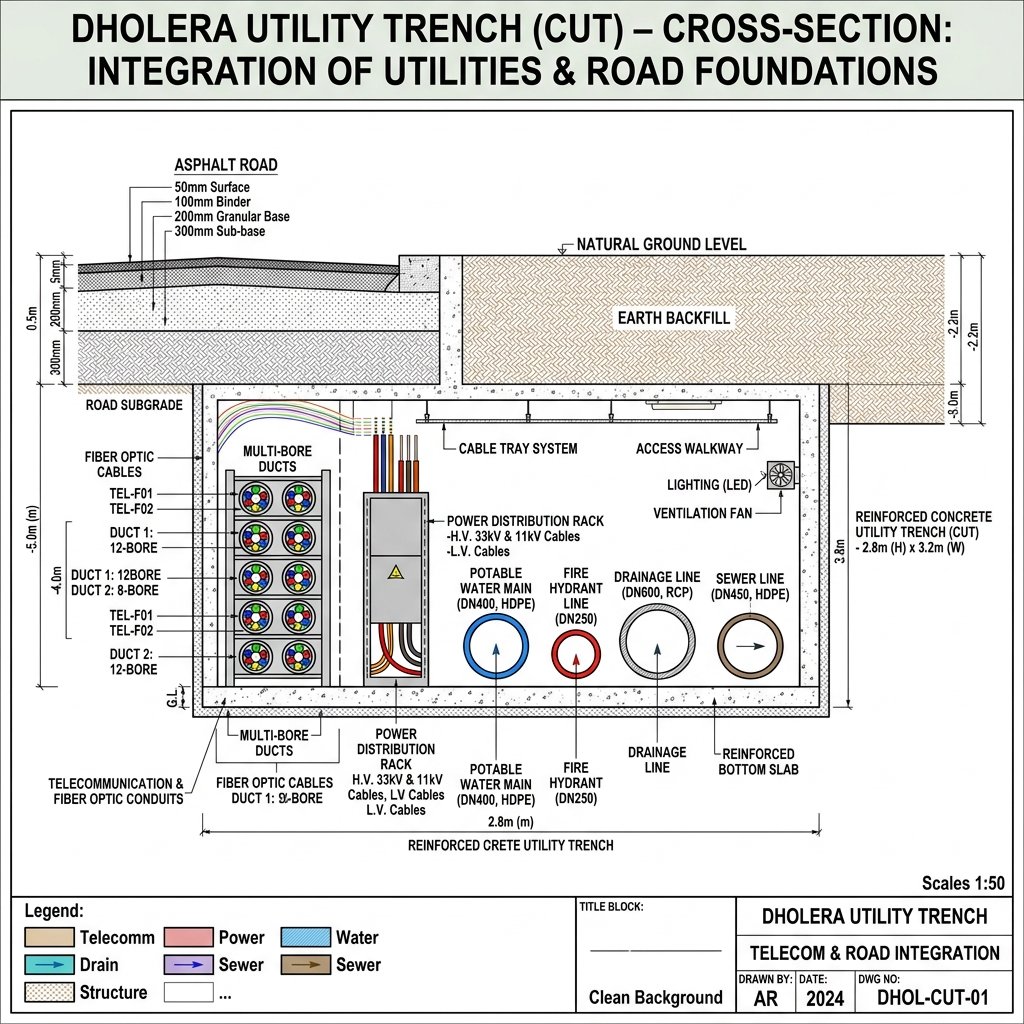
1. Telecom Trench Cross-Section and Conduits
The telecommunication layout inside Dholera’s reinforced concrete utility trenches utilizes a multi-bore conduit structure:
- Multi-Bore HDPE Conduits: Running beneath road sidewalks, telecom pathways consist of 12-bore or 8-bore HDPE ducts (each conduit measures 40mm to 50mm in internal diameter).
- Infrastructure Partitioning: Conduits are split between municipal systems (CCTV surveillance, smart streetlights, SCADA telemetry, and environmental sensors) and private commercial telecom service providers (such as Jio, Airtel, and Torrent).
- Color-Coded Tracks: Conduits are color-coded to allow technicians to identify, route, and replace fiber optic lines without disrupting other municipal networks.
2. Physical Separation and EMI Protection
To ensure data integrity and prevent service interruptions, telecom conduits must maintain safe separation distances from other utility lines:
- Clearance from Power Cables: To prevent electromagnetic induction and signal noise, telecom conduits must maintain a minimum clear distance of 0.5 meters from Torrent Power’s high-voltage electrical cabling ducts.
- Alignment relative to Wet Utilities: Telecom lines are positioned in the dry section of the utility corridor. They are placed above water mains and sewer pipes to prevent water damage during pipeline leaks or utility repairs.
- Gas Line Setbacks: Telecom trenches run parallel to gas pipelines but maintain a safety clearance to prevent sparks from contacting gas lines.
The table below outlines Dholera’s telecommunication duct specifications:
| Utility Duct Class / Capacity | Internal Duct Diameter | Conduit Material | Minimum Power Line Clearance | Access Manhole Spacing |
|---|---|---|---|---|
| **Primary Duct (12-Bore)** | 50mm per bore | HDPE (UV resistant, smooth wall) | 500 mm (0.5m) | 150 Meters (on straight runs) |
| **Secondary Duct (8-Bore)** | 40mm per bore | HDPE (Double-walled corrugated) | 500 mm (0.5m) | 200 Meters (on straight runs) |
| **Service Drop Duct (4-Bore)** | 32mm per bore | HDPE / PVC Conduit | 300 mm (0.3m) | At every plot gate junction |
| **Sub-surface Pull Box** | N/A | Precast Concrete | N/A | At every directional bend |
3. Access Manholes and Cable Pulling Intervals
To facilitate fiber optic maintenance, Dholera’s layout features standardized access chambers:
- Maximum Manhole Spacing: Telecom access manholes (pull chambers) must be positioned at intervals of no more than 150 to 200 meters along straight road sections.
- Intersection Nodes: Manholes are required at every road intersection, utility lateral crossing, and directional bend to facilitate fiber pulling and splicing.
- Precast Concrete Design: Access chambers are built using precast concrete. They feature gas-tight, heavy-duty cast iron covers designed to withstand high wheel loads from road traffic.
Frequently Asked Questions (FAQ)
#### What is the spacing of telecom manholes in Dholera Smart City?
Under the DICDL utility master plan, telecommunication manholes and fiber pull boxes must be placed at maximum intervals of 150 to 200 meters along straight utility runs.
#### Why are Dholera’s telecom cables laid in concrete trenches?
Laying cables in concrete trenches protects fiber optic lines from damage and allows technicians to install, pull, or replace lines without digging up roads or sidewalks.
#### How is electromagnetic interference (EMI) prevented in Dholera’s utility ducts?
Telecom conduits must maintain a minimum physical separation of 0.5 meters (500mm) from high-voltage electrical lines to eliminate EMI.
Download Dholera SIR 2026 Investor’s Kit
Get instant access to the official planning documents: Dholera Investment Handbook (PDF), 2026 Land Price List, TP Zone & Village Map, and the NRI Buying Guide.

Join The Discussion