

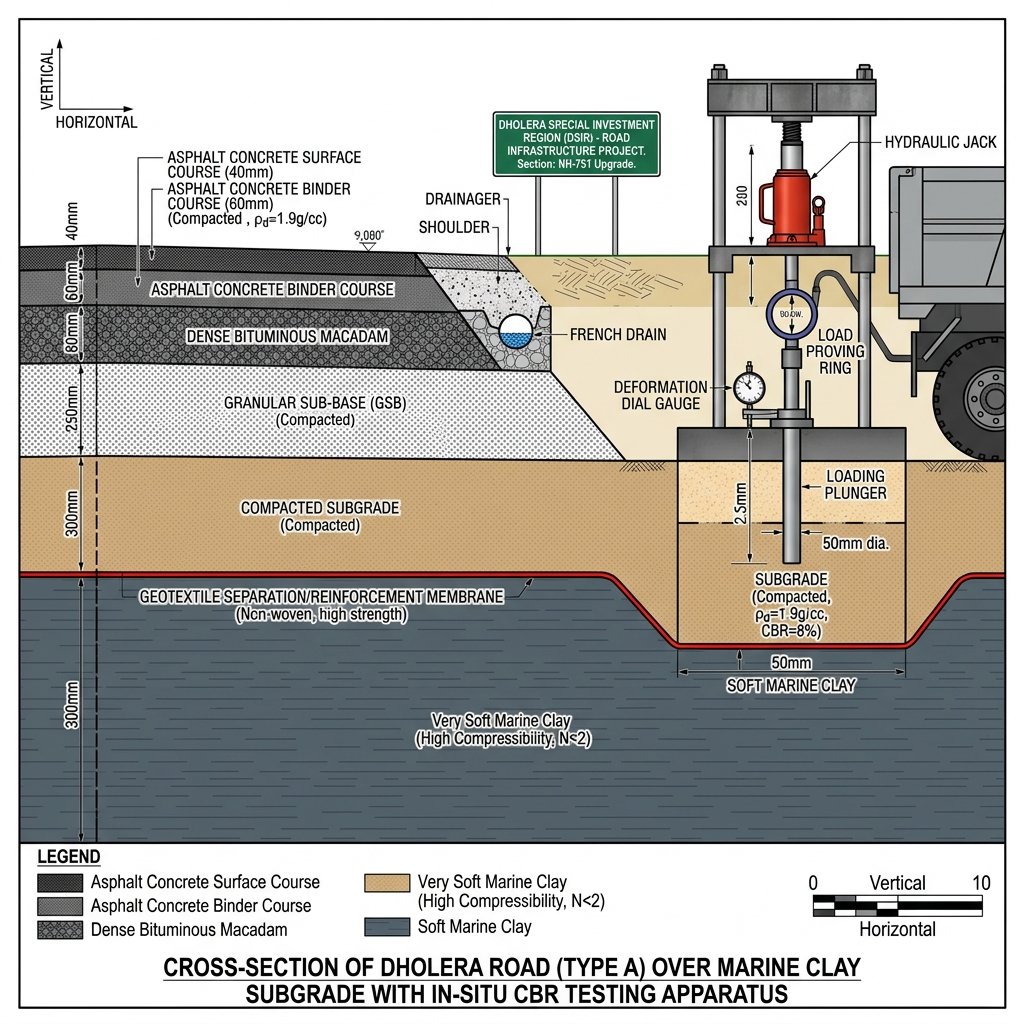
1. Modified Proctor Density & Field Compaction Caps
All earthwork embankments and road subgrades inside Dholera SIR must be compacted in controlled loose layers (maximum 250mm thick per lift) to achieve specified dry density targets:
- Road Subgrade Top 500mm: Must achieve a minimum of 98% Modified Proctor Maximum Dry Density (MDD) under IS 2720 (Part 8).
- Embankment Fill Layers: Must achieve at least 95% Maximum Dry Density.
- Industrial Floor Sub-base: Factory foundation subgrades must be compacted to 98% MDD using heavy vibratory rollers (minimum 10-tonne static weight).
- Optimum Moisture Content (OMC): Compaction must be performed within a tight moisture tolerance of $\pm 2\%$ of OMC to prevent moisture-induced swelling or shrinkage in marine clay.
2. California Bearing Ratio (CBR) & Geotextile Reinforcement
Because raw Dholera marine clay exhibits an extremely poor natural CBR strength (often $< 2\%$), ground stabilization is legally required before laying pavement courses:
- Minimum 8% Design CBR: The top 500mm compacted subgrade must exhibit a soaked California Bearing Ratio of $\text{CBR} \ge 8\%$ after a 4-day water immersion test.
- Lime/Cement Stabilization: Where natural soil CBR is below 5%, the subgrade must be stabilized by blending 3% to 5% hydrated lime or Portland cement by dry soil weight.
- High-Strength Non-Woven Geotextile: A high-tenacity polyester non-woven geotextile layer (minimum mass 250 g/m²) must be laid directly over the soft marine clay subgrade prior to placing Granular Sub-Base (GSB) material, preventing fine clay migration into the aggregate pavement.
The table below outlines DSIRDA subgrade compaction standards across pavement layers:
| Pavement / Foundation Layer | Thickness per Lift | Min. MDD Compaction % | Min. Soaked CBR % | Soil Treatment Required | Testing Frequency |
|---|---|---|---|---|---|
| **Top Subgrade (0 – 500mm)** | 250 mm | 98% Modified Proctor | $\ge 8.0\%$ | Lime Stabilization + Geotextile | 1 test per $1,000\text{ m}^2$ |
| **Embankment Core Fill** | 250 mm | 95% Modified Proctor | $\ge 5.0\%$ | Selected Granular Fill | 1 test per $1,500\text{ m}^2$ |
| **Granular Sub-Base (GSB)** | 150 mm | 98% Modified Proctor | $\ge 20.0\%$ | Crushed Aggregate ($40\text{mm}$) | 1 test per $500\text{ m}^2$ |
| **Dense Bituminous Macadam** | 80 mm | 98% Lab Density | N/A | Bituminous Binder ($VIM 3-5\%$) | Core test per $250\text{ m}^2$ |
3. Quality Assurance & Sand Replacement Field Tests
- In-Situ Density Verification: Field compaction density must be verified using the Sand Replacement Method (IS 2720 Part 28) or nuclear density gauges at mandatory grid frequencies.
- Plate Load Testing: Industrial factory subgrades supporting heavy machinery must undergo static plate load tests to confirm a modulus of subgrade reaction ($k$-value) of at least $50\text{ MPa/m}$.
Frequently Asked Questions (FAQ)
#### What is the minimum compaction requirement for road subgrades in Dholera?
Under DSIRDA GDCR Section 8.5, the top 500mm of road subgrade must achieve at least 98% Modified Proctor Maximum Dry Density (MDD).
#### Why is geotextile fabric laid under Dholera roads?
A non-woven geotextile membrane is installed over Dholera’s soft marine clay subgrade to separate aggregate layers from fine clay particles and reinforce the pavement structure.
#### What is the required CBR rating for Dholera road subgrades?
Dholera road subgrades must exhibit a minimum soaked California Bearing Ratio (CBR) of 8% to ensure adequate structural support for heavy traffic.
Download Dholera SIR 2026 Investor’s Kit
Get instant access to the official planning documents: Dholera Investment Handbook (PDF), 2026 Land Price List, TP Zone & Village Map, and the NRI Buying Guide.

Join The Discussion