

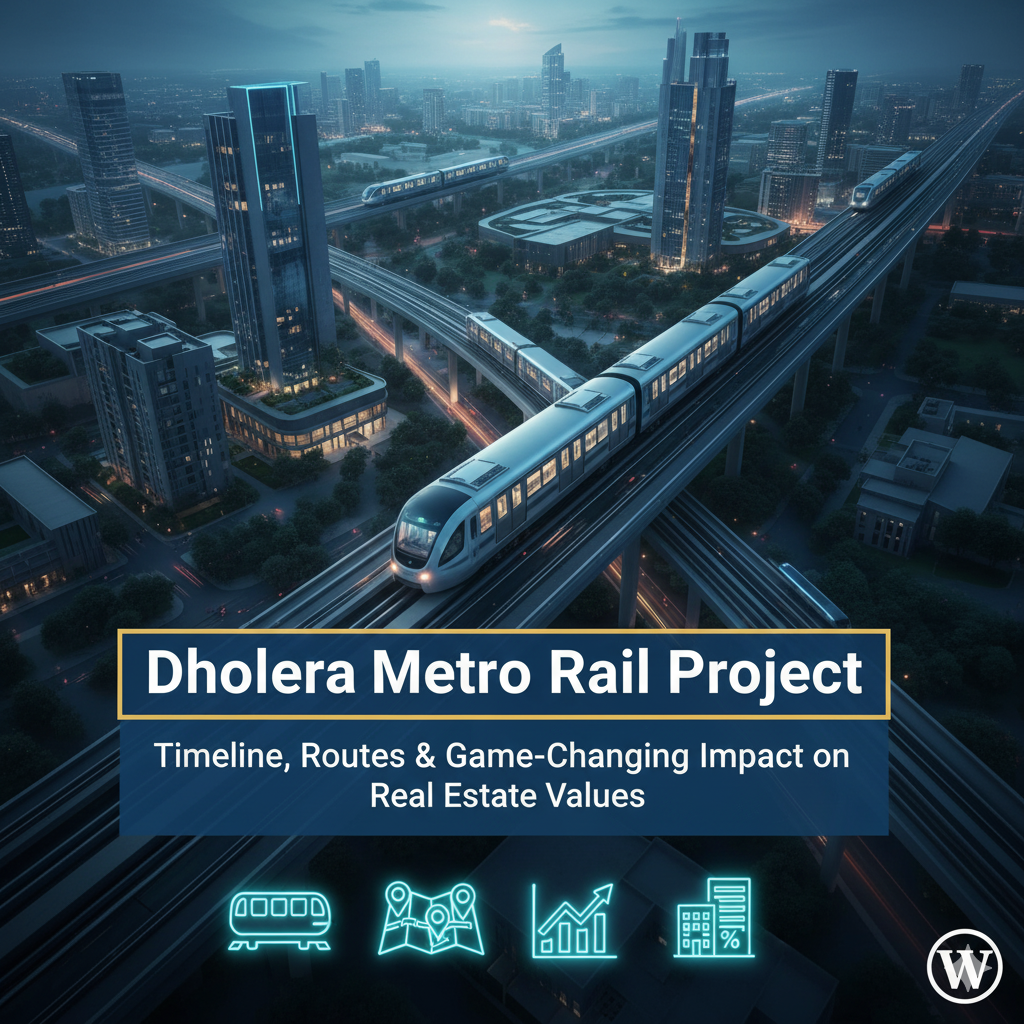
While much attention focuses on Dholera’s international airport and expressway, another infrastructure project promises to fundamentally reshape the region’s connectivity and real estate landscape—the Dholera Metro Rail Project. This ambitious mass rapid transit system will link Ahmedabad, Gandhinagar, GIFT City, and Dholera in a seamless corridor, creating one of India’s most sophisticated metropolitan transit networks. Understanding this project’s scope, timeline, and implications is crucial for real estate investors seeking to position strategically for the next wave of infrastructure-driven value creation.
Project Scope and Visionary Planning
The Dholera Metro Rail Project represents far more than a transportation system—it’s a transformative infrastructure creating an integrated mega-region connecting Gujarat’s administrative capital, commercial center, financial hub, and emerging industrial powerhouse. The project encompasses two distinct phases with complementary objectives and timelines.
Phase 1 focuses on connecting Ahmedabad to Gandhinagar, establishing the foundation for the broader metro network. This segment will link Gujarat’s two most important cities with high-speed, reliable mass transit, reducing road congestion and travel times substantially. While Phase 1 primarily serves existing urban populations, it establishes critical infrastructure and operational expertise essential for Phase 2’s success.
Phase 2 represents the truly transformative element—extending the metro from Gandhinagar through GIFT City to Dholera Smart City. This 95-kilometer corridor will create unprecedented connectivity between established urban centers and Gujarat’s emerging smart city, fundamentally altering development patterns and real estate values along the entire route. The integration with Dholera International Airport ensures the metro becomes a critical component of the city’s transportation ecosystem.
The project’s technical specifications reflect world-class standards. High-speed metro trains capable of 80-100 kilometers per hour will make the journey along the entire corridor efficient and competitive with private vehicle travel. Modern, air-conditioned rolling stock with smart features—real-time information systems, contactless payment, and accessibility features—will meet international transit standards.
Station design emphasizes transit-oriented development principles. Stations won’t merely be transportation stops—they’ll be integrated mobility hubs with multi-modal connections including bus terminals, auto-rickshaw stands, bicycle parking, pedestrian pathways, and eventual connection to other transit modes. Commercial development at stations will create vibrant activity centers rather than isolated transit points.
Timeline and Implementation Phases
Understanding realistic timelines for metro development helps investors set appropriate expectations and identify optimal investment windows. Metro projects of this scale typically require five to ten years from planning through full operations, with value creation occurring throughout the development cycle.
Phase 1 connecting Ahmedabad and Gandhinagar is in advanced planning and early implementation stages. Land acquisition, detailed project reports, and financing arrangements are progressing. Commencement of civil construction work is expected within the next one to two years, with operations potentially beginning by the late 2020s.
Phase 2 extending to Dholera through GIFT City follows Phase 1 but with some parallel development possible. Initial planning and route finalization are underway, with detailed engineering and environmental studies in progress. Civil construction for Phase 2 will likely commence in the mid-to-late 2020s, with full operations possibly by the early 2030s.
These timelines, while ambitious, reflect Gujarat’s track record of infrastructure delivery and the political priority assigned to Dholera’s success. However, investors should maintain realistic expectations—complex infrastructure projects frequently experience delays due to land acquisition challenges, contractor issues, funding adjustments, or technical complications.
The phased approach creates distinct investment opportunities at different stages. Current investments position ahead of construction commencement and benefit from all appreciation phases. Investments during construction capture value as completion approaches but avoid longest holding periods. Post-operational investments enter at higher prices but with validated transit benefits and reduced uncertainty.
Planned Metro Stations and Catchment Areas in Dholera
While exact station locations within Dholera await final planning approvals, preliminary master plans indicate stations at key locations creating distinct real estate impact zones.
The airport station will serve as a major transit hub connecting the metro to Dholera International Airport. This multimodal integration—metro, airport, road, and eventual high-speed rail—creates unprecedented connectivity making this location extraordinarily valuable for commercial development, business hotels, convention centers, and premium residential projects serving business travelers.
Central Business District stations will be positioned to maximize access to Dholera’s commercial core. These stations will drive commercial real estate development as businesses prioritize metro accessibility for employee and client convenience. Office towers, retail complexes, dining and entertainment districts, and high-density mixed-use developments will cluster around CBD stations.
Residential zone stations strategically placed in various residential sectors ensure comprehensive city coverage. These stations enable car-free or car-light lifestyles for residents commuting to employment centers in Dholera, GIFT City, or Ahmedabad. Properties within walking distance—typically 500-800 meters—of residential stations will command substantial premiums over more distant locations.
Industrial area stations serving semiconductor facilities and other major employers reduce commuting friction for workers. Companies value metro access for talent attraction and workforce reliability. Supporting commercial development—cafeterias, retail, services—will emerge around industrial stations serving employee needs.
Transit-Oriented Development and Urban Form
The metro’s introduction will fundamentally reshape Dholera’s urban development patterns through transit-oriented development principles that prioritize density, walkability, and mixed-use environments around stations.
Density concentration around stations optimizes transit system economics and creates vibrant urban environments. Higher FSI allowances and regulatory incentives near stations encourage vertical development and population concentration where transit access is optimal. This density concentration contrasts with sprawling development patterns common in car-dependent cities.
Mixed-use development integrating residential, commercial, office, and recreational uses within station areas reduces trip distances and creates 24-hour activity supporting safety and vibrancy. Residents can live, work, shop, and recreate within walkable distances, minimizing vehicle dependency and maximizing transit utility.
Pedestrian and bicycle infrastructure connecting to stations ensures last-mile connectivity. Well-designed pedestrian pathways, protected bicycle lanes, covered walkways, and weather-protected waiting areas make metro access convenient and comfortable year-round. This infrastructure investment protects property values by ensuring residents can actually access transit easily.
Parking reduction near stations reflects the reality that households with excellent metro access require fewer personal vehicles. Reduced parking minimums lower development costs, enable more efficient land use, and support transit ridership. Properties in metro-served areas justify premium pricing partially because residents save parking and vehicle costs.
Real Estate Value Impact Analysis
Historical patterns from other metro developments provide instructive precedents for understanding likely value impacts in Dholera. Cities like Bangalore, Delhi, Hyderabad, and Mumbai have demonstrated consistent patterns of metro-driven appreciation.
Proximity premiums typically range from 15-30% for properties within 500 meters of stations compared to similar properties one to two kilometers away. This premium reflects convenience value, reduced transportation costs, and higher rental demand from metro-preferring tenants. Corner properties with direct station visibility command even higher premiums.
Appreciation timelines show distinct phases. Announcement effects create 10-20% appreciation when routes and stations are officially confirmed as speculation converts to certainty. Construction phase appreciation of 20-40% occurs during visible construction as completion approaches and benefits become tangible. Post-operational appreciation continues more gradually at 5-10% annually as metro-oriented development matures and station areas fully develop.
Rental yield advantages benefit metro-adjacent properties. Tenants increasingly prioritize transit access, creating higher demand and rental premiums for well-connected properties. In mature metros, rental premiums of 10-20% for transit-adjacent properties are common, improving investor returns substantially.
Commercial real estate sees even more pronounced metro benefits. Retail tenants value pedestrian traffic generated by metro stations. Office tenants prioritize metro access for employee recruitment and retention. F&B and service businesses cluster around stations capturing passenger traffic.
Investment Strategy Implications
Strategic investors can position across the metro development lifecycle using different approaches based on risk tolerance and investment horizons.
Pre-announcement investments in areas likely to receive stations based on master planning logic capture maximum appreciation but face uncertainty until routes are officially confirmed. This approach requires strong analytical capabilities and tolerance for speculation risk.
Post-announcement, pre-construction investments benefit from confirmed routes and stations at prices not yet reflecting full metro value. Risk reduces significantly versus pre-announcement while substantial appreciation potential remains. This phase often represents optimal risk-return balance.
During-construction investments see visible progress reducing uncertainty further while appreciating as operations approach. Entry prices are higher than earlier phases but completion risk is lower and holding periods shorter.
Post-operational investments provide certainty and immediate transit benefits but at fully-valued prices reflecting all metro advantages. This conservative approach suits income-focused investors seeking rental yield enhancement from metro proximity versus capital appreciation speculation.
Geographic diversification across multiple station areas hedges against individual station underperformance while capturing sector-wide metro benefits. Some stations will outperform others based on development quality, commercial success, or infrastructure integration.
Comparative Advantage: Metro vs Road Dependency
The metro will provide Dholera with competitive advantages versus car-dependent industrial cities, particularly for attracting talent and supporting semiconductor industry requirements.
Talent attraction benefits enormously from quality mass transit. Engineers, managers, and professionals—especially younger cohorts—increasingly prioritize transit accessibility when evaluating employment locations. Cities offering convenient, reliable transit recruit talent more easily than car-dependent locations.
Cost of living advantages emerge for residents not requiring vehicle ownership. Families can function with one vehicle instead of two, or without vehicles entirely, saving substantial money on purchase costs, insurance, maintenance, fuel, and parking. These savings effectively increase disposable income for housing or other expenses.
Environmental benefits align with sustainability-conscious talent preferences and corporate ESG commitments. Metro systems produce far less pollution per passenger-kilometer than private vehicles. Companies can credibly promote sustainable commuting options when metro access is available.
Reduced parking requirements lower building development costs and enable more efficient land use. Less space dedicated to parking means more space for productive uses—residential units, office space, retail areas, or public amenities.
Congestion mitigation through mode shift to metro benefits all road users. Even residents who choose to drive experience less congestion when others shift to transit. This benefit increases with metro system maturity and ridership growth.
Integration with Other Transportation Modes
The metro’s effectiveness multiplies through intelligent integration with other transportation options creating comprehensive mobility networks.
Airport integration creates seamless air-metro connectivity. Business travelers can reach Dholera International Airport via metro, eliminating parking hassles and enabling reliable travel timing. Airport access drives substantial ridership and justifies premium service levels.
Expressway connections at strategic locations enable park-and-ride facilities where commuters from surrounding areas can drive to metro stations then continue via transit. This extends the metro’s effective catchment area far beyond its physical route.
Bus feeder services connecting residential areas to metro stations provide crucial last-mile connectivity. Coordinated bus-metro schedules and integrated ticketing create seamless door-to-door journeys even for residents not within walking distance of stations.
Bicycle sharing and micro-mobility options at stations address the last-mile challenge creatively. Dedicated bicycle lanes connecting stations to surrounding areas plus bike-sharing systems make metro access convenient within two to three kilometer radiuses.
Ride-hailing pickup/drop zones at stations accommodate taxis and app-based services for those needing door-to-door convenience. Designated zones prevent congestion while enabling multimodal flexibility.
Economic Multiplier Effects Beyond Transportation
The metro’s economic impact extends far beyond transportation efficiency into broader economic development and employment generation.
Construction phase employment includes thousands of jobs in civil engineering, electrical systems, station construction, and project management. These jobs span skill levels from unskilled labor to specialized engineers, providing income across economic strata.
Operational employment continues indefinitely—train operators, station staff, maintenance workers, security personnel, and administrative positions. Unlike construction, these permanent jobs provide stable long-term employment.
Indirect employment in supporting industries includes manufacturing rolling stock and components, providing professional services like engineering and architecture, supplying materials and equipment, and delivering maintenance and repair services.
Commercial ecosystem development around stations creates retail, food service, and personal service employment. Restaurants, shops, fitness centers, and countless other businesses emerge serving metro riders and station area populations.
Real estate development and construction surge near stations drives employment in property development, architecture and design, construction trades, and property management.
Challenges and Risk Factors
Despite compelling benefits, the metro project faces potential challenges that could affect timelines, costs, and ultimately real estate impacts.
Funding uncertainties in infrastructure projects of this scale are common. Government budget constraints, competing priorities, or economic downturns could delay phases or require financing restructuring. While Gujarat’s fiscal position is relatively strong and project priority is high, funding challenges can’t be entirely dismissed.
Land acquisition complexity increases project timelines and costs. Acquiring continuous rights-of-way through Ahmedabad, Gandhinagar, and intervening areas involves thousands of land parcels, diverse ownership, and inevitable disputes. Even with eminent domain powers, acquisition can be contentious and time-consuming.
Technical challenges in elevated metro construction through urban areas and greenfield segments include utility relocation, structural engineering complexities, and coordination with other infrastructure. While manageable, such challenges can create delays and cost overruns.
Ridership projections uncertainty affects project viability. If actual ridership significantly underperforms projections due to slower Dholera development, continued car usage, or other factors, operational deficits may require public subsidies and could reduce political support for expansion.
Integration complexity with the airport, roads, buses, and other modes requires sophisticated planning and coordination across multiple agencies. Poor integration reduces system effectiveness and ridership.
Long-Term Vision: Mega-Region Formation
The ultimate significance of the Dholera Metro extends beyond Dholera itself to the creation of an integrated mega-region spanning Ahmedabad, Gandhinagar, GIFT City, and Dholera—collectively forming one of India’s most economically powerful and livable metropolitan areas.
Economic specialization across the corridor creates complementary strengths. Ahmedabad remains the established commercial and industrial center. Gandhinagar provides administrative functions and institutions. GIFT City specializes in financial services. Dholera focuses on advanced manufacturing, semiconductors, and smart city innovation. The metro enables talent and capital to flow efficiently among these specialized nodes.
Population distribution across the corridor reduces pressure on any single city while creating region-wide economic agglomeration. Professionals can live in lower-cost areas and work in employment centers, residential choices multiply, and no single city becomes overwhelming congested.
Quality of life improvements from reduced commuting stress, lower vehicle dependency, cleaner air from reduced vehicle emissions, and improved urban livability make the corridor attractive for talent nationally and globally.
Investment diversification across the corridor allows investors to participate in multiple urban nodes—mature cities for income, emerging cities for growth—within one cohesive transportation network.
Conclusion: Metro as Game-Changing Infrastructure
The Dholera Metro Rail Project represents transformative infrastructure that will fundamentally reshape the region’s economic geography, urban form, and real estate dynamics. While the airport provides global connectivity and the expressway connects Dholera to Ahmedabad, the metro will create true regional integration making the entire corridor function as a single mega-metropolitan region.
For real estate investors, the metro creates both opportunities and complexities. Properties near planned stations will command substantial premiums and experience strong appreciation. However, identifying optimal locations requires understanding master planning, analyzing competing station areas, and timing investments appropriately across development phases.
The investors who will benefit most from the metro are those who begin positioning now—before full route confirmation drives prices higher—in locations with strong master plan logic for future stations. By the time the metro is operational in the early 2030s, early-positioned investors will have captured multiple appreciation cycles and established portfolios in what will be some of Dholera’s most valuable locations.
The metro doesn’t guarantee investment success—location quality, property selection, purchase price, and countless other factors matter. But it fundamentally alters Dholera’s investment equation, creating a level of connectivity and urban sophistication that justifies premium valuations and supports long-term value creation. For investors seeking to understand Dholera’s full potential, the metro rail project deserves attention equal to the more publicized airport and semiconductor developments.

Join The Discussion