

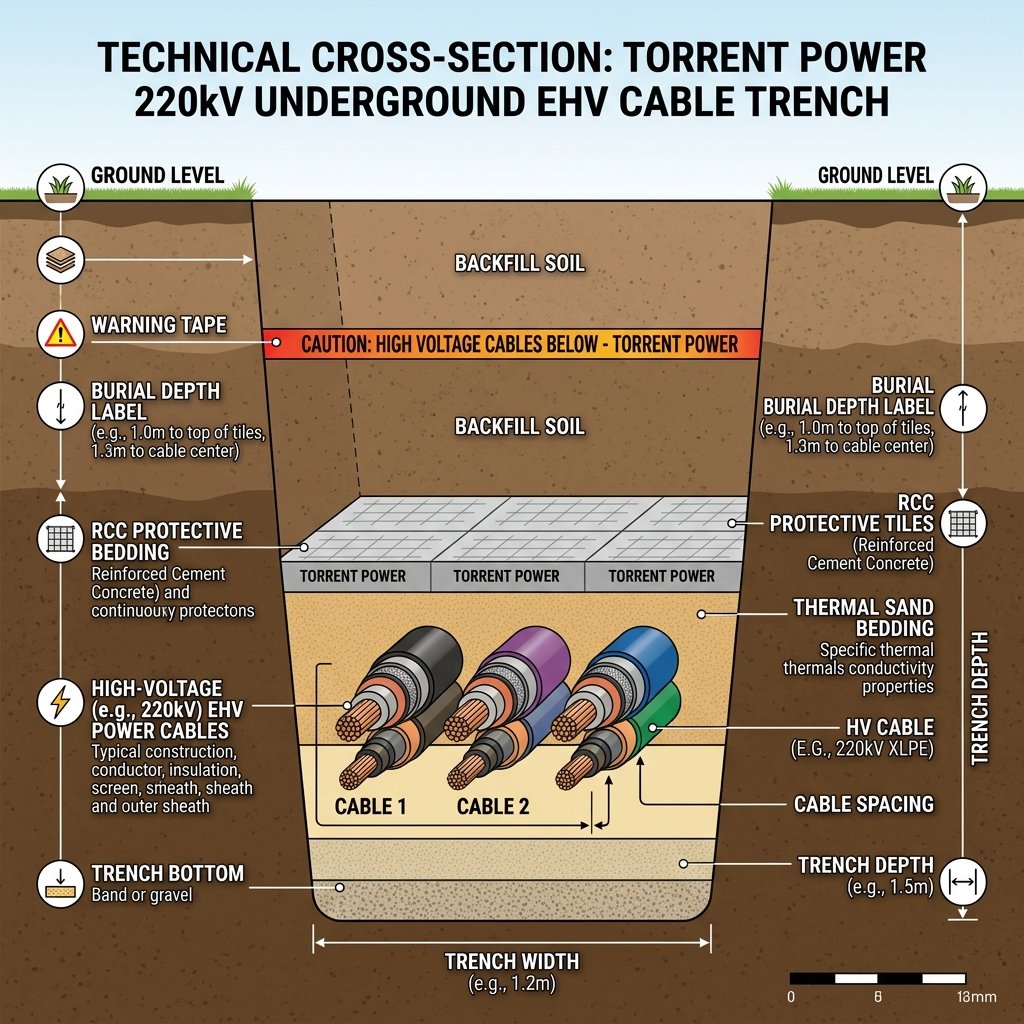
1. Regulated Burial Depths Across Voltage Classes
Underground cable trench depths are calculated from finished ground level (FGL) or road crown level to the center of the buried cable:
- Low Voltage (LV – 415V / 240V Service Cables): Minimum burial depth of 0.90 meters (900mm).
- Medium Voltage (MV – 11kV / 33kV Distribution Feeder): Minimum burial depth of 1.20 meters (1,200mm).
- High Voltage & Extra High Voltage (HV/EHV – 66kV / 220kV Transmission): Minimum burial depth of 1.50 meters (1,500mm).
- Road & Railway Crossings: Cables crossing under major road Right-of-Way (RoW) or rail tracks must be housed inside heavy-duty RCC/HDPE duct banks buried at a depth of 1.50 to 2.0 meters.
2. Trench Cross-Section: Sand Bedding & RCC Protective Tiles
To protect underground cables against soil movement, sharp stones, and heavy vehicle traffic loads:
- 75mm Thermal Sand Bedding: Cables must be cushioned above and below by a 75mm layer of well-compacted, sieved thermal sand (thermal resistivity $\le 1.2\text{ K}\cdot\text{m/W}$) to facilitate heat dissipation away from the conductors.
- Interlocking RCC Protective Cover Tiles: Heavy-duty precast Reinforced Cement Concrete (RCC) cover tiles (minimum 50mm thick, stamped with “TORRENT POWER EHV CABLE”) must be laid continuously above the upper sand bed layer to shield cables from mechanical excavator buckets.
- Bright Red Polyethylene Warning Tape: A high-visibility warning tape printed with “CAUTION: HIGH VOLTAGE CABLE BELOW” must be laid 300mm above the RCC protective tiles (approximately 500mm below ground surface) to alert diggers.
The table below outlines Torrent Power underground cable trench specifications:
| Cable Voltage Rating | Min. Burial Depth (to Cable Center) | Min. Trench Width (Single Cable) | Thermal Sand Cushion Bedding | Mechanical Cover Protection | Underground Warning Tape Depth |
|---|---|---|---|---|---|
| **LT 415V Service Line** | 0.90 Meters (900mm) | 450 mm | 75mm Sand Layer | Precast Concrete Bricks | 300mm below surface |
| **11kV Distribution Loop** | 1.20 Meters (1,200mm) | 600 mm | 75mm Sand Layer | Interlocking RCC Tiles (50mm) | 500mm below surface |
| **33kV Primary Feeder** | 1.20 Meters (1,200mm) | 750 mm | 100mm Sand Layer | Heavy-Duty Interlocking RCC Tiles | 500mm below surface |
| **66kV / 220kV EHV Line** | 1.50 Meters (1,500mm) | 1,000 mm | 150mm Sand Layer | Reinforced RCC Slab Cover (100mm) | 600mm below surface |
3. Minimum Utility Clearance & Separation Margins
To prevent thermal interference and avoid cross-utility damage:
- Separation from Telecom Ducts: High-voltage power cables must maintain a minimum physical clearance of at least 0.50 meters (500mm) from parallel fiber-optic telecommunication ducts.
- Separation from Water / Gas Pipelines: Power cables must be separated by at least 0.60 meters (600mm) from parallel water supply or gas mains, always running above sewer/drainage lines and below telecommunication conduits.
- Dholera Smart Utility Ducts: Along major arterial roads, cables are housed in dedicated multi-tier concrete utility duct trenches built under DICDL master plans, eliminating the need for open road trenching.
Frequently Asked Questions (FAQ)
#### What is the standard trench depth for 33kV distribution cables in Dholera?
Under Torrent Power and DSIRDA installation codes, 11kV and 33kV power cables must be buried at a minimum depth of 1.20 meters (1,200mm) from ground level.
#### Why is thermal sand placed around underground cables in Dholera?
Cables are surrounded by a 75mm to 150mm thermal sand cushion to protect cable insulation from sharp stones and efficiently dissipate operational heat into the surrounding soil.
#### What physical protection prevents excavators from severing power cables?
Interlocking precast RCC protective cover tiles are laid continuously above the sand bed, backed by a bright red warning tape installed 300mm higher up in the trench.
Download Dholera SIR 2026 Investor’s Kit
Get instant access to the official planning documents: Dholera Investment Handbook (PDF), 2026 Land Price List, TP Zone & Village Map, and the NRI Buying Guide.



Join The Discussion