

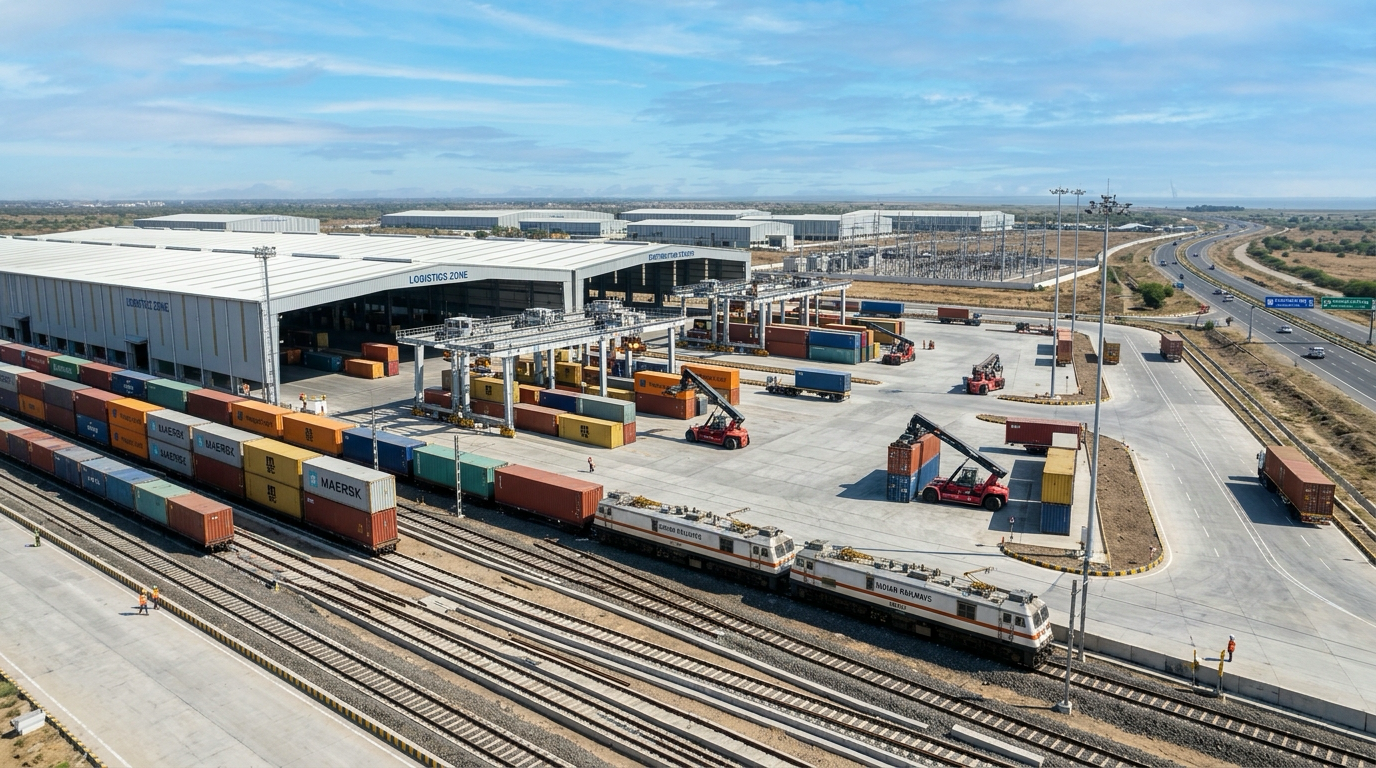
For bulk industrial manufacturers—such as cement grinding units, steel re-rolling mills, chemical fertilizer importers, automotive container logistics operators, and grain terminal operators—rail freight remains the most cost-effective and carbon-efficient mode of long-distance cargo movement in India. Moving bulk cargo via rail typically costs ₹1.40 to ₹1.70 per tonne-kilometer versus ₹3.20 to ₹4.50 per tonne-kilometer via road haulage, offering annual freight savings in the tens of crores for high-volume enterprises.
Within the Dholera Special Investment Region (DSIR), the commissioning of the Bhimnath-Dholera Broad-Gauge Railway Line (connecting Western Railway’s Botad-Ahmedabad trunk route directly into the heart of Dholera’s industrial activation zone) has unlocked private railway siding feasibility for industrial conglomerates. Under Indian Railways’ PM Gati Shakti Multi-Modal Cargo Terminal (GCT) Policy (2022), private industrial enterprises can construct, operate, and maintain dedicated rail sidings directly into their factory compounds with streamlined statutory approvals.
This technical guide outlines the civil engineering parameters, Western Railway approval protocols, land acquisition geometry, and valuation benchmarks required to site a private railway siding or GCT terminal in Dholera SIR.
1. The Strategic Backbone: Bhimnath-Dholera Rail Link
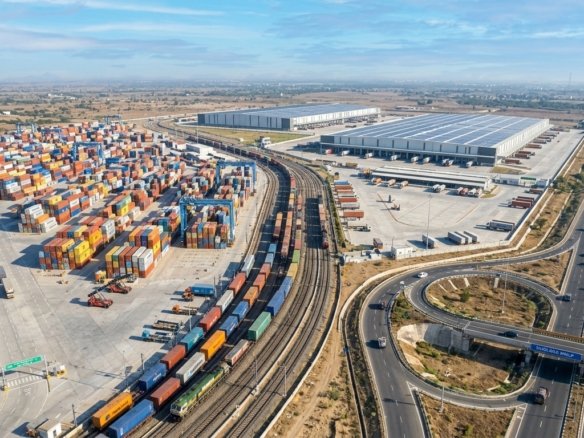
The Bhimnath-Dholera broad-gauge link bridges DSIR with India’s Western Dedicated Freight Corridor (WDFC) network, providing unhindered heavy-haul rail access to major seaports (Pipavav, Kandla, Mundra) and the northern industrial hinterland (Delhi-NCR, Haryana, Punjab).
“` +———————————————————————————–+ | BHIMNATH-DHOLERA FREIGHT CONNECTIVITY ARCHITECTURE | +———————————————————————————–+
| Western Railway Trunk Line (Ahmedabad – Botad) | |
|---|---|
| v | |
| Bhimnath Junction (Existing Marshalling & Operational Yard) | |
| +==================== [23.5 km Dedicated Broad-Gauge Link] =================+ | | | v v | Dholera Central Cargo Terminal (TP2) Private Industrial Sidings | (Container Depot & Bulk Yard) (Steel, Cement, Automotive) +———————————————————————————–+ “`
Key Rail Specifications
- Gauge: 1,676 mm Indian Broad Gauge.
- Axle Load Capacity: 25-Tonne axle load standard (compliant with heavy bulk mineral and container wagons).
- Traction: 25 kV AC Electrified railway corridor, enabling end-to-end electric locomotive haulage without engine changes.
- Signaling: Electronic Interlocking with Centralized Traffic Control (CTC) integration.
2. Engineering Parameters for Private Railway Sidings
Designing a private railway siding off the Bhimnath-Dholera alignment requires compliance with the Indian Railways Engineering Code and Western Railway operational standards:
| Engineering Parameter | Western Railway Standard | Siting & Land Impact in DSIR |
|---|---|---|
| Minimum Track Length (Full Rake) | 750 Meters to 850 Meters (Clear Standing Length) | Requires a contiguous parcel length of at least 900m to 1,200m |
| Maximum Permissible Gradient | 1 in 400 (desirable), 1 in 260 (limiting) | Favorable flat terrain across Dholera requires minimal earthwork grading |
| Maximum Degree of Curvature | $5.0^\circ$ (Radius $\ge 350\text{ meters}$) | Requires wide curve easements when taking off from the main rail spine |
| Turnout Angle | 1 in 12 (high-speed) or 1 in 8.5 (yard turnouts) | Governs the geometric footprint of the rail take-off junction |
| Track Center-to-Center Spacing | Minimum 5.30 Meters | Multi-track loading requires 15m to 25m wide operational rail strips |
| Platform Clearance (Fouling Mark) | Minimum 2.36 Meters from track center | Demarcates safe crane movement and forklift loading perimeters |
3. Land Geometry & Parcel Sizing for Railway-Connected Plots
A common mistake in industrial rail planning is acquiring a square plot that lacks the longitudinal dimension needed to accommodate a full rake length (typically 58 to 61 wagons, representing ~700 meters of train length):
“` +——————————————————————————-+ | OPTIMAL PRIVATE SIDING LAND PARCEL GEOMETRY | +——————————————————————————-+
| \ | ||
| \_______ Lead-in Curve (R >= 350m) | ||
| \___________________________________________________________ | ||
| In-Plant Full Rake Siding Track (750m – 850m CSL) | ||
| =========================================================== | ||
| Parallel Unloading Wharf / Platform (25m – 30m width) | ||
| Manufacturing Plant / Bulk Silos / Storage Warehouses | ||
| +———————————————————–+ | ||
| Optimal Plot Dimensions: 1,000m to 1,400m Length x 250m to 400m Width | ||
| Minimum Contiguous Area: 35 to 80+ Acres |
+——————————————————————————-+ “`
4. Land Valuation Matrix: Rail-Accessible Corridors
Land parcels abutting or within 1.5 km of the Bhimnath-Dholera rail alignment enjoy strong logistics value:
| Location / Corridor Sector | Proximity to Rail Spine | NA Clear Valuation Band (₹/Sq. Yd) | Price Per Acre Range (₹ Cr) |
|---|---|---|---|
| TP2 Rail Freight Terminal Zone | Direct Abutment ($< 500\text{ m}$) | ₹3,800 – ₹5,800 / sq. yard | ₹1.84 Cr – ₹2.81 Cr / Acre |
| TP4 Western Siding Corridor | Direct Abutment ($< 500\text{ m}$) | ₹2,800 – ₹4,200 / sq. yard | ₹1.35 Cr – ₹2.03 Cr / Acre |
| Bhimnath Junction Feeder Land | Within 1.5 km of Station | ₹2,200 – ₹3,400 / sq. yard | ₹1.06 Cr – ₹1.65 Cr / Acre |
| Secondary Logistics Buffer | 1.5 km to 3.0 km from Line | ₹1,600 – ₹2,500 / sq. yard | ₹0.77 Cr – ₹1.21 Cr / Acre |
5. Regulatory Approvals & Gati Shakti Cargo Terminal (GCT) Process
Under the Gati Shakti Multi-Modal Cargo Terminal Policy (2022), Western Railway has eliminated legacy revenue sharing and upfront land license fees on private land, dramatically simplifying the approval pipeline:
“` +——————————————————————————-+ | PRIVATE SIDING / GCT APPROVAL WORKFLOW (WESTERN RAILWAY) | +——————————————————————————-+
| Step 1: Feasibility Study & Conceptual Alignment Plan (CAP) |
|---|
| Step 3: In-Principle Approval (IPA) by Western Railway (Typically 30-45 Days) |
| Step 4: Submission of Detailed Engineering Survey (DES) & Engineering Scale |
| Plan (ESP) with Signalling & Interlocking Interconnection Scheme |
| Step 5: Land Boundary Verification & Western Railway Right-of-Way Agreement |
| Step 6: Construction of Track Bed, Ballast, Sleepers, and 25kV OHE Masts |
| Step 7: Inspection and Safety Certification by Commissioner of Railway Safety |
| Step 8: Commercial Notification & Commissioning of Private Siding |
+——————————————————————————-+ “`
6. Due Diligence: Revenue Land Integrity & RERA Clarity
Developing an industrial rail siding requires linear land aggregation, necessitating rigorous legal due diligence under Gujarat revenue law:
- AnyROR 7/12 & 8-A Title Verification: Every agricultural survey number within the siding take-off path must possess an unbroken 30-year search history. Ensure no co-sharer disputes, unresolved heirship entries, or pending agricultural debt charges exist on title.
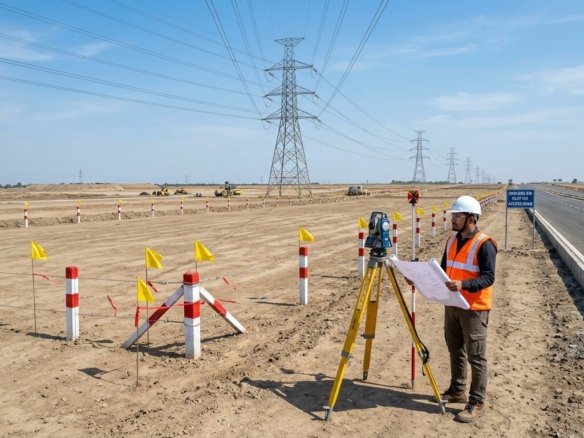
- Linear Right-of-Way (RoW) Continuity: Siding projects fail if even a single intermediary survey number refuses conveyance. Aggregating contiguous parcels under registered agreements to sell with irrevocability clauses is vital.
- NA-Industrial Conversion (Section 65): Agricultural revenue parcels must undergo formal Non-Agricultural conversion for industrial infrastructure use under Section 65 of the Gujarat Land Revenue Code, accompanied by DSIRDA development permission.
- Zero RERA Ambiguity: As clearly established under Gujarat real estate law, GujRERA has no jurisdiction over industrial land purchases, railway siding alignments, or raw revenue land acquisitions. GujRERA applies solely to residential and retail commercial plotted developments. Private rail siding land transactions are governed strictly by the Gujarat Revenue Department, the District Collector, and Western Railway statutory codes.
Frequently Asked Questions (FAQs)
1. Does Indian Railways charge land license fees for sidings built on private land?
No. Under the Gati Shakti Cargo Terminal (GCT) Policy 2022, sidings constructed entirely on privately owned land are exempt from land licensing fees, and railways does not claim a share of terminal charges.
2. Can multiple industrial units share a common private railway siding?
Yes. The GCT Policy explicitly allows the terminal developer to offer third-party logistics access, permitting neighboring factories in TP2 or TP4 to handle cargo on a shared-user tolling basis.
3. What is the typical gestation period for constructing a private railway siding?
From In-Principle Approval (IPA) and ESP sanction to physical track-laying, overhead electrification, and Commissioner of Railway Safety (CRS) clearance, typical execution spans 12 to 18 months.
Acquire Rail-Connected Industrial Land with Dholera Acres
Dholera Acres provides strategic land acquisition and aggregation services for industrial enterprises requiring dedicated rail connectivity:
- Linear Contiguous Parcels: 30 to 100+ acre parcels with verified rail mainline frontage.
- Title Due Diligence & AnyROR Verification: Bank-certified 30-year search reports across all survey numbers.
- Western Railway Liaison & Siting: Complete advisory from preliminary alignment to DSIRDA NA approvals.
Industrial Logistics Advisory: Call +91 9328742003 or email dholeraacres@gmail.com to inspect surveyed railway siding land parcels in Dholera SIR.
Download Dholera SIR 2026 Investor’s Kit
Get instant access to the official planning documents: Dholera Investment Handbook (PDF), 2026 Land Price List, TP Zone & Village Map, and the NRI Buying Guide.

Join The Discussion