

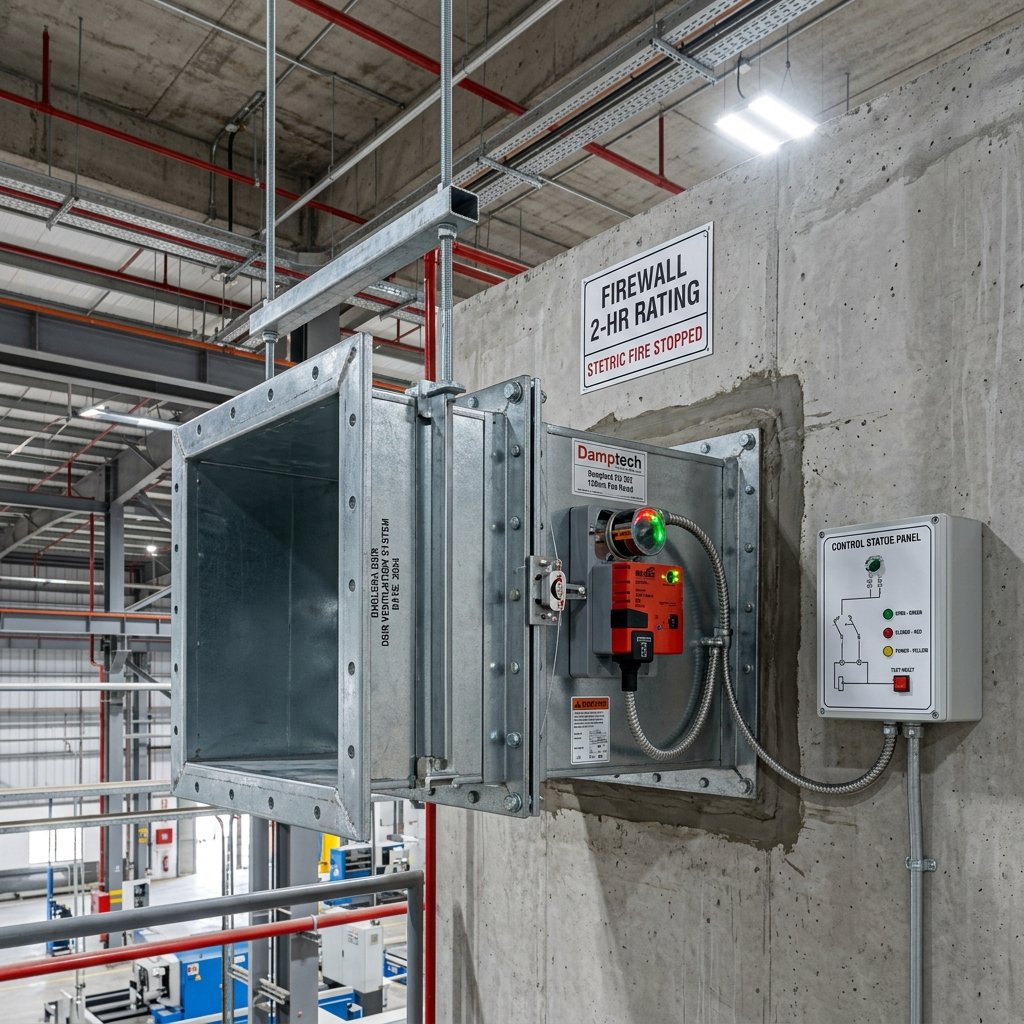

1. Statutory Fire Separation Standards in Dholera Industrial Plots
The statutory framework governing duct penetrations through fire barriers enforces strict mechanical integrity criteria:
| Standard / Authority | Regulatory Mandate | Specific Application in Dholera Factories |
|---|---|---|
| **NBC 2016 Part 4 (Table 1 & Sec 3.4.10)** | Fire Compartmentation & Duct Penetrations | Mandates certified fire dampers at every penetration of a 2-hour or greater fire-rated barrier. |
| **UL 555 & UL 555S** | Fire Endurance & Dynamic Smoke Leakage | Standard for 1.5-hr to 3-hr fire endurance and Class I dynamic smoke leakage under active airflow. |
| **IS 3614 / IS 1642** | Indian Standard for Fire Doors and Dampers | Governs thermal insulation, flame penetration resistance, and structural stability under high temperature. |
| **DSIRDA GDCR (Industrial Safety Section)** | HVAC Emergency Fire Shutdown Integration | Mandates that all motorized dampers communicate open/closed positional telemetry to plant BMS and central SCADA. |
2. Mechanical Construction & Material Metallurgy
To withstand extreme thermal shock exceeding 1,000°C without blade warping or frame dislodgement, fire dampers in Dholera industrial facilities must meet rigid metallurgical benchmarks:
| Damper Component | Minimum Engineering Material Specification | Performance Requirement under Thermal Load |
|---|---|---|
| **Damper Outer Sleeve** | Minimum **1.60 mm (16 Gauge) Galvanized Steel (GI)** or SS 304 | Extends minimum 150 mm beyond both sides of the concrete firewall to house actuator and linkage. |
| **Damper Blades** | Multi-Blade Airfoil Profile, **1.5 mm GI / SS 316** Interlocking | Double-skin airfoil profile minimizing airflow static pressure drop ($\Delta P \le 25\text{ Pa}$) during normal operation. |
| **Blade Edge Seals** | Extruded Silicone or Flexible Stainless Steel Spring Seals | Resists smoke migration up to 250°C; satisfies UL 555S **Class I or II Leakage** limits ($< 4.0\text{ cfm/ft}^2$). |
| **Bearings & Pivot Pins** | Sintered Bronze / Stainless Steel Oil-Impregnated Bushings | Eliminates seizure risks across decadal standby periods in Dholera’s humid coastal saline air. |
| **Perimeter Thermal Packing** | Ceramic Fiber Blanket ($128\text{ kg/m}^3$) + Firestop Intumescent Sealant | Fills the 25 mm perimeter annular expansion gap between the sleeve and the concrete wall opening. |
3. Dual-Action Actuation & Fusible Link Staging
Under NBC 2016 Part 4, fire dampers installed in modern semiconductor, electronics, and automotive plants cannot rely solely on passive gravity or manual fusible links. They must operate via coordinated dual-action triggers:
“` +———————————————————————————–+ | INDUSTRIAL MOTORIZED FIRE & SMOKE DAMPER (MFSD) TRACE ARCHITECTURE | +———————————————————————————–+
| Optical smoke sensor detects particulate -> Transmits 24V DC cut-off to actuator | |
| v | |
| High-Torque Spring-Return Actuator isolates blades within < 15 seconds | |
| ============================== OR ============================== | |
| [ Secondary Failsafe: Thermal Fusible Link Overheat ] | |
| Air temperature in duct reaches 72°C (Standard) or 93°C (Process Exhaust) | |
| v | |
| Alloy pellet melts -> Mechanical tension spring drives blades shut instantly (< 2s) |
+———————————————————————————–+ “`
Thermal Fusible Link Rating Criteria:
- General HVAC & Supply Air Ducts: Calibrated at $72^\circ\text{C} \pm 2^\circ\text{C}$ ($162^\circ\text{F}$).
- High-Heat Process Exhaust (Boilers, Curing Ovens, Solder Reflow): Calibrated at $93^\circ\text{C}$ to $141^\circ\text{C}$ ($200^\circ\text{F}\text{ to }286^\circ\text{F}$) to prevent false trips during normal thermal exhaust spikes.
4. Damper Penetration Hierarchy by Building Compartment
Different industrial spaces require specific fire ratings depending on fire load density under NBC hazard classifications:
| Factory Zone / Wall Penetration | Wall Fire-Resistance Rating | Mandatory Damper Fire Rating | Dynamic Airflow Rating |
|---|---|---|---|
| **Cleanroom Fab Core to Service Chase** | 2 Hours ($120\text{ min}$) | **2 Hours (UL 555 Certified)** | Dynamic ($2,000\text{ FPM}$ at $4.0\text{ in. wg}$) |
| **Hazardous Chemical / Solvent Storage Rooms** | 3 Hours ($180\text{ min}$) | **3 Hours (UL 555 Certified)** | Dynamic ($3,000\text{ FPM}$ at $4.0\text{ in. wg}$) |
| **Main Plant Floor to Office / Admin Block** | 2 Hours ($120\text{ min}$) | **2 Hours (UL 555 Certified)** | Static or Dynamic ($2,000\text{ FPM}$) |
| **Main Electrical Substation & Transformer Vaults** | 3 Hours ($180\text{ min}$) | **3 Hours (UL 555 Certified)** | Dynamic with Gas Fire Suppression Interlock |
| **Vertical Ventilation Shafts & Service Risers** | 2 Hours ($120\text{ min}$) | **2 Hours (UL 555 Certified)** | Dynamic Smoke Exhaust Rated |
5. Inspection, Testing & Maintenance (ITM) Protocols
Under the Gujarat Fire Prevention and Life Safety Measures Act, industrial plant managers in Dholera must maintain strict inspection logs:
- Commissioning Test: Following mechanical installation, dampers must undergo dynamic operational testing verifying full blade closure under operating ventilation velocity within $< 15\text{ seconds}$.
- Semi-Annual Functional Cycling: Maintenance teams must test motorized dampers at least twice per year, utilizing the local external test switch to verify spring-return closure and feedback signal transmission to the central BMS.
- Visual Annular Inspection: Inspect perimeter intumescent firestop mastic to confirm zero cracks, settling, or moisture debonding caused by ambient temperature swings in Dholera.
Frequently Asked Questions (FAQ)
What is the minimum fire rating required for HVAC fire dampers in Dholera factories?
Under NBC 2016 Part 4 and DSIRDA fire bylaws, ducts traversing standard fire-rated compartment walls require a minimum 2-hour fire-rated damper. For hazardous chemical enclosures, transformer rooms, and boiler houses, a 3-hour fire rating is mandatory.What is the difference between a static and a dynamic fire damper?
A static fire damper is certified to close only when the ventilation fans shut down automatically upon fire alarm. A dynamic fire damper is engineered with heavy-duty internal spring linkages capable of forcing blades shut against active high-velocity airflow (up to 2,000 to 4,000 FPM) if fans fail to stop.At what temperature do fusible links melt in Dholera industrial dampers?
Standard comfort HVAC and supply ducts use fusible links calibrated at 72°C (162°F). High-temperature industrial process exhausts, industrial kitchens, and curing oven exhaust ducts utilize higher-rated links calibrated at 93°C (200°F) or 141°C (286°F) to avoid nuisance trips.Can flexible duct connectors pass through a fire separation wall?
No. Flexible canvas or vinyl duct connectors are strictly forbidden from passing through any fire-rated wall or floor barrier. Dampers must be housed inside a rigid steel sleeve (minimum 1.6 mm thickness) solidly anchored and fire-stopped within the structural concrete opening.How do motorized fire dampers integrate with Dholera smart factory systems?
Motorized dampers feature micro-switch auxiliary contacts wired to the factory Building Management System (BMS) and fire alarm panel (FACP), providing real-time telemetry confirming blade status (Open, Closed, or Tripped) for immediate operator visibility.Download Dholera SIR 2026 Investor’s Kit
Get instant access to the official planning documents: Dholera Investment Handbook (PDF), 2026 Land Price List, TP Zone & Village Map, and the NRI Buying Guide.

Join The Discussion