

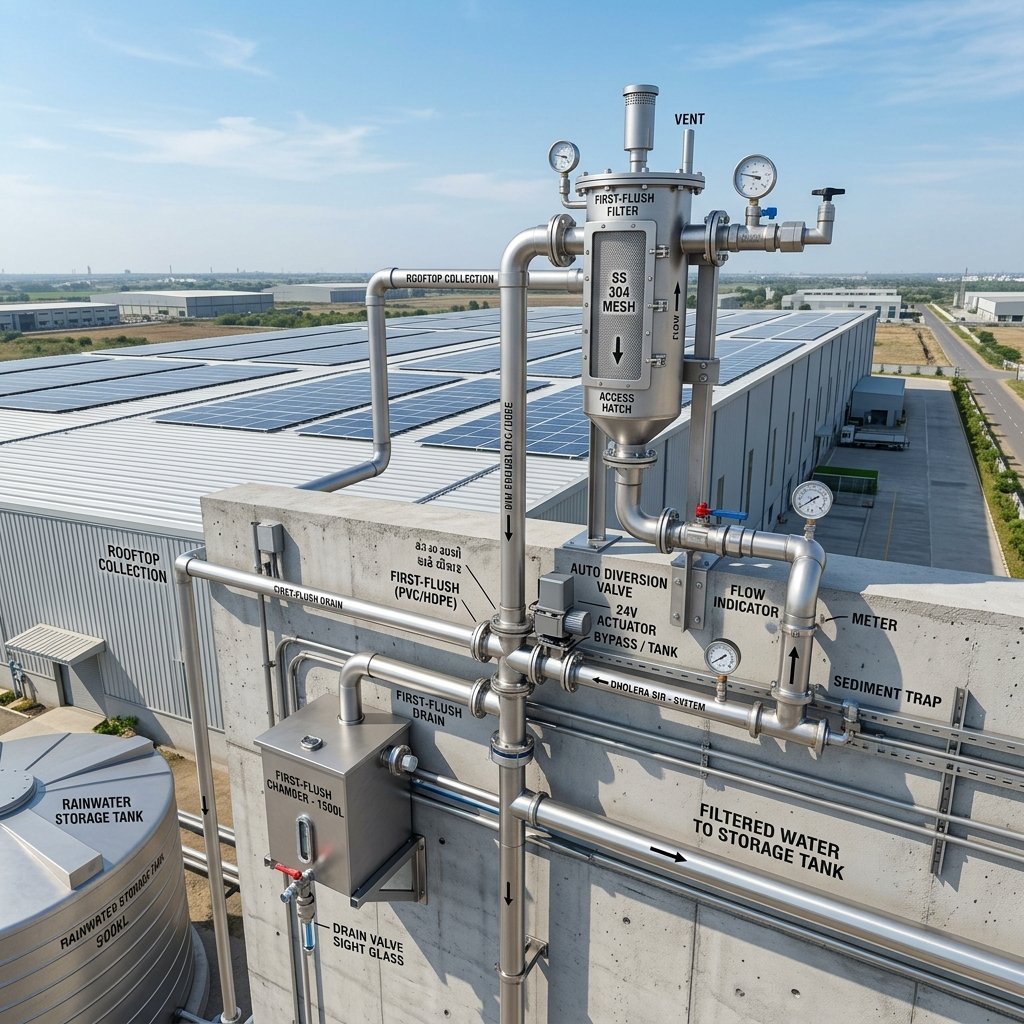

1. Statutory RWH Filtration Standards in Dholera SIR
The design of rooftop harvesting filters is governed by national building codes and municipal bylaws:
| Standard / Regulatory Code | Statutory Mandate in Dholera SIR | Technical Compliance Metric |
|---|---|---|
| **DSIRDA GDCR Section 10.8** | Mandatory Rainwater Harvesting & Recharge | Requires 1 recharge well per $1,000\text{ m}^2$ of plot area, fed by filtered rooftop runoff. |
| **IS 15797:2008** | Roof Top Rainwater Harvesting Guidelines | Prescribes first-flush diversion, self-cleaning mesh strainers, and settlement tank retention times. |
| **NBC 2016 Part 9 Section 5** | Plumbing Services & Drainage Systems | Governs downcomer pipe hydraulic capacity, rainwater gutter slopes (minimum 1:100), and overflow weirs. |
| **GPCB Environmental Guidelines** | Prevention of Subsurface Aquifer Contamination | Strictly prohibits ground recharge of industrial yard/shop-floor runoff; restricts recharge to certified clean roofs. |
2. First-Flush Diverter Volumetric Sizing Formula
The primary defense against particulate ingress is the automatic mechanical first-flush diverter, which traps the heavily contaminated initial rainfall wash before directing clean water to the filter mesh.
Under DSIRDA coastal arid design parameters, the required first-flush diversion volume ($V_{ff}$) is calculated as:
$$V_{ff} = A_{roof} \times d_{flush}$$
Where: * $A_{roof}$ = Effective horizontal catchment area of the building terrace ($m^2$). * $d_{flush}$ = Statutory first-flush depth allowance. While wet tropical zones use 0.5 to 1.0 mm, Dholera’s dusty coastal climate mandates $d_{flush} = 1.5\text{ to }2.0\text{ mm}$ ($0.0015\text{ to }0.0020\text{ m}$).
$$\text{Example (Industrial Fab with } 5,000\text{ m}^2\text{ Roof): } V_{ff} = 5,000 \times 0.0020 = 10.0\text{ m}^3 = 10,000\text{ Liters}$$
Operating Mechanism:
The first-flush diverter utilizes a vertical PVC/SS chamber with a calibrated internal hollow polyurethane float ball. As the first 10,000 liters of silt-laden water enter, the chamber fills by gravity, raising the float ball until it seats against a top nitrile rubber sealing gasket. Once seated, all subsequent clean rainwater bypasses the chamber and flows horizontally into the fine stainless steel mesh filter.
3. Filter Mesh Aperture & Material Specifications
Following first-flush diversion, the secondary filtration chamber must remove suspended solids ($> 100\ \mu\text{m}$) without inducing hydraulic backpressure or causing premature surface blinding:
| Filter Layer / Component | Engineering Material Standard | Mesh Aperture / Grain Rating | Function in Dholera RWH Architecture |
|---|---|---|---|
| **Primary Parapet Dome Strainer** | UV-Stabilized Cast Aluminum or Ductile Iron | 10 mm to 15 mm Slotted Vane | Prevents large debris, leaves, and building trash from entering the vertical downcomers. |
| **Secondary Wedge Wire Screen** | Austenitic Stainless Steel SS 304 / SS 316 | **150 to 200 Microns** (70 to 100 Mesh) | Continuous V-shaped slot profile; resists clogging from airborne desert dust particles. |
| **Polishing Micro-Screen (Storage)** | Food-Grade SS 316L Woven Wire Cloth | **100 Microns** (140 Mesh) | High-efficiency mechanical polishing for water routed to factory cooling tower backup sumps. |
| **Desilting Media Filter Bed** | Silica Sand + Graded Gravel + Activated Carbon | Effective Size: $0.45\text{ to }0.70\text{ mm}$, Sand Depth: $400\text{ mm}$ | Polishing gravity media bed located inside the underground recharge well header chamber. |
4. Terrace Downcomer Pipe Sizing & Peak Runoff Hydraulics
To prevent terrace ponding during Dholera’s monsoon storm bursts, downcomer pipes must be sized for a peak rainfall intensity of $75\text{ mm/hour}$ using the Rational Method:
$$Q = \frac{C \times I \times A_{roof}}{360}$$
Where: * $Q$ = Peak stormwater discharge ($L/s$). * $C$ = Runoff coefficient ($0.90\text{ to }0.95$ for non-absorbent concrete terraces or metal roofing sheets). * $I$ = Design peak rainfall intensity ($75\text{ mm/hr}$ for Dholera 1-in-10-year storm curve). * $A_{roof}$ = Terrace catchment area ($m^2$).
Statutory Downcomer Sizing Table (IS 1742 / NBC 2016):
| Internal Pipe Diameter (NB) | Pipe Material Standard | Maximum Terrace Catchment Area Served | Maximum Discharge Flow Capacity ($Q$) |
|---|---|---|---|
| **75 mm (3″)** | Heavy-Duty uPVC / SWR Class B | Up to $115\text{ m}^2$ | $2.2\text{ L/s}$ ($132\text{ LPM}$) |
| **110 mm (4″)** | Heavy-Duty uPVC / SWR Class B | Up to $275\text{ m}^2$ | $5.3\text{ L/s}$ ($318\text{ LPM}$) |
| **160 mm (6″)** | HDPE PE100 PN10 or uPVC | Up to $700\text{ m}^2$ | $13.5\text{ L/s}$ ($810\text{ LPM}$) |
| **200 mm (8″)** | HDPE PE100 PN10 or Ductile Iron | Up to $1,350\text{ m}^2$ | $26.0\text{ L/s}$ ($1,560\text{ LPM}$) |
5. Subsurface Desilting Chamber & Dual Recharge Well
Due to Dholera’s impermeable marine clay surface layer, rainwater cannot be absorbed via simple shallow soak pits. Filtered water must be channeled into a deep bored recharge well passing through the clay layer to reach semi-confined sand aquifers:
“` +——————————————————————————-+ | ROOFTOP RUNOFF COLLECTION & SUBTERRANEAN FILTRATION SYSTEM (DSIRDA GDCR) | +——————————————————————————-+ | (75 mm/hr Storm Burst across Factory Terrace) v +——————————————————————————-+ | Roof Gutter with UV-Stabilized Aluminum Dome Strainers (12 mm Openings) | +——————————————————————————-+ | v +——————————————————————————-+ | Vertical uPVC Downcomer with 1.5 – 2.0 mm Automatic First-Flush Chamber | +——————————————————————————-+ | (Clean Post-Flush Water Flow to Pre-Filter) v +——————————————————————————-+ | Inline SS 304 Wedge Wire Filter Unit (150 – 200 Micron Self-Cleaning Mesh) | +——————————————————————————-+ | v +——————————————————————————-+ | Dual-Chamber RCC Desilting Tank (M30 Grade, Minimum 30-Minute Hydraulic Head) | +——————————————————————————-+ | v +——————————————————————————-+ | Bored Recharge Well (Slotted Invert Screen reaching Sandy Strata at 25-40m) | +——————————————————————————-+ “`
Frequently Asked Questions (FAQ)
What is the mandatory first-flush volume for buildings in Dholera SIR?
Under DSIRDA and CGWB specifications for Dholera’s arid coastal conditions, the first-flush diverter must hold at least 1.5 to 2.0 mm of rainfall multiplied by the horizontal terrace area. This washes away high concentrations of airborne saline dust and industrial particulates before filtration.What wire mesh aperture is required for rooftop rainwater harvesting filters?
The secondary mechanical filter requires a stainless steel SS 304 or SS 316 screen with an aperture rating of 150 to 200 microns (70 to 100 mesh). For storage destined for industrial boiler or cooling tower use, a 100-micron polish screen is utilized.Can factory surface yard runoff be diverted to rainwater recharge wells?
No. GPCB and DSIRDA regulations strictly forbid mixing paved ground surface runoff (which may contain vehicular oil, grease, or chemical residues) with rooftop rainwater. Only certified clean non-traffic roof catchments are permitted to recharge groundwater.What pipe material is approved for rainwater downcomers in Dholera?
Approved materials include heavy-duty lead-free unplasticized Polyvinyl Chloride (uPVC Type B under IS 13592), High-Density Polyethylene (HDPE PE100 PN10), and Cast Iron/Ductile Iron (IS 3989) with corrosion-resistant exterior coatings.Why are deep recharge wells necessary instead of traditional shallow soak pits in Dholera?
Dholera’s near-surface soil consists of dense, impermeable marine black cotton clay with extremely low percolation rates. Shallow soak pits quickly fill up and fail. Recharge wells must be drilled 25 to 40 meters deep to penetrate through the clay barrier into permeable sand strata.Download Dholera SIR 2026 Investor’s Kit
Get instant access to the official planning documents: Dholera Investment Handbook (PDF), 2026 Land Price List, TP Zone & Village Map, and the NRI Buying Guide.

Join The Discussion