

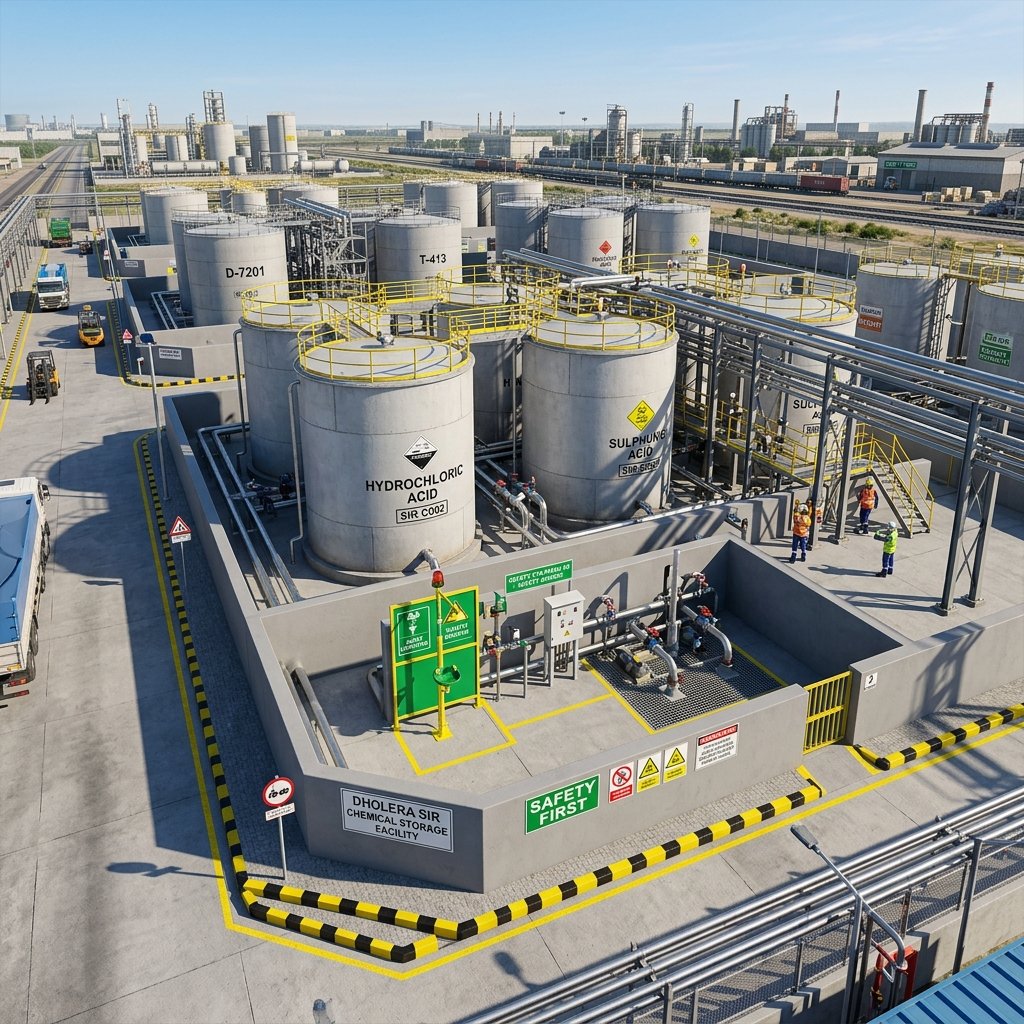

1. Statutory Containment Framework in Dholera SIR
Industrial facilities in Dholera must comply with a hierarchy of environmental and building safety codes:
| Regulatory Authority / Code | Regulatory Mandate | Specific Application in Dholera Plots |
|---|---|---|
| **GPCB (Water & Air Acts / Hazmat Rules)** | Zero Liquid Discharge (ZLD) Compliance | Mandates physical segregation of chemical spill runoff from common stormwater and domestic effluent drains. |
| **DSIRDA GDCR (Hazardous Industry Section)** | Spatial Setbacks & Structural Fireproofing | Prescribes minimum 15-meter buffer setbacks from plot boundaries for bulk solvent/acid dyke enclosures. |
| **MSIHC Rules (1989 & Amendments)** | On-Site Emergency Plan & Secondary Dykes | Mandates impenetrable secondary containment for toxic, flammable, and corrosive chemicals exceeding threshold quantities. |
| **IS 4991 / NFPA 30 (Flammable Liquids Code)** | Tank Spacing and Bund Wall Stability | Governs hydrostatic pressure resistance and fire-resistant reinforced cement concrete (RCC) construction for containment bunds. |
| **DICDL ICT & Smart City SCADA** | Environmental Monitoring Telemetry | Requires hazardous chemical containment sumps to connect optical level sensors to the ABCD Building Central Command Center. |
2. Bund Wall Sizing Formulas & Capacity Mathematics
Secondary containment dykes must be dimensioned to capture sudden cataclysmic tank ruptures, violent splashes, and simultaneous 24-hour peak precipitation.
Under GPCB and international chemical safety engineering standards, the net containment volume ($V_{containment}$) is defined by the following rule:
$$V_{containment} \ge \max\left(1.10 \times V_{largest\_tank}, \quad 0.25 \times \sum_{i=1}^{n} V_{tank\_i} + V_{rain}\right)$$
Where: * $V_{largest\_tank}$ = Liquid storage volume of the single largest storage vessel located within the bunded enclosure ($m^3$). * $\sum V_{tank\_i}$ = Combined aggregate volume of all storage tanks within the shared containment dyke ($m^3$). * $V_{rain}$ = Additional volumetric buffer for a 1-in-25-year 24-hour storm event ($120\text{ mm}$ for Dholera coastal region) falling across the footprint area of the bund enclosure.
Calculation of Effective Dyke Wall Height ($H_{bund}$):
The required structural wall height is derived after subtracting the displacement volume of other tank foundations, piping stools, and equipment footings:
$$H_{bund} = \frac{V_{containment} + V_{displacement}}{A_{bund\_footprint}} + F$$
Where: * $A_{bund\_footprint}$ = Clear interior plan area of the containment compound ($m^2$). * $V_{displacement}$ = Total volume displaced by submerged tank bases, concrete plinths, and structural piers up to the spill liquid line ($m^3$). * $F$ = Standard regulatory freeboard allowance (minimum 0.15 m to 0.30 m to prevent wind-induced wave sloshing over the crest).
Under DSIRDA GDCR, the maximum height of a human-accessible bund wall is capped at 1.80 meters to ensure adequate natural ventilation and safe operator egress via exterior and interior non-slip RCC staircases.
3. Civil Structural & Anti-Corrosion Liner Specifications
Because the soil in Dholera SIR is saline marine clay with elevated sulfate and chloride levels, the exterior of containment foundations and the interior chemical-wetted surfaces must meet rigorous material standards:
| Structural Component | Material / Engineering Specification | Functional Objective in Dholera Coastal Environment |
|---|---|---|
| **Primary Structural Basin** | M35 to M40 Grade Reinforced Cement Concrete (RCC) | Provides crack-resistant structural capacity under full hydrostatic head ($f_{ck} \ge 35\text{ N/mm}^2$). |
| **Concrete Reinforcement** | Corrosion Resistant Deformed (CRD) TMT Steel Bars | Withstands aggressive saline soil moisture and atmospheric airborne chlorides from the Gulf of Khambhat. |
| **Interior Chemical Barrier** | Multi-layer Glass Flake Vinyl Ester / FRP (3 to 5 mm thickness) | Resists concentrated acids ($H_2SO_4$, $HCl$, $HNO_3$) and caustic alkalis without resin breakdown. |
| **Flexible Under-Slab Liner** | 1.5 mm High-Density Polyethylene (HDPE) Geomembrane | Installed beneath structural RCC floor slab to provide redundant groundwater barrier against microscopic fissures. |
| **Hydrophilic Waterstops** | Swellable Bentonite / Neoprene Strips at all Cold Joints | Eliminates fluid migration pathways along construction joints between base slab and vertical bund walls. |
| **Piping Penetrations** | Strictly Prohibited through Vertical Bund Walls | All process piping must route up and over the dyke crest via galvanized pipe bridges; zero core drilling permitted. |
4. Emergency Blind Sump & Neutralization Protocol
In the event of an accidental solvent or acid rupture, the chemical must not remain standing within the open dyke basin where solar radiation can generate toxic vapor plumes.
“` +———————————————————————————+ | CHEMICAL STORAGE TANK (e.g. 50 m³) | +———————————————————————————+ | (Accidental Tank Rupture) v +———————————————————————————+ | 1:100 Sloped Vinyl-Ester Lined Floor Dyke Basin (Capacity >= 110% = 55 m³) | +———————————————————————————+ | (Gravity Invert Drainage) v +———————————————————————————+ | Flameproof / Chemical Blind Collection Sump with Automated Conductivity Sensor | +———————————————————————————+ | | (pH < 5 or pH > 9: Hazmat Alarm) (pH 6.5 – 8.5: Clean Rainwater) | | v v +———————————–+ +——————————-+
| Transfer via ATEX Pneumatic Pump | Isolation Valve to Storm Ditch |
|---|
+———————————–+ +——————————-+ “`
- Sloped Collection Invert: The interior dyke floor is cast with a minimum 1:100 (1%) unidirectional slope directing all spills to a low-point collection trench.
- Blind Sump Isolation: The low point discharges into a covered blind collection sump equipped with an automated chemical conductivity sensor and pH probe.
- Normally-Closed Stormwater Valve: A manual drainage valve for non-contaminated rainwater is kept locked shut under padlock control. Operators must test collected stormwater with calibrated field pH meters before opening the valve to the storm channel.
- Hazmat Transfer Pumping: For hazardous chemical transfers, only intrinsically safe, explosion-proof, compressed-air-driven double diaphragm pumps (AODD) constructed of PVDF or Hastelloy-C are approved under factory fire safety codes.
Frequently Asked Questions (FAQ)
What is the minimum secondary containment capacity required in Dholera SIR?
Under GPCB and DSIRDA rules, secondary containment dykes must hold at least 110% of the volume of the single largest tank inside the enclosure, or 25% of the total aggregate volume of all tanks combined (plus allowance for a 24-hour rainfall event), whichever is greater.Can process piping penetrate through the concrete bund wall in Dholera?
No. DSIRDA building safety standards strictly prohibit pipes from penetrating through the vertical walls of chemical secondary containment dykes. All chemical feed, suction, and drainage lines must be routed over the top of the wall via structural pipe bridges to prevent leak paths around wall sleeves.What lining materials are approved for acid containment bunds in Dholera?
Approved linings include multi-layer vinyl ester resin glass-flake systems (minimum 3 to 5 mm dry film thickness), heavy-duty Fiber Reinforced Polymer (FRP) laminates, and double-welded 1.5 mm HDPE geomembranes certified chemically inert against stored process chemicals.How are chemical spills differentiated from rainwater in containment basins?
Basins feature an automated instrumentation sump with continuous pH and electrical conductivity analyzers. Rainwater can only be drained if certified neutral (pH 6.5 to 8.5) and free of chemical contamination. Any deviation triggers an automated lock-out and sounds an SCADA alert to route the liquid to the on-site Effluent Treatment Plant (ETP).What is the maximum allowable height for an industrial bund wall in Dholera?
Under DSIRDA GDCR fire safety provisions, the maximum height of a secondary containment dyke wall is 1.80 meters above internal floor level. This ceiling ensures adequate natural air dispersion to prevent flammable vapor entrapment and enables rapid worker evacuation in an emergency.Download Dholera SIR 2026 Investor’s Kit
Get instant access to the official planning documents: Dholera Investment Handbook (PDF), 2026 Land Price List, TP Zone & Village Map, and the NRI Buying Guide.

Join The Discussion