

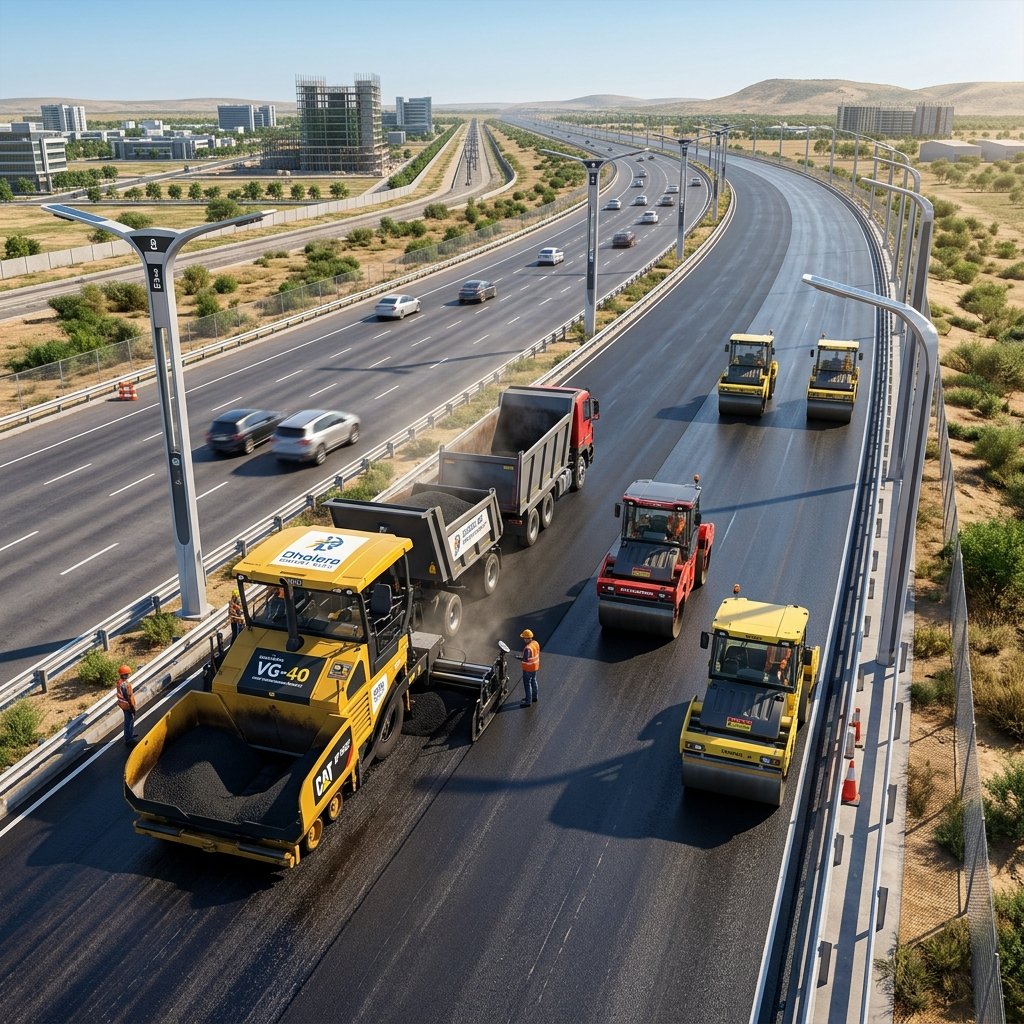

1. Statutory Bitumen Grades by Road Hierarchy in Dholera SIR
The road network in Dholera SIR is categorized by design traffic volume (measured in Million Standard Axles, MSA) and statutory right-of-way (ROW) widths:
| Road Classification / Zone | Right-of-Way (ROW) Width | Design Traffic Volume | Prescribed Bitumen Binder Grade | Primary Pavement Layer Application |
|---|---|---|---|---|
| **Central Expressway Interchanges & Toll Plazas** | 100m to 125m | > 150 MSA | **Polymer Modified Bitumen (PMB-40 / PMB-120)** | Bituminous Concrete (BC) wearing course at high-braking zones |
| **Primary Industrial Arterial Corridors** | 55m to 70m | 80 to 120 MSA | **Viscosity Grade VG-40** | Dense Bituminous Macadam (DBM) & Bituminous Concrete (BC) |
| **Secondary Logistics & Sector Roads** | 30m to 45m | 40 to 80 MSA | **Viscosity Grade VG-40 / VG-30** | Dense Bituminous Macadam (DBM) and BC wearing course |
| **Internal Plotted Access Streets (Town Planning)** | 18m to 24m | 10 to 30 MSA | **Viscosity Grade VG-30** | Standard 40 mm BC wearing surface over 75 mm DBM base |
| **Heavy Container Stacking Yards (MMLP)** | Plot Internal | Static High Load | **Rigid RCC Pavement (PQC M40)** | Non-bituminous rigid concrete paving with heavy dowel bars |
2. Technical Specifications of VG-40 and PMB Bitumen
Under Bureau of Indian Standards (BIS) IS 73:2018 and IS 15462, the paving bitumen used across Dholera municipal contracts must satisfy strict physical test criteria:
| Physical & Rheological Property | Standard Testing Method | Viscosity Grade VG-40 Benchmark | Polymer Modified Bitumen (PMB) Benchmark |
|---|---|---|---|
| **Absolute Viscosity at 60°C, poises** | IS 1206 (Part 2) | **3,200 to 4,800** | > 4,000 |
| **Kinematic Viscosity at 135°C, cSt** | IS 1206 (Part 3) | Min **400** | Min 500 |
| **Penetration at 25°C, 100g, 5s (0.1 mm)** | IS 1203 | **35 to 50** | 40 to 60 |
| **Softening Point (Ring and Ball), °C** | IS 1205 | Min **50°C** | Min **60°C** (Critical for Dholera heat) |
| **Ductility at 25°C, cm** | IS 1208 | Min **25** | Min 50 |
| **Flash Point (Cleveland Open Cup), °C** | IS 1448 | Min **220°C** | Min 220°C |
| **Elastic Recovery of Binder at 15°C, %** | IS 15462 | Not Applicable | Min **70%** (Prevents fatigue cracking) |
3. Structural Pavement Cross-Section for Dholera Industrial Roads
Because Dholera’s natural subgrade consists of expansive marine clay with low initial California Bearing Ratio (CBR 2% to 3%), roads are constructed on an elevated embankment with multi-layer stabilization adhering to IRC:37-2018:
“` +————————————————————–+ | 50 mm Bituminous Concrete (BC) with VG-40 / PMB-40 (Top) | +————————————————————–+ | 100 mm – 150 mm Dense Bituminous Macadam (DBM) with VG-40 | +————————————————————–+ | Prime Coat / Tack Coat (Rapid Setting Bitumen Emulsion RS-1) | +————————————————————–+ | 200 mm – 250 mm Wet Mix Macadam (WMM) Crushed Stone Base | +————————————————————–+ | 200 mm Granular Sub-Base (GSB) with Drainage Layer Grading | +————————————————————–+ | Biaxial Polypropylene Geogrid Reinforcement (40 kN/m) | +————————————————————–+ | 500 mm Lime / Cement Stabilized Subgrade (CBR >= 8% to 10%) | +————————————————————–+ | Non-Woven Geotextile Membrane (Separation & Filtration) | +————————————————————–+ | Compacted Native Marine Clay Sub-Base (Proctor Density >= 97%) | +————————————————————–+ “`
4. Temperature Control and Mixing Protocols
Due to Dholera’s harsh ambient climate, asphalt mixing and laying must follow strict quality assurance tolerances under MoRTH Section 500:
- Hot Mix Plant (HMP) Temperature: The binder (VG-40) must be heated between 160°C and 170°C. Aggregates must be heated between 160°C and 175°C. The mixed material discharge temperature must not exceed 175°C to avoid thermal oxidation and premature bitumen aging.
- Laying Temperature: When delivered by covered tipper trucks to the sensor paver, the asphalt mix temperature must be at least 140°C to 150°C. Laying when road surface temperatures drop below 15°C or during rain is strictly forbidden.
- Breakdown Compaction: Primary breakdown rolling must occur immediately behind the paver screed at a temperature of 135°C to 145°C using 8-10 tonne vibratory steel tandem rollers, followed by pneumatic tyre rollers (PTR) to achieve a minimum field density of 98% of laboratory Marshall density.
Frequently Asked Questions (FAQ)
Why is VG-40 bitumen preferred over VG-30 in Dholera SIR?
Dholera experiences severe summer heat, with road surface temperatures often exceeding 65°C. VG-40 bitumen features a higher viscosity (3,200 to 4,800 poises at 60°C) and higher softening point, preventing asphalt softening, rutting, and corrugation caused by heavy multi-axle freight trucks.Where is Polymer Modified Bitumen (PMB) mandatory in Dholera?
PMB is mandatory on high-stress traffic nodes, including expressway exit interchanges, toll plaza deceleration lanes, major signalized intersections, and curved flyovers where heavy vehicles induce high horizontal shear and braking forces.What is the minimum CBR required for road subgrades in Dholera SIR?
While native marine clay exhibits an untreated CBR of only 2% to 3%, DICDL specifications mandate that road subgrades be stabilized with lime or cement and reinforced with geogrids to achieve a compacted design CBR of at least 8% to 10% under IRC:37 standards.What standard governs bitumen testing and pavement design in Dholera?
Pavement thickness design is governed by the Indian Roads Congress guidelines (IRC:37-2018 for flexible pavements), while paving bitumen testing complies with IS 73:2018 (paving bitumen) and IS 15462 (polymer modified binders).How does Dholera prevent road flooding and moisture damage to asphalt?
All major roads in Dholera feature deep subsurface perforated storm drainage pipes integrated within the utility ducts, an open-graded Granular Sub-Base (GSB) drainage layer, and prime coat emulsions that prevent moisture ingress from the saline groundwater table into the bituminous layers.Download Dholera SIR 2026 Investor’s Kit
Get instant access to the official planning documents: Dholera Investment Handbook (PDF), 2026 Land Price List, TP Zone & Village Map, and the NRI Buying Guide.

Join The Discussion