


1. GPCB and DICDL CETP Inlet Discharge Thresholds
To protect the centralized CETP biological reactors and underground pipeline infrastructure, effluent leaving an industrial plot’s equalization and primary treatment plant must meet strict pre-treatment standards before discharge into the DICDL underground collection grid:
| Effluent Parameter | Raw Process Range (Typical) | Maximum Permissible CETP Inlet Limit | Analytical Test Protocol |
|---|---|---|---|
| **pH Value** | 2.0 to 11.5 (Highly Variable) | **6.5 to 8.5** | Continuous Inline Glass Electrode |
| **Biochemical Oxygen Demand (BOD₅)** | Up to 3,500 mg/L | **< 400 mg/L** | 5-Day Incubation at 20°C (IS 3025) |
| **Chemical Oxygen Demand (COD)** | Up to 10,000 mg/L | **< 1,000 mg/L** | Closed Reflux Titrimetric Method |
| **Total Suspended Solids (TSS)** | 500 to 2,500 mg/L | **< 300 mg/L** | Gravimetric Method at 105°C |
| **Oil and Grease** | Up to 250 mg/L | **< 20 mg/L** | Gravimetric Solvent Extraction |
| **Total Dissolved Solids (TDS)** | Up to 12,000 mg/L | **< 2,100 mg/L** (for discharge) | Conductivity Probes (Calibrated) |
| **Hexavalent Chromium (Cr⁶⁺)** | Heavy Metal Spikes | **< 0.1 mg/L** | Diphenylcarbazide Colorimetry |
Note: High-COD or toxic chemical industries (e.g., semiconductor chemical suppliers, electroplating, dye intermediates) must deploy on-site Multiple Effect Evaporators (MEE) and Zero Liquid Discharge (ZLD) plants. Direct discharge into DICDL sewers without written GPCB CETP allotment is illegal.
2. Equalization Tank Sizing and Hydraulic Retention Time (HRT)
Under GPCB design guidelines and DSIRDA GDCR Section 12, an industrial effluent equalization tank must be sized based on total daily wastewater flow ($Q_{\text{day}}$) and discharge variability:
A. Minimum Hydraulic Retention Time Formula
The physical liquid volume of the equalization tank must satisfy:
$$V_{\text{eq}} \ge Q_{\text{avg}} \times \text{HRT}$$
Where: * $Q_{\text{avg}}$ = Average hourly wastewater generation rate ($\text{m}^3/\text{hr}$). * HRT Standards: * Continuous Manufacturing (3 Shifts): Minimum HRT of 8 to 12 Hours. * Batch Processing Industries (1 to 2 Shifts): Minimum HRT of 16 to 24 Hours to balance intermittent batch dump volumes. * Freeboard Allowance: Tanks must include a minimum 0.5-meter freeboard above the high-liquid level to prevent foam overflow.
3. Mixing and Aeration System Specifications
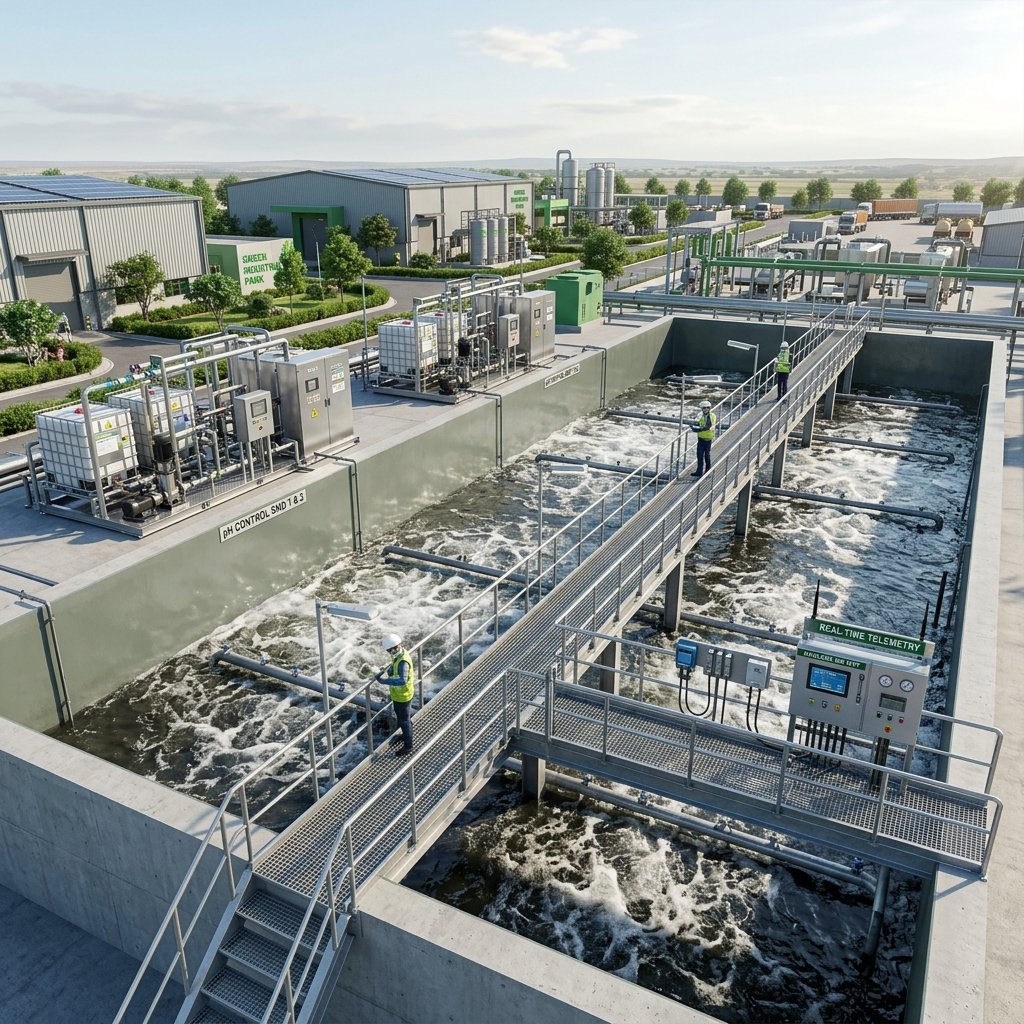
To prevent anaerobic septic conditions, sludge sedimentation, and volatile odor formation, equalization tanks in Dholera SIR must feature active homogenization:
- Submerged Coarse Bubble Aeration: Compressed air grids using non-clog tubular EPDM diffusers must supply at least 1.2 to 1.5 m³ of air per hour per m³ of tank volume (or 0.02 to 0.03 m³/min per m² of tank floor area).
- Mechanical Floating / Submersible Mixers: In chemical facilities where excessive aeration causes volatile organic compound (VOC) stripping, low-speed submersible mixers (propeller diameter ≥ 1.5 m) providing continuous velocity gradients greater than 0.3 m/sec across the entire floor must be deployed to keep solids suspended.
- Automated pH Neutralization Skid: Dholera factories must install dual inline pH sensor transmitters inside the equalization basin that automatically trigger dosing metering pumps (injecting 10% Caustic Soda ($\text{NaOH}$) or 15% Sulfuric Acid ($\text{H}_2\text{SO}_4$)) to maintain neutral effluent between pH 6.8 and 7.8.
4. Civil Engineering and Anti-Corrosion Linings
Because raw industrial effluent contains aggressive acids, organic solvents, and high chlorides, equalization tank construction in Dholera SIR must comply with stringent structural codes:
- Concrete Grade & Waterproofing: The basin must be constructed from RCC Grade M30 or higher, utilizing sulfate-resisting cement with integral crystalline waterproofing compounds complying with IS 3370.
- Epoxy / FRP Lining: All internal wetted surfaces must be lined with a minimum 3 mm thick Fiberglass Reinforced Plastic (FRP) dual-layer coating or heavy-duty chemical-resistant vinyl ester resin to prevent sulfuric acid degradation of the structural concrete.
- Leak Detection Sump: Underground equalization basins must be built within a double-containment concrete pit or include sub-slab perforated drain tiles leading to an observation inspection sump. This ensures any tank leakage into Dholera’s marine clay water table is detected within 24 hours.
Frequently Asked Questions (FAQ)
What is the purpose of an industrial effluent equalization tank in Dholera SIR?
The equalization tank buffers and homogenizes fluctuating daily effluent flows, stabilizes extreme pH levels, and dampens high chemical shock loads before wastewater enters secondary treatment or is discharged into the DICDL Common Effluent Treatment Plant (CETP) network.What is the minimum retention time required for an equalization tank?
For continuous manufacturing plants operating 24/7, GPCB requires a minimum Hydraulic Retention Time (HRT) of 8 to 12 hours. Batch processing plants operating on single or double shifts must provide 16 to 24 hours of holding capacity.What are the maximum COD and BOD limits for discharging into Dholera’s CETP?
Under DICDL and GPCB norms, industrial effluent discharging into the municipal CETP inlet line must not exceed a Chemical Oxygen Demand (COD) of 1,000 mg/L, Biochemical Oxygen Demand (BOD) of 400 mg/L, and Suspended Solids (TSS) of 300 mg/L.Why is aeration or mixing mandatory in equalization basins?
Aeration (1.2 to 1.5 m³ air per m³ tank volume per hour) or submersible mechanical mixers are required to keep solids suspended and maintain aerobic conditions, preventing anaerobic septic breakdown and hydrogen sulfide ($H_2S$) foul odors.Are underground equalization tanks permitted in Dholera SIR?
Yes, but they must be constructed with M30+ sulfate-resistant concrete, lined internally with a 3 mm chemical-resistant FRP or vinyl ester coating, and engineered with anti-buoyancy anchors to withstand Dholera’s high saline groundwater table.Download Dholera SIR 2026 Investor’s Kit
Get instant access to the official planning documents: Dholera Investment Handbook (PDF), 2026 Land Price List, TP Zone & Village Map, and the NRI Buying Guide.

Join The Discussion