

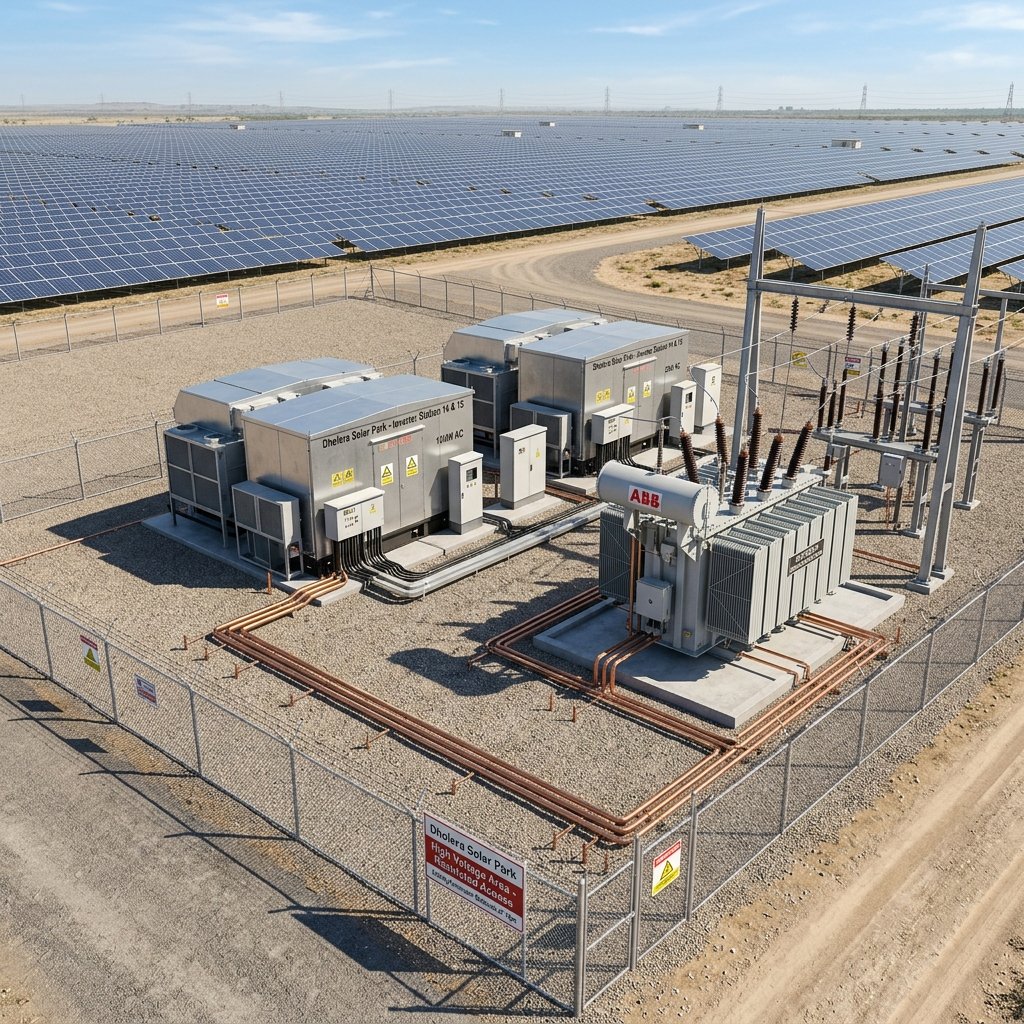

1. Statutory Clearances for Utility-Scale Solar Inverter Stations
In large ground-mounted photovoltaic projects and industrial microgrids across TP1 through TP6, Central Inverter Stations typically combine central inverters (1.5 MW to 3.125 MW units), compact medium-voltage (MV) step-up transformers (e.g., 0.69 kV to 33 kV), and SF6/vacuum ring main units (RMU). The required clearance margins are:
| Electrical Equipment Interface | Minimum Clear Setback | Regulatory Standard | Critical Safety Rationale |
|---|---|---|---|
| **Inverter Enclosure to Compound Wall** | 5.0 Meters | DSIRDA GDCR Sec 8.3 & CEA | Fire service emergency vehicle access & thermal ventilation |
| **Central Inverter to Step-Up Transformer** | 3.0 Meters | IS 1646 / CBIP Manual | Isolation from transformer dielectric oil fire hazard |
| **Inter-Inverter Container Spacing** | 2.5 Meters | IEEE 1584 / CEA Safety Regs | Safe technician egress and maintenance door swing (180°) |
| **Transformer Oil Soak Pit to Solar PV Tables** | 7.5 Meters | Tariff Advisory Committee (TAC) | Prevents burning oil overflow from damaging PV module strings |
| **MV Switchgear to Air-Cooled Radiators** | 2.0 Meters | Torrent Power Distribution Code | Prevents hot exhaust air from overheating protective relays |
| **Inverter Station to Overhead High-Voltage Line** | 10.0 Meters (Horizontal) | Indian Electricity Rules Rule 79 | Prevents induction interference and arc-flash coupling |
2. Transformer Fire Barrier Walls and Gravel Buffers
Where spatial constraints on compact industrial plots prevent the standard 3.0-meter physical separation between the central inverter skid and oil-filled step-up transformers, a Fire Separation Barrier Wall must be erected under IS 1646:
- Fire Resistance Rating: The firewall must be constructed from Reinforced Cement Concrete (RCC) or solid masonry engineered to withstand exposure to open hydrocarbons for a minimum of 240 minutes (4 Hours).
- Dimensional Overhang: The firewall must extend at least 0.6 meters beyond the top and sides of the transformer tank or conservator, physically shielding the adjacent inverter cabin doors.
- Fire-Trap Gravel Bed: The entire perimeter of the inverter and transformer plinth must be surrounded by a crushed granite gravel bed (stone size 40 mm to 60 mm) with a minimum depth of 300 mm extending at least 1.5 meters beyond the footprint. This rapidly quenches burning dielectric oil and prevents surface flame spread to solar panel mounting structures.
3. Earthing Grid Buffer and Ground Potential Rise (GPR) Setbacks
Inverter stations convert direct current (DC) into alternating current (AC) and operate under high fault current potentials. Torrent Power and DSIRDA require specialized grounding setbacks:
- Earth Electrode Spacing: Driven earth electrodes (copper-bonded steel rods, minimum 3.0-meter length and 17.2 mm diameter) around the inverter yard must be spaced at a distance equal to at least two times the driven rod length (6.0 meters) to prevent overlapping resistance zones.
- Touch and Step Potential Shielding: The finished surface inside the inverter station perimeter fence must be laid with a 100 mm compacted gravel layer to maintain permissible step and touch voltage thresholds under IEEE 80 calculation formulas.
- Perimeter Fence Grounding: Metal chain-link security fences surrounding the solar inverter yard must either be bonded directly to the main station earthing grid at 10-meter intervals or located at least 2.0 meters outside the outer perimeter earth ring to prevent external touch-potential hazards to pedestrians.
4. Ventilation Clearance and Ambient Thermal Buffers
Inverter efficiency in Dholera’s solar belt is directly impacted by air circulation. Industrial plot owners must design inverter yard enclosures to avoid premature thermal throttling:
- Air Intake Clearance: Forced-air ventilated inverter cabins must maintain a clear, unobstructed buffer of at least 2.5 meters in front of intake louver filters. Positioning storage sheds, landscape hedges, or boundary walls within this buffer is an inspection violation.
- Exhaust Air Re-circulation: Air exhaust hoods must discharge vertically upward or downstream of prevailing wind directions (predominantly south-westerly in Dholera) to prevent thermal short-circuiting back into adjacent inverter intake fans.
- Sunshade Canopy Setbacks: When overhead sunshades or thermal canopies are installed over central inverter skids to minimize direct solar radiant heat gain, the canopy roof must clear the top of the inverter enclosure by at least 1.5 meters to maintain natural convective draft.
Frequently Asked Questions (FAQ)
What is the minimum distance between a solar inverter and a plot boundary wall in Dholera?
Under DSIRDA GDCR Section 8.3 and Central Electricity Authority (CEA) guidelines, utility-scale and central solar inverter stations must maintain a minimum clear setback of 5.0 meters from any external plot boundary wall to allow emergency fire tender access.Can inverters be installed directly adjacent to step-up transformers?
No. Inverters must maintain a minimum physical clearance of 3.0 meters from oil-filled transformers. If space is restricted, an RCC fire barrier wall rated for 4 hours of fire resistance must be built between the transformer and the inverter enclosure.Why is a gravel bed mandatory around inverter and transformer yards in Dholera?
A 300 mm deep layer of crushed stone (40–60 mm gravel) is mandatory because it serves two safety functions: it rapidly quenches burning transformer oil during catastrophic ruptures and provides electrical insulation that reduces step-potential shock hazards under IEEE 80 standards.What earthing separation is required for solar inverter yards in Dholera?
Earth pits must be separated by at least twice the length of the driven electrode (typically 6.0 meters). Furthermore, the security perimeter fence must be bonded to the main earthing grid or located at least 2.0 meters outside the outermost buried ground conductor.How does Dholera’s high ambient heat affect inverter station placement?
Summer temperatures in Dholera frequently exceed 45°C. To prevent equipment shutdown due to thermal overload, inverters require a 2.5-meter unobstructed intake clearance and overhead sunshade canopies elevated 1.5 meters above the enclosure to facilitate heat dissipation.Download Dholera SIR 2026 Investor’s Kit
Get instant access to the official planning documents: Dholera Investment Handbook (PDF), 2026 Land Price List, TP Zone & Village Map, and the NRI Buying Guide.

Join The Discussion