

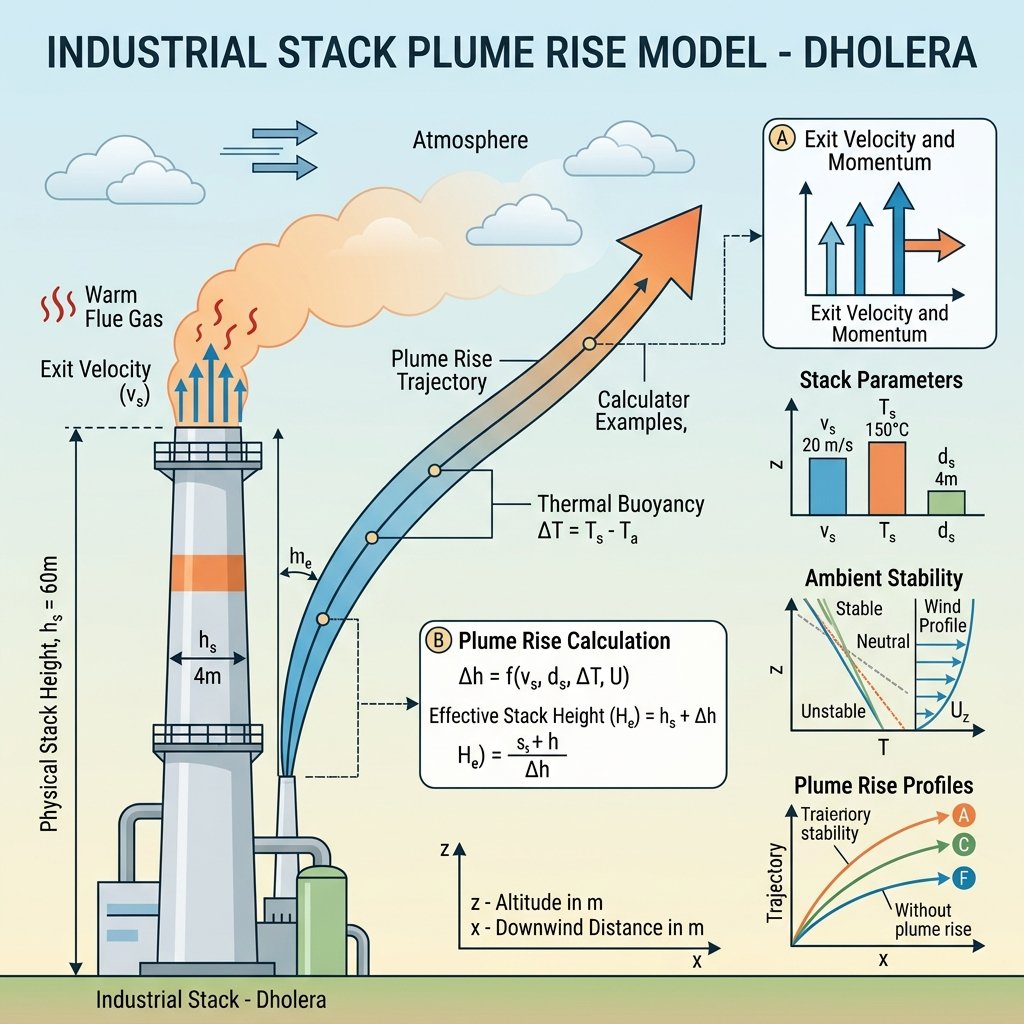
1. Effective Stack Height ($H_e$) & Plume Physics
When hot flue gases exit an industrial chimney, the plume continues rising above the physical stack top due to vertical discharge momentum and thermal buoyancy:
$$\Large H_e = h_s + \Delta h$$
Where: * $H_e$ = Effective Stack Height (Meters): The total vertical elevation reached by the plume centerline before dispersing horizontally. * $h_s$ = Physical Stack Height (Meters): The physical chimney height measured from ground level. * $\Delta h$ = Plume Rise (Meters): The additional height gained by the gas column above the stack tip.
2. Briggs Plume Rise Equations & Buoyancy Flux ($F$)
GPCB environmental engineers require industrial plants to model plume rise using Briggs Equations, categorized into buoyancy-dominated and momentum-dominated plumes:
Buoyancy Flux Parameter ($F$)
$$\Large F = g \cdot V_s \cdot r_s^2 \cdot \left(\frac{T_s – T_a}{T_s}\right)$$
Where: * $g$ = Acceleration due to gravity ($9.81\text{ m/s}^2$). * $V_s$ = Flue Gas Exit Velocity ($\text{m/s}$): Minimum mandated exit velocity is $15.0\text{ m/s}$ to prevent stack tip downwash. * $r_s$ = Inside Stack Top Radius ($\text{m}$). * $T_s$ = Stack Gas Temperature ($\text{K}$). * $T_a$ = Ambient Air Temperature ($\text{K}$).
Briggs Formula for Neutral / Unstable Conditions ($F \ge 55\text{ m}^4/\text{s}^3$)
$$\Large \Delta h = \frac{1.6 \cdot F^{1/3} \cdot x_f^{2/3}}{U}$$
Where $U$ is ambient wind speed at stack height ($\text{m/s}$) and $x_f$ is downwind distance to final rise.
The table below outlines GPCB plume rise physics parameters across industrial stack categories:
| Factory Stack Application | Exit Velocity ($V_s$) | Flue Gas Temp ($T_s$) | Calculated Buoyancy ($F$) | Wind Speed ($U$) | Calculated Plume Rise ($\Delta h$) | Effective Stack Height ($H_e$) |
|---|---|---|---|---|---|---|
| **Gaseous PNG Boiler ($5\text{ TPH}$)** | $15.0\text{ m/s}$ | $140^\circ\text{C}$ ($413\text{K}$) | $2.5\text{ m}^4/\text{s}^3$ | $3.5\text{ m/s}$ | $12.5\text{ Meters}$ | $36.5\text{ Meters}$ ($h_s=24\text{m}$) |
| **Heavy Coal/Oil Furnace Stack** | $18.5\text{ m/s}$ | $180^\circ\text{C}$ ($453\text{K}$) | $18.2\text{ m}^4/\text{s}^3$ | $4.0\text{ m/s}$ | $28.0\text{ Meters}$ | $58.0\text{ Meters}$ ($h_s=30\text{m}$) |
| **Chemical Plant Reactor Stack** | $20.0\text{ m/s}$ | $210^\circ\text{C}$ ($483\text{K}$) | $62.0\text{ m}^4/\text{s}^3$ | $4.5\text{ m/s}$ | $44.5\text{ Meters}$ | $96.0\text{ Meters}$ ($h_s=51.5\text{m}$) |
| **High-Capacity Power Boiler** | $22.5\text{ m/s}$ | $160^\circ\text{C}$ ($433\text{K}$) | $125.0\text{ m}^4/\text{s}^3$ | $5.0\text{ m/s}$ | $56.0\text{ Meters}$ | $136.0\text{ Meters}$ ($h_s=80\text{m}$) |
3. Downwash Prevention & Ground-Level Concentration (GLC)
- Stack Tip Downwash Protection: To ensure the plume escapes the aerodynamic wake created by nearby factory buildings, physical stack height ($h_s$) must satisfy Good Engineering Practice (GEP) rules ($h_s \ge H_b + 1.5 L$, where $H_b$ is building height and $L$ is lesser dimension of building height or projected width).
- Max Ground-Level Concentration (GLC): AERMOD dispersion modeling must confirm that peak 24-hour ground-level concentrations for $\text{SO}_2$ and $\text{NO}_x$ remain below National Ambient Air Quality Standards ($80\,\mu\text{g/m}^3$ in industrial zones).
Frequently Asked Questions (FAQ)
#### What is plume rise ($\Delta h$) in industrial stack modeling?
Plume rise is the additional vertical height gained by hot flue gases above the physical stack top due to thermal buoyancy and exit velocity momentum.
#### What is the minimum stack exit velocity required by GPCB in Dholera?
GPCB environmental guidelines mandate a minimum stack gas exit velocity of 15.0 m/s to prevent stack tip aerodynamic downwash.
#### What mathematical equation is used to model stack plume rise?
Environmental engineers use Briggs Plume Rise Equations, which calculate plume trajectory based on buoyancy flux parameter ($F$), ambient wind speed ($U$), and atmospheric stability classes.
Download Dholera SIR 2026 Investor’s Kit
Get instant access to the official planning documents: Dholera Investment Handbook (PDF), 2026 Land Price List, TP Zone & Village Map, and the NRI Buying Guide.

Join The Discussion