

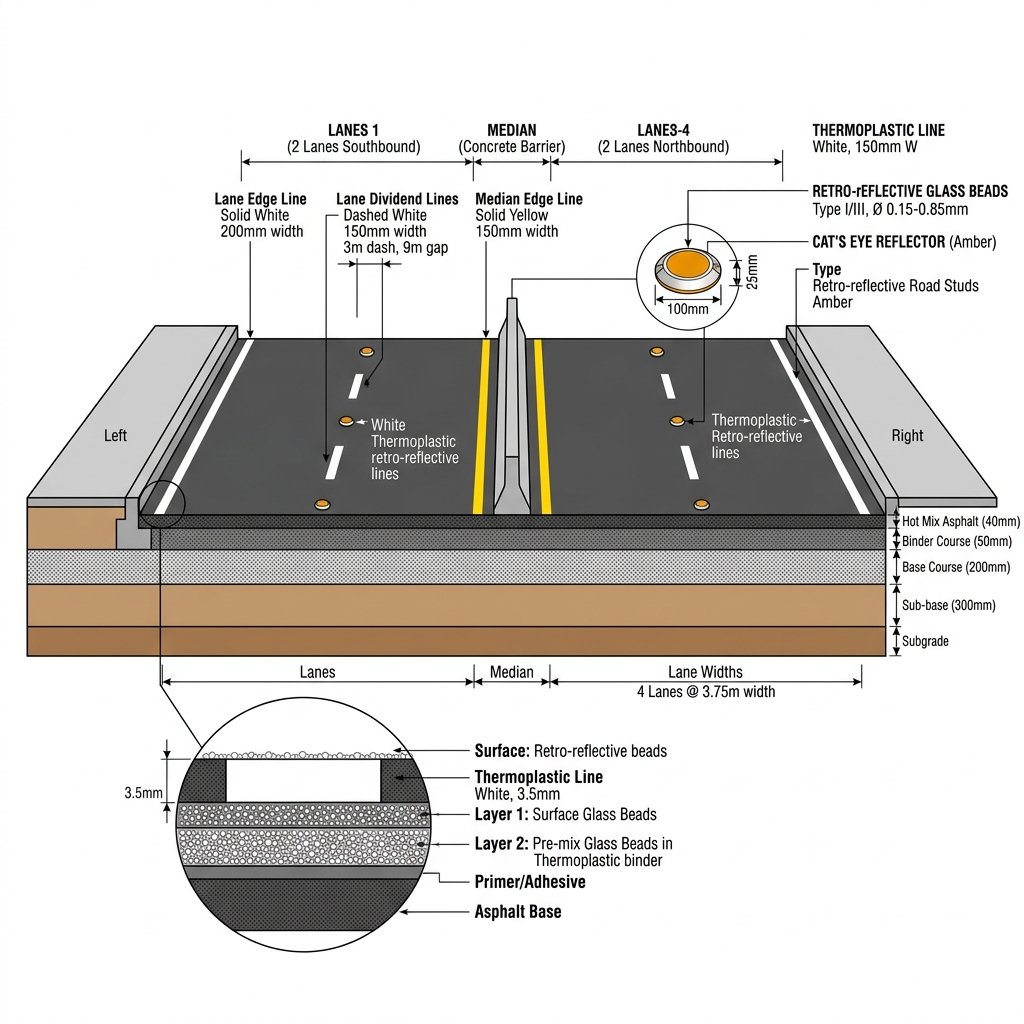
1. Thermoplastic Compound & Glass Bead Retro-Reflectivity
To ensure road markings remain visible at night and during torrential monsoon downpours, DICDL strictly prohibits cold solvent paint on major thoroughfares:
- Hot-Applied Thermoplastic Paint: All lane lines, edge markings, and zebra crossings must be executed using hot-applied thermoplastic road marking compound (compliant with MORTH Clause 803 specifications) applied at a melt temperature of $180^\circ\text{C}$ to $200^\circ\text{C}$.
- Double-Drop Glass Bead Embedment: Thermoplastic material must contain 20% to 30% pre-mixed glass beads by weight (Type 1 under BS 6088). In addition, high-index glass beads (Type 2) must be automatically surface-sprayed (“drop-on”) at a rate of 250 g/m² immediately behind the screed shoe.
- Retro-Reflectivity Benchmark ($\ge 300\text{ mcd/lx/m}^2$): Newly applied white lane markings must achieve an initial retro-reflectivity coefficient ($R_L$) of at least $300\text{ mcd}\cdot\text{lx}^{-1}\cdot\text{m}^{-2}$, maintaining a minimum of $150\text{ mcd}\cdot\text{lx}^{-1}\cdot\text{m}^{-2}$ after 2 years of heavy traffic wear.
2. Line Widths & Geometry Across Road Hierarchy
Road line widths and dashed line ratios are standardized to assist both human drivers and machine-vision sensors on autonomous vehicles:
- Lane Dividend Lines: Dashed white lines dividing traffic lanes must be 150mm wide, consisting of a 3-meter painted dash followed by a 6-meter gap on urban arterials (1:2 ratio), and a 3m dash / 9m gap on high-speed expressways (1:3 ratio).
- Carriageway Edge Lines: Solid white edge lines defining pavement margins must be 200mm wide on 30m and 55m RoW roads to clearly demarcate shoulders.
- Median Line & Yellow No-Overtaking Barriers: Central medians feature solid 150mm yellow lines (using yellow heat-stable pigment resistant to solar UV fading).
The table below outlines DICDL road pavement marking technical specifications:
| Road Marking Category | Line Width & Color | Thermoplastic Application Thickness | Min. Retro-Reflectivity ($R_L$) | Glass Bead Content (% Weight) | Raised Stud (Cat’s Eye) Spacing |
|---|---|---|---|---|---|
| **Expressway Edge Line** | Solid White (200mm) | 3.0 mm | $\ge 350\text{ mcd/lx/m}^2$ | 30% Pre-mix + Drop-on | Amber Studs @ 12m intervals |
| **Arterial Lane Dividend** | Dashed White (150mm) | 2.5 mm | $\ge 300\text{ mcd/lx/m}^2$ | 25% Pre-mix + Drop-on | White Studs @ 18m intervals |
| **Center Median Barrier** | Solid Yellow (150mm) | 3.0 mm | $\ge 250\text{ mcd/lx/m}^2$ | 25% Pre-mix + Drop-on | Red Studs @ 9m intervals |
| **Zebra Pedestrian Crossing** | Solid White (500mm) | 5.0 mm Screed | $\ge 300\text{ mcd/lx/m}^2$ | 30% Pre-mix + High Index | Red/Amber Flashing Solar Studs |
3. Raised Pavement Markers (Cat’s Eyes) & Colored Lanes
- Retro-Reflective Road Studs (Cat’s Eyes): Die-cast aluminum alloy road studs featuring dual-directional micro-prismatic glass reflectors must be installed along lane lines. Red studs mark median edges, amber studs mark outer carriageway shoulders, and white studs mark lane dividers.
- Color-Coded Transit Lanes: Dedicated Cycle Tracks are surfaced in skid-resistant green acrylic macadam (RAL 6024), while Bus Rapid Transit (BRT) priority corridors are surfaced in red oxide pavement coating (RAL 3009).
Frequently Asked Questions (FAQ)
#### What type of road paint is used on Dholera Smart City thoroughfares?
Dholera roads mandate hot-applied thermoplastic road marking compound with pre-mixed and drop-on glass beads for maximum durability and night-time retro-reflectivity.
#### What is the minimum retro-reflectivity rating for white road markings in Dholera?
Newly applied white thermoplastic markings must achieve an initial retro-reflectivity level of at least $300\text{ mcd}\cdot\text{lx}^{-1}\cdot\text{m}^{-2}$.
#### How are cycle tracks and bus lanes color-coded in Dholera SIR?
Under DICDL transit codes, dedicated cycle paths are painted in skid-resistant green, while BRT bus lanes are coated in red oxide.
Download Dholera SIR 2026 Investor’s Kit
Get instant access to the official planning documents: Dholera Investment Handbook (PDF), 2026 Land Price List, TP Zone & Village Map, and the NRI Buying Guide.



Join The Discussion