

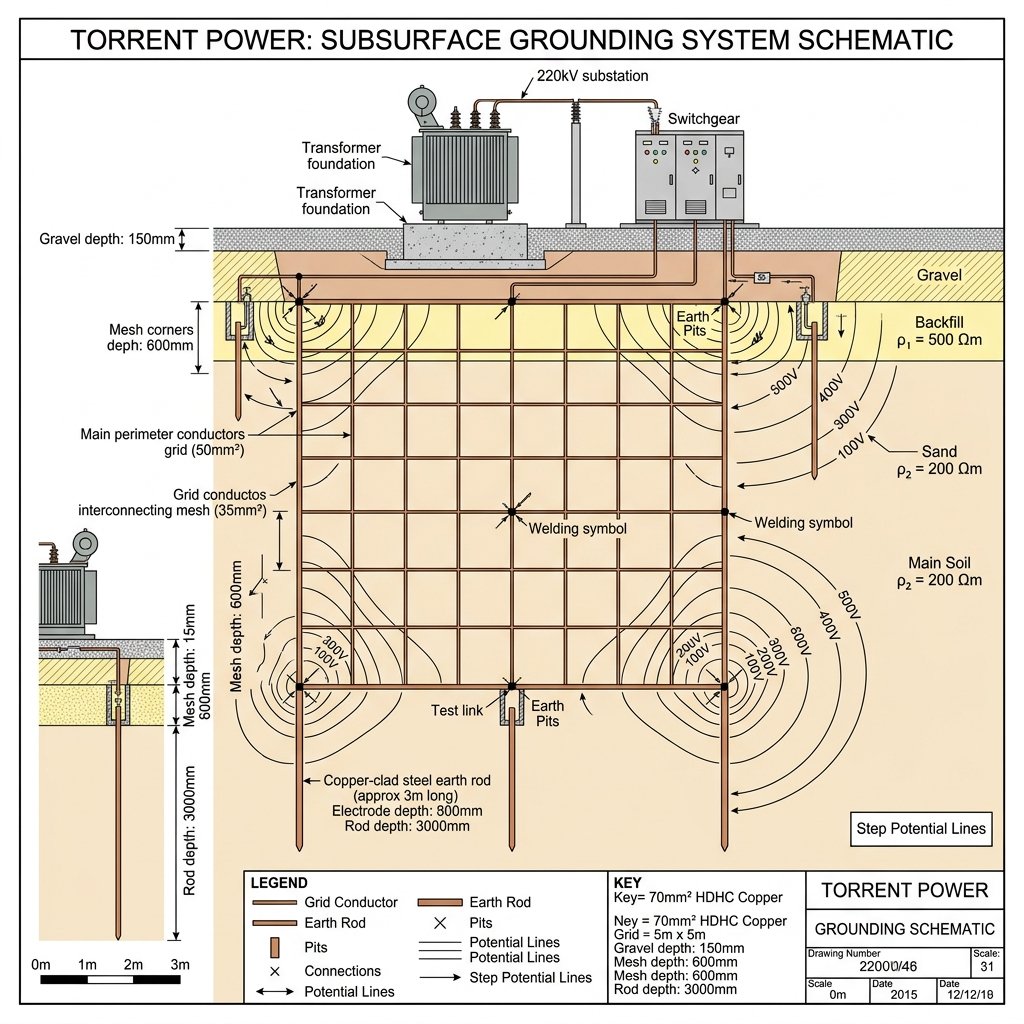
1. Subsurface Grounding Mesh & Marine Clay Soil Physics
The primary function of a substation earth grid is to provide a low-impedance path for fault currents to dissipate into the earth without causing dangerous surface voltage gradients:
- Low Grid Resistance ($\le 1.0\,\Omega$): The overall electrical resistance of a substation grounding grid to the main earth mass must not exceed 1.0 ohm for 33kV/11kV substations, and 0.5 ohm for 220kV/400kV transmission substations.
- HDHC Copper Conductor Mesh: Grounding grids consist of heavy-duty hard-drawn high-conductivity (HDHC) copper conductors or hot-dip galvanized steel flats ($75 \times 10\text{ mm}$ or $50 \times 6\text{ mm}$) buried at a depth of 600mm to 1,000mm beneath prepared surface gravel.
- Gravel Surface Layer: Substation switchyards must be covered with a 150mm thick layer of washed crushed granite/gravel (resistivity $\ge 3,000\,\Omega\cdot\text{m}$) to increase the electrical resistance between a worker’s feet and the underlying soil, significantly raising safe step and touch potential thresholds.
2. Earth Pit Design & Minimum Spacing Rules
To augment the main mesh and reach deeper, low-resistivity soil layers, vertical earth electrodes are driven at key grid nodes:
- Copper-Bonded Steel Earth Rods: Vertical electrodes must measure at least 3.0 meters in length with a diameter of 17.2mm to 20mm, featuring a 254-micron molecular bond of pure copper over a high-tensile steel core.
- 3-Meter Minimum Inter-Pit Spacing: To prevent electrical overlap and mutual resistance interference between adjacent earth pits, vertical electrodes must be spaced at a distance of at least twice the electrode length (minimum 3.0 to 6.0 meters apart).
- Chemical Earth Pits with Bentonite Backfill: In hyper-saline clay areas, earth pits must be backfilled with a non-corrosive, moisture-retaining conductive compound (such as Bentonite or carbon-based backfill) to maintain low earth resistance throughout the dry summer months.
The table below outlines Torrent Power substation earth grid specifications:
| Substation Voltage Rating | Grounding Mesh Conductor Size | Max. Allowed Grid Resistance | Earth Rod Length & Diameter | Min. Earth Pit Spacing | Switchyard Gravel Depth |
|---|---|---|---|---|---|
| **11kV / 415V Kiosk Substation** | 50 × 6mm GI Flat / 35mm² Cu | $\le 2.0\,\Omega$ | 2.5m Length / 16mm Dia | 3.0 Meters | 100 mm |
| **33kV / 11kV Distribution Hub** | 75 × 8mm GI / 70mm² HDHC Cu | $\le 1.0\,\Omega$ | 3.0m Length / 19mm Dia | 4.0 Meters | 150 mm |
| **66kV / 132kV Grid Substation** | 75 × 10mm GI / 95mm² HDHC Cu | $\le 0.75\,\Omega$ | 3.0m Length / 20mm Dia | 5.0 Meters | 150 mm |
| **220kV / 400kV Bulk Station** | 75 × 12mm GI / 120mm² HDHC Cu | $\le 0.5\,\Omega$ | 6.0m Segmented / 25mm Dia | 6.0 Meters | 150 mm |
3. Step and Touch Potential Safety Caps
Under IEEE 80 standards, grounding grid configurations are engineered to restrict fault voltages to safe levels:
- Touch Potential Safety Limit: The maximum voltage difference between a grounded metallic structure (transformer tank, breaker frame) and a person standing 1 meter away during a 50kA ground fault must not exceed IEEE 80 safety thresholds (typically $< 850\text{ V}$).
- Step Potential Safety Limit: The maximum voltage difference between a person’s feet spaced 1 meter apart on the switchyard gravel surface during a fault must remain below safe limits ($< 2,500\text{ V}$).
- Surge Arrestor Dedicated Grounding: High-voltage lightning surge arrestors must be connected to the main grounding grid via independent, direct down-conductors using the shortest possible path without sharp right-angle bends.
Frequently Asked Questions (FAQ)
#### What is the maximum allowed earth grid resistance for a 33kV substation in Dholera?
Under Torrent Power and GETCO engineering standards, the overall earth grid resistance for a 33kV substation must not exceed 1.0 ohm.
#### Why is crushed gravel spread across Dholera substation switchyards?
A 150mm layer of high-resistivity crushed granite gravel is spread over switchyard soil to increase foot contact resistance, protecting workers from dangerous step and touch potential voltages during ground faults.
#### What is the minimum recommended spacing between substation earth pits?
Vertical earth electrodes must maintain a minimum physical clearance of at least 3.0 to 6.0 meters (twice the length of the earth rod) to avoid mutual resistance overlap.
Download Dholera SIR 2026 Investor’s Kit
Get instant access to the official planning documents: Dholera Investment Handbook (PDF), 2026 Land Price List, TP Zone & Village Map, and the NRI Buying Guide.

Join The Discussion