

1. The Mathematical Sizing Formula
Calculating the required capacity of a rainwater soak pit is based on the peak runoff volume generated by the building’s roof footprint:
The sizing formula is defined as: \[V = A \times I \times C \times 1000\]
Where: * \(V\) = Required volume of the soak pit (in Liters). * \(A\) = Roof Catchment Area (in square meters). * \(I\) = Design hourly rainfall intensity (taken as 0.05 meters/hour or 50 mm/hour for the Dholera region based on historical monsoon data). * \(C\) = Runoff coefficient (taken as 0.90 for concrete roof slabs and tiled surfaces, representing the percentage of water that flows off the roof). * \(1000\) = Conversion factor to convert cubic meters to liters.
Calculation Example:
For a standard building with a roof area of 200 square meters: \[V = 200 \times 0.05 \times 0.90 \times 1000 = 9,000 \text{ Liters}\] Thus, the developer must construct a soak pit with a minimum capacity of 9,000 Liters (or 9.0 cubic meters of open space/void volume).
2. Filter Media Layer Configuration
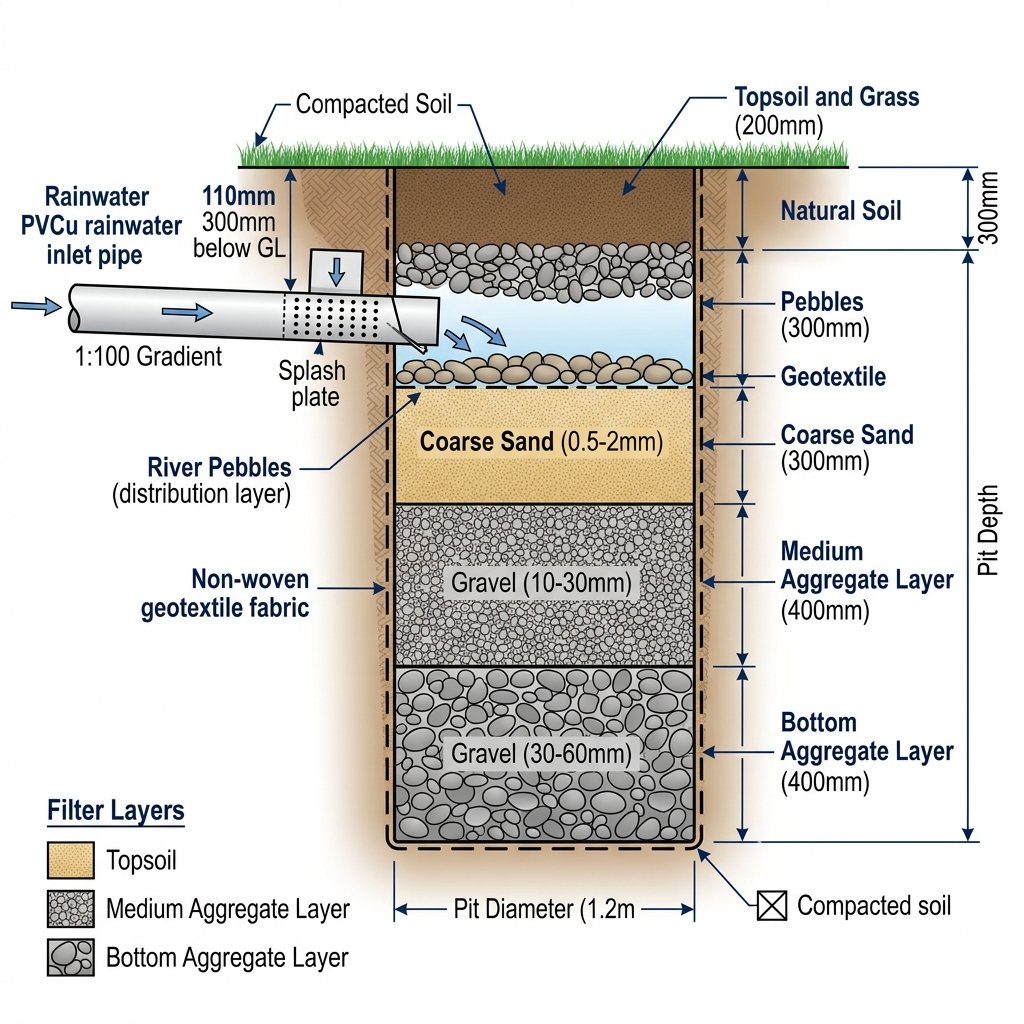
Because Dholera’s marine clay has a low percolation rate (0.5 to 1.5 liters/hour/m²), the pit must be backfilled with graded filter media. This allows the pit to store water during heavy downpours while it drains slowly into the ground:
- Top Silt Filter (Geotextile Fabric): A layer of non-woven geotextile fabric is laid over the top of the filter bed to trap fine silt and prevent it from clogging the aggregate layers below.
- Upper Sand Layer (300mm Depth): Coarse, clean river sand (grain size 0.5mm to 2.0mm) to filter out organic debris.
- Middle Gravel Layer (400mm Depth): Medium aggregate gravel (size 10mm to 30mm) to support the sand bed and provide initial storage volume.
- Base Aggregate Layer (400mm Depth): Coarse stone aggregate (size 30mm to 60mm) placed at the bottom of the pit, creating a high-void storage chamber where water collects before draining into the soil.
The table below outlines soak pit sizing by roof area:
| Roof Area (Sq. Meters) | Calculated Runoff Volume | Recommended Pit Diameter | Minimum Pit Depth | Required Gravel Void Capacity |
|---|---|---|---|---|
| **100 Sq.m** | 4,500 Liters | 1.2 Meters | 3.0 Meters | 4.5 Cubic Meters |
| **150 Sq.m** | 6,750 Liters | 1.5 Meters | 3.0 Meters | 6.8 Cubic Meters |
| **200 Sq.m** | 9,000 Liters | 2.0 Meters | 3.0 Meters | 9.0 Cubic Meters |
| **300 Sq.m** | 13,500 Liters | 2.5 Meters | 3.5 Meters | 13.5 Cubic Meters |
| **500 Sq.m** | 22,500 Liters | 3.0 Meters | 4.0 Meters | 22.5 Cubic Meters |
3. Maintenance and Desilting Guidelines
- Silt Pit Cleaning: The brick-lined silt trap located before the soak pit inlet must be cleared of sand and leaves before the start of the monsoon season.
- Sand Replacement: The top 100mm of the river sand layer should be scraped off and replaced with clean sand every two years to maintain filtration rates.
- Perimeter Protection: The ground surrounding the soak pit must be graded to slope away from the pit opening, preventing dirty surface runoff from washing into the filtered system.
Frequently Asked Questions (FAQ)
#### How do you calculate the size of a soak pit in Dholera?
The volume is calculated using the formula \(V = A \times I \times C \times 1000\). For example, a 150 sq.m roof area requires a soak pit capacity of 6,750 Liters under DSIRDA’s design guidelines.
#### What filter layers are required inside a Dholera soak pit?
The pit must contain a 300mm coarse sand layer on top, a 400mm medium gravel layer in the middle, and a 400mm aggregate base layer at the bottom, topped with a geotextile silt filter.
#### Why is geotextile fabric used in soak pits?
The geotextile fabric acts as a filter layer that allows water to pass through while preventing fine soil and silt from washing down and clogging the gravel bed, maintaining the pit’s drainage capacity.
Download Dholera SIR 2026 Investor’s Kit
Get instant access to the official planning documents: Dholera Investment Handbook (PDF), 2026 Land Price List, TP Zone & Village Map, and the NRI Buying Guide.

Join The Discussion