

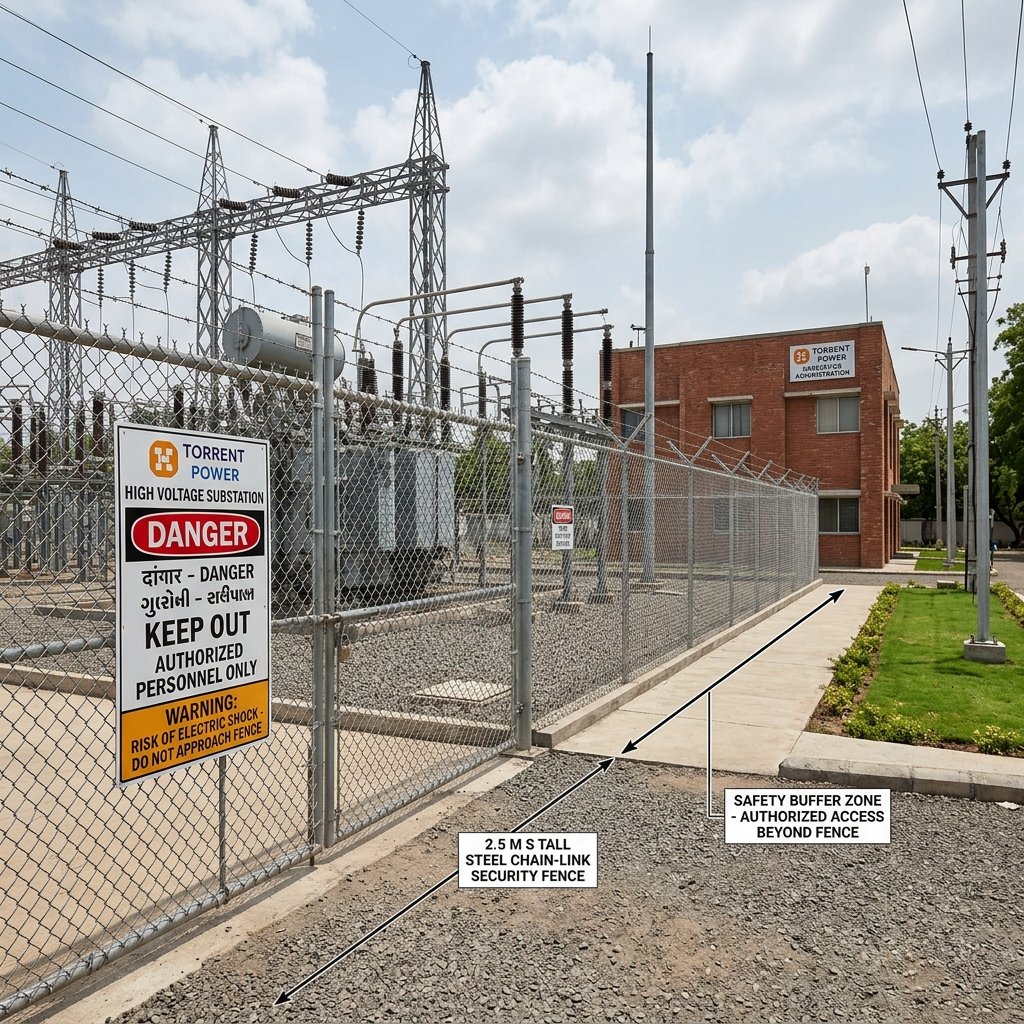
1. Substation Setback Buffer Zones
The safety setback distance (measured from the substation boundary fence to the nearest building foundation) scales based on the substation’s operating voltage:
- 33kV Substations (Local Distribution): A minimum safety setback of 10 meters is required.
- 66kV Substations (TP Scheme Hubs): A minimum safety setback of 15 meters is mandatory.
- 220kV/400kV Substations (Primary Grid Nodes): A minimum safety buffer zone of 30 meters must be maintained around the facility.
- Adjacent Zoning Constraints: DSIRDA does not zone land directly adjacent to substations for residential use. Instead, these areas are utilized as green belts, parking zones, or utility corridors.
2. Structural Shielding and Fire Safety Codes
Substations are engineered to contain hazards and minimize radiation risk:
- Electromagnetic Shielding (EMF Control): Substations must incorporate grounded copper grounding grids and concrete walls reinforced with steel meshes (acting as partial Faraday cages) to suppress electromagnetic field emissions below safety limits (100 microteslas for public exposure).
- Blast-Proof Fire Barriers: Transformer bays must be separated by reinforced concrete partition walls at least 230mm thick (with a 4-hour fire resistance rating) to contain localized equipment failures.
- Oil Containment Sumps: Large transformers filled with cooling oil must have an underground gravel-filled containment pit underneath. The pit must be large enough to capture the full volume of oil in the event of a leak or fire, preventing soil contamination.
The table below summarizes safety regulations for electrical substations:
| Grid Substation Class | Safety Setback Distance | Permitted Adjacent Zoning | Required Fire Barrier Wall | EMF Exposure Cap |
|---|---|---|---|---|
| **33kV Station** | 10 Meters | Utility zones, roads, green buffers | 230mm Concrete (2-hour) | < 100 µT (at boundary) |
| **66kV Station** | 15 Meters | Green buffers, parking yards, logistics | 300mm Concrete (4-hour) | < 100 µT (at boundary) |
| **220kV Station** | 30 Meters | Green belts, major roads, canals | 350mm Concrete (4-hour) | < 50 µT (at boundary) |
| **400kV Solar Pool** | 50 Meters | Protected environmental buffer zone | 350mm Concrete (4-hour) | < 50 µT (at boundary) |
3. Grid Grounding & Lightning Protections
To protect nearby electronic devices from power surges during storms, Torrent Power substations utilize multi-point grounding systems:
- Grounding Grid Mat: A mesh of copper conductors is buried 0.5 meters beneath the entire substation site to disperse electrical faults into the earth.
- Lightning Shield Masts: Steel masts equipped with early streamer emission (ESE) air terminals are positioned around the yard to intercept lightning strikes and route them safely to ground.
Frequently Asked Questions (FAQ)
#### What is the safety buffer zone around a 66kV substation in Dholera?
A minimum safety buffer setback of 15 meters must be maintained between the substation boundary wall and any adjacent building structure.
#### Are electromagnetic fields (EMF) dangerous near Dholera substations?
No. All Torrent Power substations are built with grounded reinforcement meshes and grounding grids, keeping electromagnetic emissions well below international safety standards at the property boundary.
#### What is the purpose of the gravel pits under transformers?
The gravel-filled pits are designed to capture cooling oil from transformers in the event of a leak or fire, preventing oil from seeping into the ground and containing fire hazards.
Download Dholera SIR 2026 Investor’s Kit
Get instant access to the official planning documents: Dholera Investment Handbook (PDF), 2026 Land Price List, TP Zone & Village Map, and the NRI Buying Guide.

Join The Discussion