

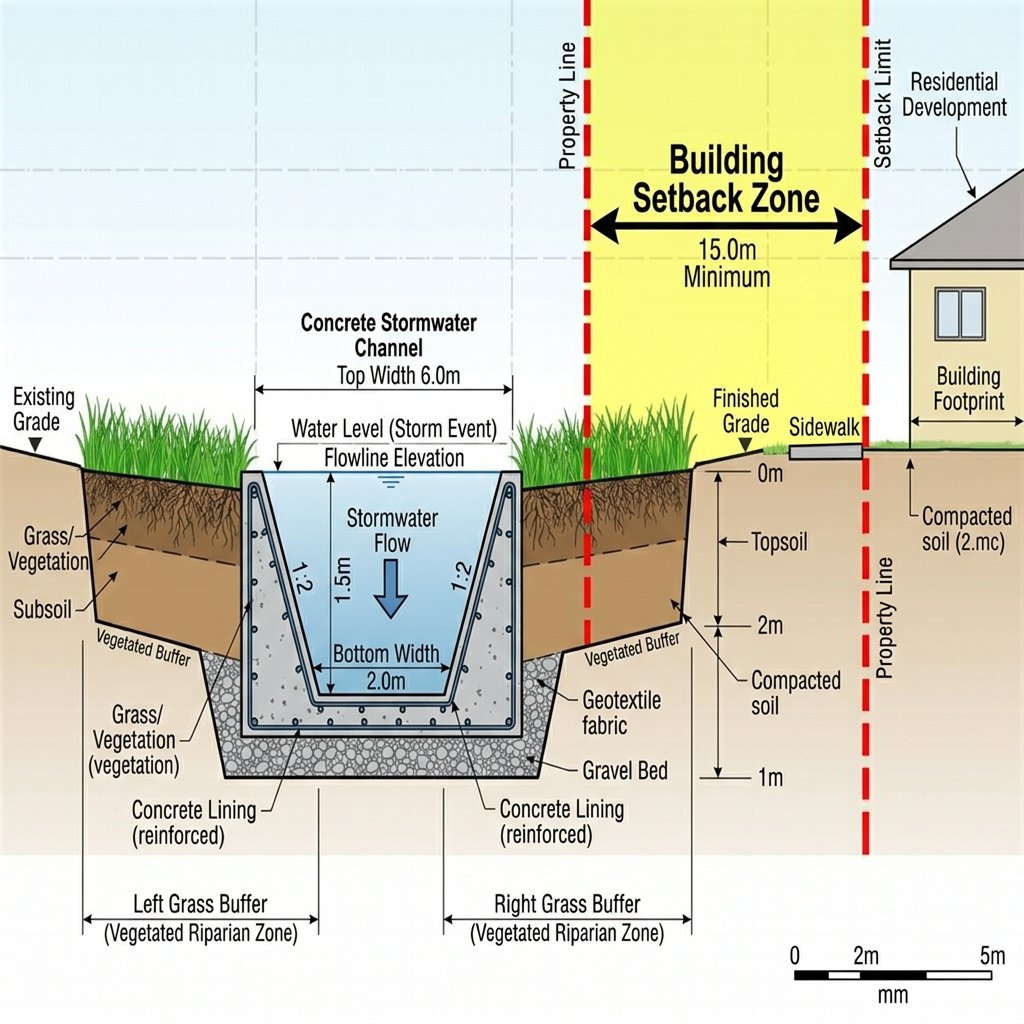
1. Statutory Setback Brackets from Water Channels
Building setbacks along water pathways scale based on the flow capacity and structural type of the channel:
- Natural River Channels (Sukhbhadar, Lilka, Adhiya): To protect the natural floodplains, a mandatory buffer zone of 30 meters must be left clear of all construction, measured outward from the high flood level (HFL) of the river bank.
- Trunk Stormwater Canals (Width > 10 Meters): For Dholera’s major concrete stormwater canals, developers must maintain a minimum setback of 15 meters from the outer edge of the concrete structure.
- Secondary Drainage Channels (Width 3m to 10m): For medium-sized concrete drainage trenches, a minimum setback of 9 meters is required.
- Micro-Drainage Gutters (Width < 3 Meters): For minor street-side rainwater channels, a minimum clearance of 3.0 meters from the plot boundary is required.
2. Environmental Discharges and Safety Rules
- Untreated Discharge Prohibitions: Sump systems, sewer lines, and industrial pipelines must not discharge wastewater into the stormwater network. The network is reserved exclusively for clean, filtered rainwater runoff.
- Buffer Landscaping Permission: While permanent buildings are prohibited within the buffer setbacks, developers can utilize these spaces for grass lawns, low-growing landscaping shrubs, or open surface parking, provided the surface remains permeable to water.
- Access Requirements: The buffer zone along concrete canals must remain clear of gates and fences to allow municipal crawler cranes and desilting machinery to access the channels for seasonal maintenance.
The table below summarizes DSIRDA drainage buffer requirements:
| Waterway Category / Width | Minimum Setback Buffer | Allowed Activities within Setback | Prohibited Structures |
|---|---|---|---|
| **Natural Rivers (Any Width)** | 30 Meters | Grass landscaping, open pathways, tree belts | Brick walls, RCC foundations, septic tanks |
| **Concrete Trunk Canals (>10m)** | 15 Meters | Open surface parking, driveways, green sod | Fences blocking machinery access, utility sheds |
| **Secondary Canals (3m – 10m)** | 9 Meters | Paved driveways, open storage (non-hazardous) | Permanent guard rooms, generator pads |
| **Micro Street Gutters (<3m)** | 3.0 Meters | Sidewalks, residential setbacks, grass margins | Solid building projections, structural columns |
3. Structural Stabilization Near Canal Setbacks
Because Dholera’s marine clay soil experiences sliding when saturated with water, buildings located adjacent to the drainage setbacks must implement protective engineering measures:
- Sheet Piling: For heavy commercial or industrial foundations built near canal margins, engineers must drive sheet piles to prevent lateral soil shifting toward the canal bed.
- Slope Protection: Raw earth embankments within a property boundary must be reinforced using grass turfing or concrete geo-cells to prevent soil erosion during monsoons.
Frequently Asked Questions (FAQ)
#### What is the setback distance for building near the Sukhbhadar River in Dholera?
Under DSIRDA regulations, a minimum setback of 30 meters must be maintained from the boundary of the river bank, and no concrete construction is permitted within this buffer.
#### Can I use the drainage setback space for parking?
Yes. You can use the setback zones for open-air surface parking, permeable pavements, or green landscaping, provided you do not construct permanent buildings or solid fences that block maintenance machinery.
#### Can industrial factories discharge treated wastewater into Dholera’s stormwater channels?
No. Only clean rainwater runoff is permitted inside Dholera’s stormwater network. All treated industrial wastewater must be recycled within the factory or sent to the central Effluent Treatment Plant (CETP).
Download Dholera SIR 2026 Investor’s Kit
Get instant access to the official planning documents: Dholera Investment Handbook (PDF), 2026 Land Price List, TP Zone & Village Map, and the NRI Buying Guide.

Join The Discussion