

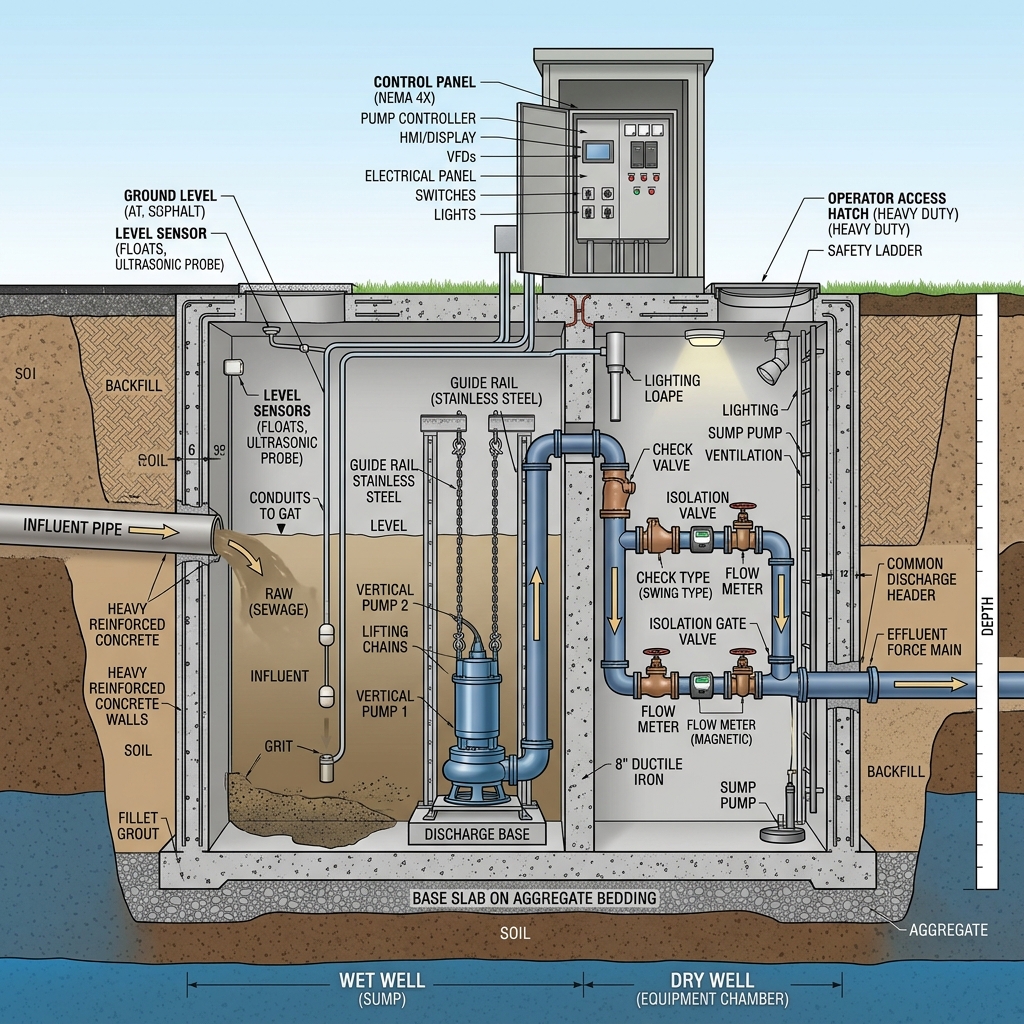
1. The Lift Station Infrastructure Design
Dholera’s lift stations are built using a split wet-well/dry-well underground concrete structure to ensure safety and simple maintenance:
- The Wet Well (Collection Chamber): An underground concrete sump that collects incoming raw sewage. It features ultrasonic level sensors that monitor fluid levels.
- Non-Clog Submersible Pumps: Heavy-duty vertical pumps are lowered into the wet well along stainless steel guide rails. These pumps are equipped with non-clog impellers designed to handle solids without binding.
- The Dry Well (Equipment Chamber): Located adjacent to the wet well, this dry room houses check valves, flow meters, isolation valves, and sump pumps. This layout allows technicians to inspect piping without contact with raw wastewater.
2. SCADA and Automated Telemetry Systems
Every sewage pumping station in Dholera is fully automated, removing the need for manual on-site operation:
- Pumping Control Cycles: When incoming sewage reaches a high level in the wet well, level sensors trigger the primary submersible pump. Once the level drops to a designated low point, the pump shuts off.
- Alternating Pump Rotation: The system alternates operation between two or more pumps to distribute wear evenly and prevent motor overheating.
- ABCD Command Center Alarms: Integrated telemetry transmitters report pump performance, motor temperature, vibration, and flow rates back to the ABCD Building. If a pump experiences a clog or electrical trip, an alarm is triggered, and a backup pump starts immediately.
The table below lists the technical parameters of Dholera’s sewage pumping stations:
| Technical Parameter | Specification / Material | Operational Function |
|---|---|---|
| **Chamber Construction** | Reinforced Cement Concrete (M30/M40) | Underground water-tight containment structure |
| **Pumping Technology** | Submersible Centrifugal Non-Clog Pumps | Grinds solids and pumps wastewater along the loop |
| **Control System** | SCADA-Linked Variable Frequency Drives (VFDs) | Modulates pump speeds based on wet well inflow |
| **Level Telemetry** | Dual Ultrasonic & Backup Float Switches | Controls automated pump start/stop trigger levels |
| **Internal Piping** | Ductile Iron (DI) Class K9 | Resists wear from sand grit and chemical waste |
3. Municipal Advantages of Automated Lift Stations
- Energy Optimization: Variable Frequency Drives (VFDs) adjust pump motor speeds to match incoming sewage flow, reducing energy consumption during low-flow nighttime hours.
- No Odor Release: Wet wells are sealed with air-tight access hatches and connected to active carbon filters, preventing the release of sewer gases into surrounding streets.
- Environmental Protection: Backup diesel generators are installed at primary lift stations to ensure sewage pumping continues during grid power failures, preventing local sewer overflows.
Frequently Asked Questions (FAQ)
#### Why does Dholera require sewage pumping stations?
Because Dholera’s terrain is flat, wastewater cannot flow long distances by gravity alone. Sewage pumping (lift) stations are installed to collect sewage at low points and pump it to higher elevations, allowing it to continue flowing toward the treatment plant.
#### Are Dholera’s sewage lift stations noisy or smelly?
No. The pumping stations are constructed entirely underground. The wet wells are sealed with air-tight covers and equipped with active carbon odor-treatment units to prevent smell leakage.
#### How are pump blockages detected?
The stations are monitored via SCADA. If a pump impellor becomes blocked, the electrical current (amperage) rises, triggering an automated shut-off and flagging the issue at the central ABCD Command Center for maintenance.
Download Dholera SIR 2026 Investor’s Kit
Get instant access to the official planning documents: Dholera Investment Handbook (PDF), 2026 Land Price List, TP Zone & Village Map, and the NRI Buying Guide.

Join The Discussion