Executive Overview
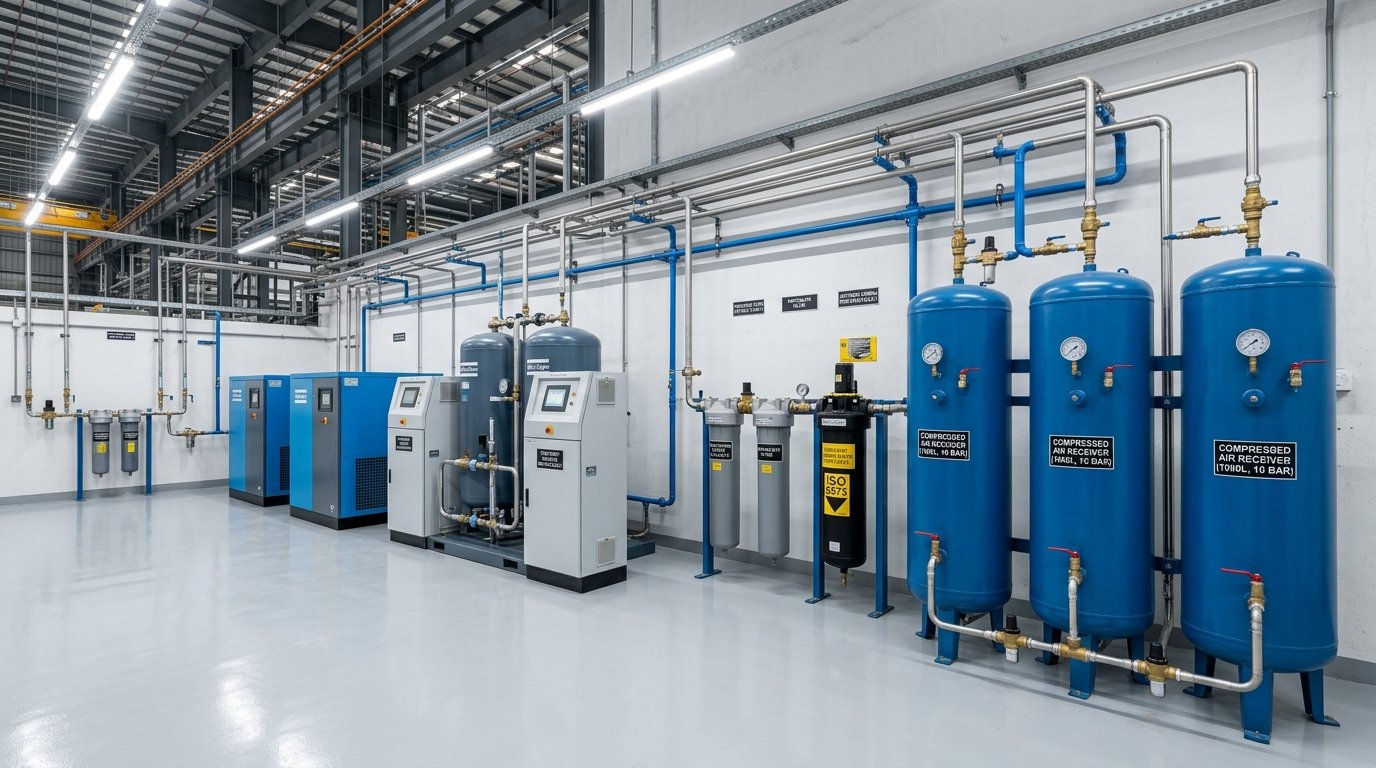
Industrial compressed air systems in Dholera Special Investment Region (DSIR) supply instrument air to process control valves, tool air to production lines, and breathing air to confined-space workers. The quality of compressed air directly affects product quality, instrument reliability, and worker safety. The DSIRDA General Development Control Regulations (GDCR) 2023 Chapter 12.5 (Compressed Air Utilities), NBC 2016 Part 8 Section 2, ISO 8573 (Parts 1–9) (compressed air quality and purity), and IS 10767 (industrial compressed air systems) define the minimum standards for compressed air treatment in Dholera industrial zones.
Uncontrolled moisture, oil carry-over, and particulate contamination in compressed air cause corrosion in pneumatic actuators, false trips in instrument control loops, and product contamination in pharmaceutical or food-grade facilities — all reportable events to DSIRDA’s industrial operations compliance cell.
1. Regulatory Framework
| Code / Standard | Scope |
|---|
| DSIRDA GDCR 2023 Chapter 12.5 | Compressed air quality and distribution |
| NBC 2016 Part 8 Section 2 | MEP utility standards for industrial buildings |
| ISO 8573-1:2010 | Compressed air — contaminant classes |
| ISO 8573-2 | Test for aerosol oil content |
| ISO 8573-4 | Test for solid particle contamination |
| ISO 8573-7 | Test for viable microbiological contamination |
| IS 10767:1999 | Industrial compressed air and gas distribution |
| IS 9428 | Air receivers for compressed air |
| ASME Section VIII Div. 1 | Pressure vessel design (for air receivers > 250 L) |
DSIRDA GDCR 2023 Clause 12.5.1 requires compressed air systems serving process instrumentation to achieve minimum ISO 8573-1 Class 2 purity for particulates, Class 2 for moisture (dew point ≤ −40 °C pdp), and Class 1 for oil content (≤ 0.01 mg/m³).
2. ISO 8573-1 Compressed Air Quality Classes
2.1 Solid Particle Classes
| Class | Maximum Particle Count (per m³) | Max Particle Size |
|---|
| 0 | Better than Class 1 (manufacturer-specified) | — |
| 1 | ≤ 20,000 particles (0.1–0.5 µm) | 0.5 µm |
| 2 | ≤ 400,000 particles (0.1–0.5 µm) | 1.0 µm |
| 3 | ≤ 90,000,000 particles (0.1–0.5 µm) | 5.0 µm |
| 4 | — | 15 µm |
| 5 | — | 40 µm |
| 6 | ≤ 5 mg/m³ (mass concentration) | — |
2.2 Water/Moisture Classes (Pressure Dew Point — pdp)
| Class | Max Pressure Dew Point (°C) | Notes |
|---|
| 1 | −70 °C pdp | Desiccant dryer required |
| 2 | −40 °C pdp | Desiccant dryer (standard industrial) |
| 3 | −20 °C pdp | High-capacity desiccant or refrigerated |
| 4 | +3 °C pdp | Refrigerated dryer (standard) |
| 5 | +7 °C pdp | Refrigerated dryer (relaxed) |
| 6 | +10 °C pdp | Partial drying only |
| 7 | Not specified | No requirement |
2.3 Total Oil Content Classes
| Class | Max Oil (aerosol + vapour + liquid) | Typical Application |
|---|
| 0 | Per manufacturer — better than Class 1 | Pharmaceutical, semiconductor |
| 1 | ≤ 0.01 mg/m³ | Instrument air, food processing |
| 2 | ≤ 0.1 mg/m³ | General industry — DSIRDA instrument air minimum |
| 3 | ≤ 1.0 mg/m³ | Tool air, non-critical applications |
| 4 | ≤ 5.0 mg/m³ | Heavy construction tools |
| 5 | ≤ 25 mg/m³ | Pneumatic conveying (dry materials) |
| X | > 25 mg/m³ | Special applications only |
3. Dryer Technologies and Selection
3.1 Refrigerated Compressed Air Dryer
| Parameter | Specification |
|---|
| Achieved dew point | +3 °C to +10 °C pdp (ISO Class 4–5) |
| Operating principle | Compressed air cooled below dew point → condensate separated |
| Cooling medium | Refrigerant (R134a, R410A, or HFO variants) |
| Energy consumption | 0.5–1.0% of compressor rated power |
| Application | General tool air, non-instrument applications |
| Limitation | Not suitable for below-freezing dew point requirements |
3.2 Desiccant Dryer (Heatless / Heated)
| Parameter | Heatless (PSA) | Heated (TSA) |
|---|
| Achieved dew point | −40 °C to −70 °C pdp (Class 1–2) | −20 °C to −70 °C pdp |
| Regeneration energy | 10–15% of inlet air flow (purge) | External heater (50–70% less purge) |
| Desiccant material | Silica gel or activated alumina | Activated alumina or molecular sieve |
| Cycle time | 5–10 minutes per tower | 4–8 hours per tower |
| Application | Instrument air, pharma, electronics | Large-flow instrument air systems |
| DSIRDA requirement | Mandatory for ISO Class 2 moisture | Recommended for > 500 Nm³/h flow |
3.3 Dryer Selection Matrix (DSIRDA Application)
| Application | ISO Target | Dryer Type | Pre-filter Required |
|---|
| Instrument / control air | 2.2.1 | Desiccant (PSA or TSA) | 1 µm coalescing + 0.01 µm |
| Process air (general) | 4.3.3 | Refrigerated | 3 µm coalescing |
| Tool air (pneumatic tools) | 5.3.3 | Refrigerated | 5 µm particulate |
| Breathing / respiratory | D (ISO 8573-1 Annex D) | Desiccant + HEPA | 0.01 µm + carbon |
| Pharmaceutical / cleanroom | 1.1.1 or 0.0.0 | Desiccant + sterile filter | 0.01 µm + 0.01 µm |
“`
COMPRESSED AIR TREATMENT TRAIN
Compressor → [Aftercooler] → [Moisture Separator]
↓
[Pre-filter 5 µm]
↓
[Refrigerated Dryer] OR [Desiccant Dryer]
↓
[Coalescing Filter 1 µm]
↓
[Coalescing Filter 0.01 µm]
↓
[Activated Carbon Filter] (if oil < 0.01 mg/m³ needed)
↓
[Sterile/HEPA Filter] (pharma/semiconductor)
↓
[Air Receiver/Reservoir]
↓
Distribution to plant
```
4. Filter Specifications
4.1 Coalescing Filter Grades
| Filter Grade | Particle Retention | Oil Removal Efficiency | ISO Downstream Class |
|---|
| General purpose | 5 µm | 5 mg/m³ max | Class 3 oil |
| High efficiency | 1 µm | 0.5 mg/m³ max | Class 2 oil |
| High precision | 0.01 µm | 0.01 mg/m³ max | Class 1 oil |
4.2 Activated Carbon Filter
- Removes oil vapour (≤ 0.003 mg/m³ downstream)
- Replace element every 4000 operating hours or annually (whichever first)
- Downstream sampling port required: test per ISO 8573-5
- Do not use as primary oil removal — place after coalescing filter
4.3 Pressure Drop Monitoring
| Filter Type | New Element ΔP | Change Element at ΔP |
|---|
| 5 µm general | < 0.04 bar | > 0.07 bar |
| 1 µm coalescing | < 0.06 bar | > 0.10 bar |
| 0.01 µm precision | < 0.08 bar | > 0.14 bar |
| Activated carbon | < 0.05 bar | > 0.10 bar |
DSIRDA GDCR Clause 12.5.4 requires differential pressure gauges on each filter element with a visual indicator panel visible to maintenance staff.
5. Air Receiver Specifications (IS 9428 / ASME Section VIII)
| Parameter | DSIRDA Requirement |
|---|
| Volume (as multiple of compressor delivery) | Minimum 5 × free air delivery (Nm³/min) |
| Design pressure | 1.1× maximum allowable working pressure (MAWP) |
| Safety valve | Mandatory — ASME/BIS certified, set ≤ MAWP |
| Drain valve | Automatic timer-operated drain at lowest point |
| Inspection manholes | Mandatory for vessels > 1 m diameter |
| Statutory test | Three-yearly hydrostatic test per Indian Boilers Act |
| Third-party certification | PESO (Petroleum and Explosives Safety Organisation) if > 250 L in DSIR industrial zone |
6. Piping for Compressed Air Distribution
| Parameter | Specification |
|---|
| Main headers | Schedule 40 carbon steel (IS 1239 Medium) — internally clean and dry |
| Branch lines | Carbon steel or copper (IS 1545 Type B) |
| Instrument air | Stainless steel SS316L tubing (OD 6 mm–25 mm) |
| Max velocity | 6 m/s headers, 10 m/s branch |
| Pressure drop (design) | ≤ 0.1 bar across total distribution |
| Loop system | Ring main preferred for installations > 5 outlets |
| Slope | 1:500 slope to low-point drain valves |
| Isolation valves | Ball valves (SS316) at each branch takeoff |
7. Monitoring and Quality Assurance
7.1 Online Instruments (Mandatory per DSIRDA GDCR Cl. 12.5.6)
| Instrument | Location | Parameter |
|---|
| Dew point transmitter | After final dryer | Pressure dew point — alarm at > −35 °C pdp |
| Oil vapour analyser | After carbon filter | Oil content — alarm at > 0.015 mg/m³ |
| Differential pressure gauge | Each filter stage | Element condition |
| Pressure transmitter | Distribution header | Supply pressure |
| Flow meter | Main compressor outlet | Total delivery (Nm³/h) |
7.2 Periodic Quality Testing
| Test | Standard | Frequency |
|---|
| Particulate count | ISO 8573-4 | Semi-annual |
| Oil content (aerosol) | ISO 8573-2 | Annual |
| Oil vapour | ISO 8573-5 | Annual |
| Dew point verification | ISO 8573-3 | Monthly (reference check) |
| Microbiological (pharmaceutical zones) | ISO 8573-7 | Monthly |
FAQ
What ISO 8573 quality class is required for instrument air in Dholera industrial facilities?
DSIRDA GDCR 2023 Clause 12.5.1 requires a minimum of **ISO 8573-1 Class 2** for particulates, **Class 2** for moisture (dew point ≤ −40 °C pdp), and **Class 1** for oil content (≤ 0.01 mg/m³) for compressed air serving process instrumentation in Dholera industrial zones.
When is a desiccant dryer mandatory versus a refrigerated dryer in Dholera?
A **desiccant dryer** (PSA or TSA type) is mandatory whenever instrument air, pharmaceutical process air, or electronics manufacturing air is required — these need ISO 8573 Class 2 moisture (−40 °C pdp) or better, which refrigerated dryers cannot achieve. Refrigerated dryers (achieving +3 to +10 °C pdp) are acceptable only for tool air and general non-critical applications.
Is PESO certification required for air receivers in Dholera SIR?
Yes. DSIRDA GDCR 2023 requires PESO (Petroleum and Explosives Safety Organisation) third-party certification for compressed air receivers exceeding **250 litres capacity** in Dholera industrial zones. All receivers also require a three-yearly hydrostatic test per the Indian Boilers Act.
What is the maximum compressed air velocity allowed in distribution headers in Dholera?
DSIRDA GDCR 2023 and IS 10767 limit compressed air velocity to **6 m/s in main headers** and 10 m/s in branch lines. Exceeding these limits causes excessive pressure drop, turbulence, and re-entrainment of moisture from pipe walls into the air stream.
How often must the activated carbon filter element be replaced in a Dholera compressed air system?
Activated carbon filter elements must be replaced every **4000 operating hours or annually**, whichever occurs first, per DSIRDA GDCR Clause 12.5.4 and manufacturer guidance. A downstream oil vapour analyser alarm set at 0.015 mg/m³ is also required to detect element breakthrough.
Free Investor ResourceDownload Dholera SIR 2026 Investor’s Kit
Get instant access to the official planning documents: Dholera Investment Handbook (PDF), 2026 Land Price List, TP Zone & Village Map, and the NRI Buying Guide.



Join The Discussion