

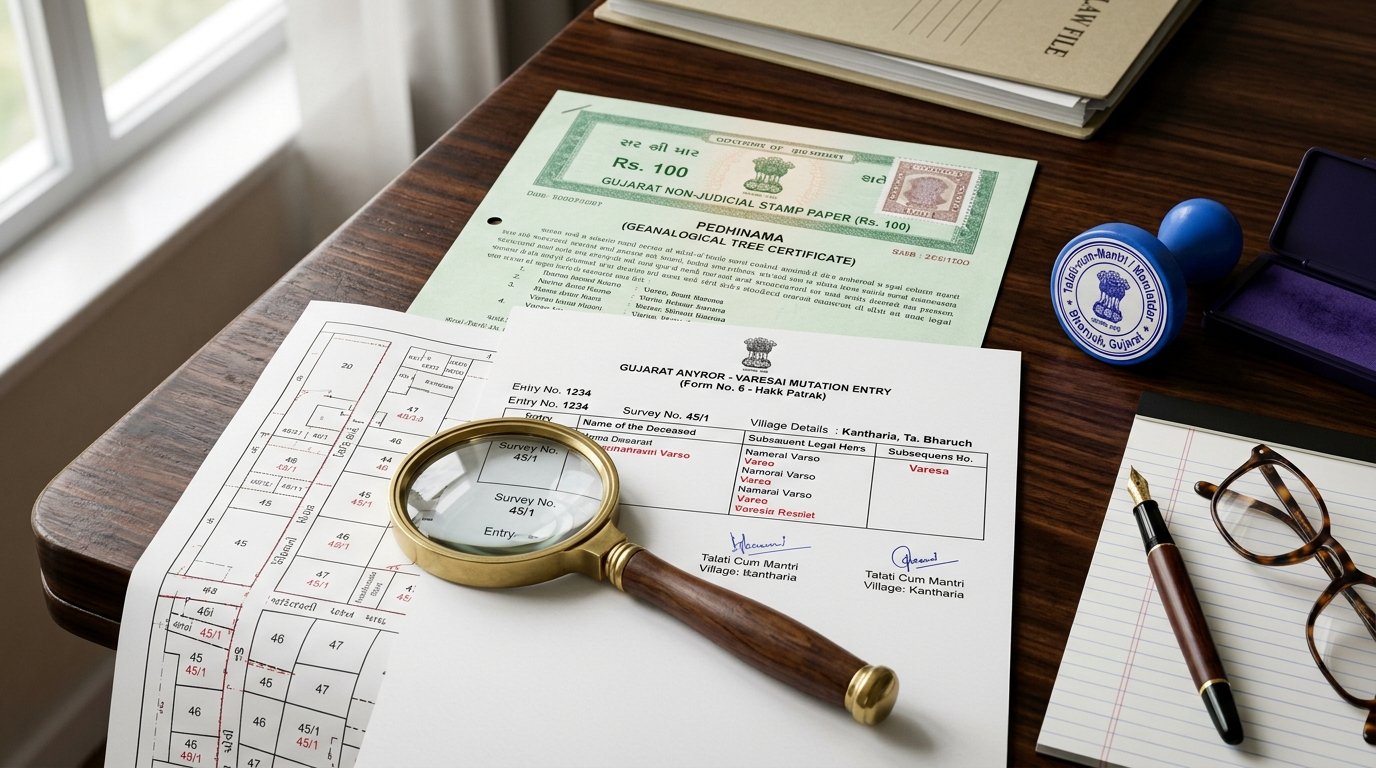
What is a Pedhinama and Varsai in Gujarat Land Law?
In Gujarat revenue administration, hereditary land rights follow a rigorous statutory verification procedure governed by the Gujarat Land Revenue Code, 1879:
“` +—————————————————————————————————-+
| GUJARAT ANCESTRAL VARSAI & PEDHINAMA WORKFLOW | ||
|---|---|---|
| [Deceased Khatedar (Landowner Passes Away)] | ||
| v | ||
| [Drafting of Pedhinama (Genealogical Tree Affidavit / Panchkyas)] | ||
| v | ||
| [Talati-cum-Mantri Field Inquiry & Village Panchnama Verification] | ||
| v | ||
| [Submission of Varsai Application (Revenue Entry in Village Form 6)] | ||
| v | ||
| [Issuance of Statutory 30-Day Public Notice Under Section 135D] | ||
| +——————————+——————————+ | ||
| (No Objections Filed) | (Objection Filed) | |
| v v | ||
| [Certified by Mamlatdar / E-Dhara] [Dispute Case to Deputy Collector] | ||
| v | ||
| [Final Update to Village Form 7/12 & 8A Khata] |
+—————————————————————————————————-+ “`
Key Legal Definitions:
- Pedhinama (પેઢીનામું / વારસાઈ આંબો): An official affidavit and genealogical chart certified by the local Talati-cum-Mantri or an Executive Magistrate, documenting all lawful surviving heirs (male, female, direct, and collateral) of a deceased property owner.
- Varsai (વારસાઈ): The formal administrative act of mutating the names of legal heirs onto the government land records (Village Form 7/12 and Form 8A) upon the death of the registered landholder.
- Village Form 6 (Hakk Patrak – હક્ક પત્રક): The statutory mutation register where every change in land rights—inheritance, sale deeds, mortgages, partitions—is chronologically recorded and certified by the Revenue Mamlatdar.
Step-by-Step: How to Verify Varsai Entries Online via AnyROR
The Gujarat Revenue Department enables digital tracking of all historical mutation entries through the AnyROR (Any Records of Rights Anywhere in Gujarat) portal:
Step 1: Access the Official AnyROR Portal
- Navigate to the official Gujarat Government revenue portal: `anyror.gujarat.gov.in`.
- Select the “View Land Record – Rural” (ગ્રામ્ય જમીનનો રેકોર્ડ) section.
Step 2: Select Village Form 6 (Hakk Patrak)
- Under the dropdown menu, select “VF-6 Entry Details” (ગામ નમૂના નંબર ૬ ની વિગતો).
- Choose your administrative details:
- District: Ahmedabad
- Taluka: Dholera
- Village: (e.g., Mingalpur, Kadipur, Hebatpur, or Gorasu)
Step 3: Enter the Specific Mutation Entry Number
- Enter the mutation entry number corresponding to the Varsai transaction (found in the “Other Rights” / “ઈતર હક્ક” column of Village Form 7/12).
- Complete the captcha security code and click “Generate Details”.
Step 4: Analyze the Certified Form 6 Extract
- Verify the exact date on which the Varsai entry was made by the Talati.
- Confirm whether the entry status is marked as “Pramanit” (પ્રમાણિત – Certified/Sanctioned) by the competent Revenue Mamlatdar or remains “Kacchi Entry” (કચ્ચી નોંધ – Uncertified/Pending).
- Review the list of all recorded heirs to confirm that every family member identified in the Pedhinama was formally entered onto the record.
Critical Risks: What to Look for in a Pedhinama & Varsai
Ancestral land transactions are vulnerable to several common legal defects. Diligent investors must inspect:
| Potential Legal Hazard | Legal Risk & Statutory Implication | Diligence & Verification Protocol |
|---|---|---|
| Omission of Married Daughters | Under the Hindu Succession (Amendment) Act, 2005, daughters hold equal coparcenary rights by birth. Omitting married daughters renders the sale voidable. | Inspect the Pedhinama to ensure all surviving and deceased daughters are named, and insist on registered relinquishment deeds (Hakk Sod Kamal). |
| Uncertified “Kacchi” Entries | A Varsai entry recorded by the Talati but not yet certified by the Mamlatdar has no legal finality and can be challenged. | Verify that Form 6 reflects an official certification endorsement with Mamlatdar stamp and date. |
| Minor Legal Heirs | If any surviving heir was a minor at the time of property disposal, sale without prior District Court guardianship permission is unlawful. | Check birth dates on family tree records; verify District Court order under the Guardians and Wards Act if minor rights were alienated. |
| Fraudulent or “Private” Pedhinamas | A self-attested private affidavit without Talati inquiry or village panchnama carries minimal evidentiary weight in court. | Insist on a formal Revenue Pedhinama (તલાટીનું પેઢીનામું) prepared following local panchnama inquiry and entered into the government register. |
| Suppression of First Wife / Children | In cases of remarriage, children or widows from earlier marriages are occasionally concealed from the revenue affidavit. | Conduct independent on-ground village inquiry with local elders, Sarpanch, and village revenue staff. |
The Indispensable Role of Registered Relinquishment Deeds (Hakk Sod Kamal)
When ancestral land is sold by selected family members (for instance, brothers selling land while sisters choose not to take a share), a simple oral statement or unnotarized letter of consent is legally insufficient:
- Mandatory Registration: Under the Indian Registration Act and Gujarat Revenue Department circulars, any surrender of ancestral property rights must be executed through a Registered Release Deed (હક્ક છોડ દસ્તાવેજ – Hakk Sod Kamal) with proper stamp duty paid at the Sub-Registrar Office.
- Subsequent Mutation: The release deed must be entered as a fresh mutation entry in Village Form 6 and certified by the Mamlatdar, officially deleting the releasing co-heir’s name from Form 7/12.
For additional guidance on related legal records, read our comprehensive guides on How to Check 7/12 Utara Online Gujarat, downloading Form 8A Khatiyan on AnyROR, and securing an Index-2 Copy Online via GARVI.
Step-by-Step Title Due Diligence Protocol for Land Buyers
Before transferring funds or executing a registered sale deed for ancestral land in Dholera SIR:
- Obtain Certified Pedhinama Copy: Secure a certified true copy of the official Pedhinama from the Talati office along with the underlying village Panchnama statements.
- Cross-Check with Birth & Death Certificates: Cross-verify the registered dates of death of the previous khatedars with municipal death registry records.
- Verify All Form 6 Mutation Entries for 30 Years: Track the chain of title chronologically through every mutation entry in Village Form 6 spanning at least 30 years.
- Issue Public Notice in Vernacular Newspapers: Publish a formal 14-day title clearance public notice in a widely circulated Gujarati daily newspaper (e.g., Gujarat Samachar, Sandesh) inviting legal heir claims.
- Secure an Advocate’s Title Clearance Certificate: Mandate that an independent Gujarat High Court or revenue advocate issue a formal written 30-Year Title Search and Clearance Report.
Statutory Legal & Land Verification Disclaimer
> [!NOTE] > Land title verification procedures, AnyROR digital records, and inheritance laws referenced herein are based on the Gujarat Land Revenue Code, 1879, the Hindu Succession Act, 1956 (as amended), and published Gujarat Revenue Department administrative guidelines. Revenue entries do not confer absolute proprietary title; they serve as fiscal records for taxation and administrative presumption of rights. All prospective land purchasers must engage an independent qualified revenue advocate to conduct primary title searches before executing property transactions.
Frequently Asked Questions (FAQs)
#### Can I verify a Pedhinama online in Gujarat?
While the text of a private genealogical affidavit may not be fully digitized as an image, you can verify the official succession mutation entry resulting from that Pedhinama online via AnyROR. By accessing Village Form 6 (VF-6 Entry Details), you can view the complete list of mutated legal heirs and the Mamlatdar’s certification status.
#### What happens if a daughter’s name was left out of the Pedhinama?
Under the Hindu Succession (Amendment) Act, 2005, daughters possess equal ancestral inheritance rights by birth. If a daughter is excluded from a Pedhinama and Varsai, she or her legal descendants can file a revenue appeal or civil lawsuit challenging any subsequent sale of the property.
#### What is the difference between a Kacchi Entry and a Pakki Entry in Form 6?
A Kacchi Entry (કચ્ચી નોંધ) is a preliminary mutation entry made by the village Talati. A 30-day statutory notice is served under Section 135D for objections. Once the 30 days lapse without valid objection, the Revenue Mamlatdar confirms it as a Pakki Entry (પ્રમાણિત નોંધ), legally updating Forms 7/12 and 8A.
#### Who is the competent authority to issue a legal Pedhinama in Gujarat?
In rural Gujarat and Dholera Taluka, the official Pedhinama is prepared and attested by the local Talati-cum-Mantri following an on-ground inquiry and signed panchnama of respectable local village residents, or certified by an Executive Magistrate / Mamlatdar.
Download Dholera SIR 2026 Investor’s Kit
Get instant access to the official planning documents: Dholera Investment Handbook (PDF), 2026 Land Price List, TP Zone & Village Map, and the NRI Buying Guide.



Join The Discussion