

Executive Overview
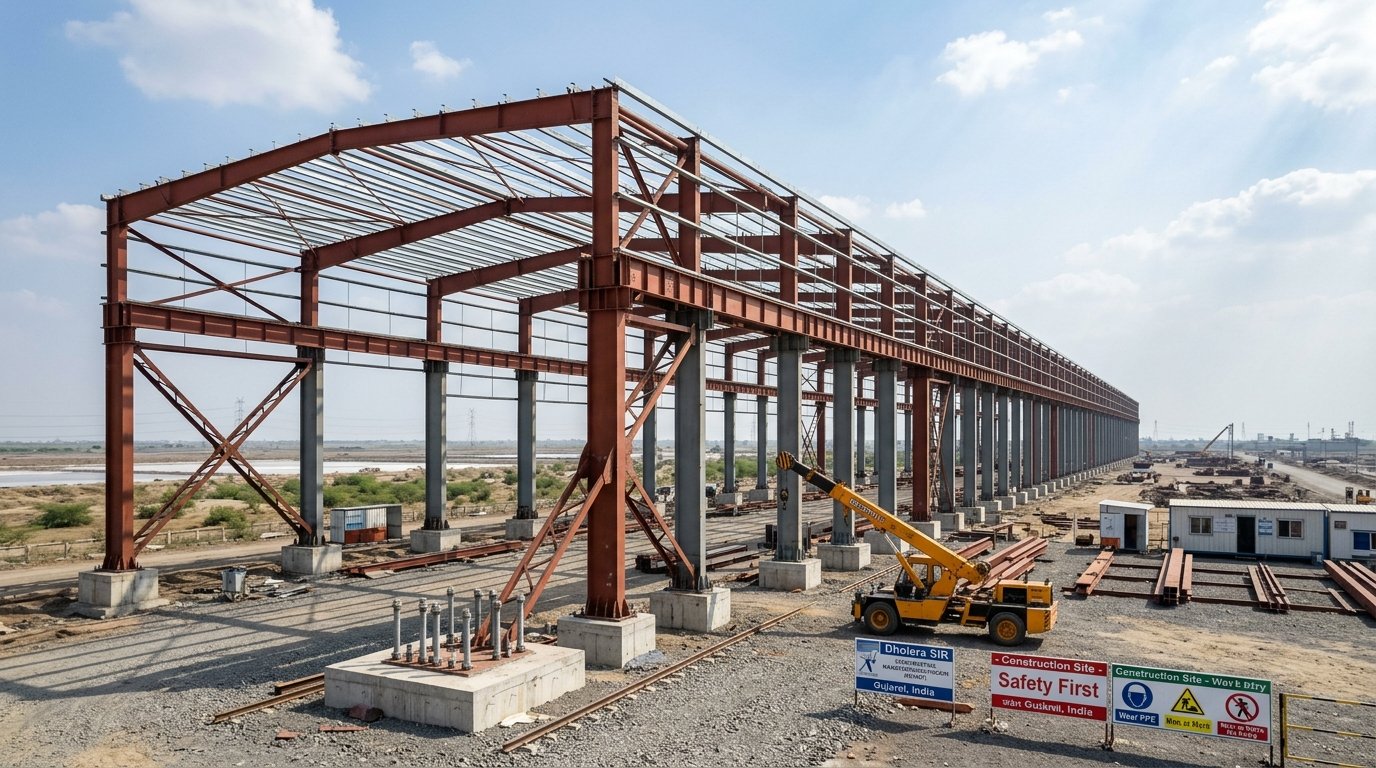
Factory buildings in Dholera Special Investment Region (DSIR) are predominantly constructed as pre-engineered steel buildings (PEB) or conventional welded steel portal frame structures. All structural steel must comply with DSIRDA General Development Control Regulations (GDCR) 2023 Chapter 3 (Structural Design), IS 800:2007 (General Construction in Steel — Code of Practice), IS 2062:2011 (Hot Rolled Medium and High Tensile Structural Steel), IS 1977 (structural steel standard quality), NBC 2016 Part 6 Section 1, and IS 1893 (Part 4):2015 (earthquake resistant design — industrial structures).
Dholera’s seismic zone (Zone III per IS 1893), wind speed (Vb = 47 m/s per IS 875 Part 3, Zone I of Gujarat), and expansive black cotton soil sub-layer in parts of DSIR impose specific structural requirements that differ from standard industrial steel design elsewhere in Gujarat.
1. Regulatory Framework
| Code / Standard | Scope |
|---|---|
| DSIRDA GDCR 2023 Chapter 3 | Structural design regulations |
| IS 800:2007 | Design of steel structures — limit state method |
| IS 2062:2011 | Structural steel plate, sections, and bars |
| IS 1977:1975 | Structural steel standard quality |
| IS 1893 (Part 4):2015 | Earthquake design — industrial structures |
| IS 875 (Part 1–5) | Dead, live, wind, snow, and special loads |
| IS 875 (Part 3):2015 | Wind loads on buildings |
| NBC 2016 Part 6 Section 1 | Structural design general requirements |
| IS 9595 | Welding of structural steel — procedure |
| IS 1608 | Tensile testing of metallic materials |
DSIRDA GDCR 2023 Clause 3.2.1 mandates that all structural steel designs for industrial buildings exceeding 500 m² or 6 m height be prepared by a licensed Structural Engineer (DSIRDA-registered), accompanied by structural drawings, calculations, and soil investigation reports submitted before building permit issuance.
2. Steel Grade Selection (IS 2062:2011)
| Grade | Yield Strength (MPa) | Ultimate Tensile Strength (MPa) | Elongation (%) | DSIRDA Use |
|---|---|---|---|---|
| E250A (Fe410WA) | 250 | 410 | 23 | General sections, angles, channels |
| E250B (Fe410WB) | 250 | 410 | 23 | Impact-tested for low-temp exposure |
| E300 (Fe440) | 300 | 440 | 22 | PEB main frames, rafter beams |
| E350 (Fe490) | 350 | 490 | 22 | Column bases, heavily loaded members |
| E410 (Fe540) | 410 | 540 | 20 | High-strength columns, tension members |
| E450D (Fe570) | 450 | 570 | 20 | High-rise frames, special structures |
DSIRDA Default: DICDL infrastructure connections (column base to ground anchor) must use minimum E350 grade. PEB main frames commonly use E300 or E350 per IS 2062:2011.
3. Section Profiles Used in Dholera Factory Structures
3.1 Hot-Rolled Sections (IS 808)
| Section | Description | Typical Use |
|---|---|---|
| ISMB (Indian Standard Medium-weight Beam) | I-section | Secondary beams, purlins (≤ 6 m span) |
| ISWB (Indian Standard Wide-Flange Beam) | Wide-flange I | Main beams, transfer beams |
| ISHB (Indian Standard H-section Beam) | H-profile | Columns (bending + compression) |
| ISMC (Channel) | Channel section | Girts, bracing, secondary members |
| ISA (Angle) | Equal/unequal angle | Bracing, connection plates |
| ISHT (T-section) | T-profile | Chord of built-up trusses |
3.2 Pre-Engineered Building (PEB) Sections
| Member | Section Type | Typical Dimensions | Notes |
|---|---|---|---|
| PEB Column | Built-up variable I-section | Depth 300–800 mm | Tapered for efficiency |
| PEB Rafter | Built-up tapered I-section | Depth 250–600 mm | Deeper at eave, shallow at ridge |
| Purlin | Z-purlin or C-purlin (cold-formed) | 200–250 mm depth | Galvanized, IS 811 |
| Girt | C-section (cold-formed) | 150–200 mm | Galvanized, IS 811 |
| Eave strut | C or modified Z-section | 250 mm | Connects rafter to wall |
| Ridge beam | Built-up I | 250 mm | At roof apex |
4. Design Method — IS 800:2007 Limit State Design
4.1 Partial Safety Factors
| Load Combination | γf (Load Factor) | γm (Material Factor) |
|---|---|---|
| DL + LL | 1.5 | 1.10 (steel) |
| DL + LL + WL/EL | 1.2 | 1.10 |
| DL + WL/EL (max wind/earthquake) | 0.9 DL + 1.5 WL | 1.10 |
| DL + LL + Thermal | 1.2 | 1.10 |
4.2 Member Capacity Checks
Per IS 800:2007 Chapter 8–10:
Tension member: $$T_d = \frac{f_y \cdot A_g}{\gamma_{m0}} \text{ or } \frac{0.9 f_u \cdot A_n}{\gamma_{m1}}$$
Compression member (column): $$P_d = \frac{A \cdot f_{cd}}{\gamma_{m0}}$$
Where f_cd is design compressive strength accounting for buckling: $$f_{cd} = \frac{f_y / \gamma_{m0}}{\phi + (\phi^2 – \lambda^2)^{0.5}}$$
Beam bending capacity: $$M_d = \frac{Z_p \cdot f_y}{\gamma_{m0}}$$
(for compact section — check lateral torsional buckling for spans > 4 m)
5. Wind and Seismic Load Design
5.1 Wind Load (IS 875 Part 3:2015)
Dholera SIR wind parameters: – Basic wind speed (Vb): 47 m/s (Gujarat Wind Zone I) – Terrain category: 2 (open flat terrain with scattered obstructions) – Design life factor (k1): 1.07 for 100-year design life; 1.0 for 50-year – Design wind speed: Vz = Vb × k1 × k2 × k3
| Height (m) | k2 (Terrain Cat 2) | Design Wind Speed Vz (m/s) | Design Wind Pressure (N/m²) |
|---|---|---|---|
| Up to 10 m | 1.00 | 47.0 | 1318 |
| 10–15 m | 1.05 | 49.4 | 1457 |
| 15–20 m | 1.07 | 50.3 | 1509 |
| 20–30 m | 1.12 | 52.6 | 1651 |
DSIRDA GDCR 2023 Clause 3.4.1: Wind uplift on roof cladding must be calculated with pressure coefficients for enclosed and open buildings per IS 875 Part 3 Appendix. PEB roof purlins must be designed for net uplift including internal positive pressure.
5.2 Seismic Load (IS 1893 Part 4:2015)
| Parameter | Dholera Value |
|---|---|
| Seismic Zone | Zone III |
| Zone Factor (Z) | 0.16 |
| Response Reduction Factor (R) | 4.0 (SMRF), 3.0 (OMRF) |
| Importance Factor (I) | 1.5 (critical industrial), 1.0 (ordinary) |
| Soil Type | Type II (medium stiffness) for most DSIR zones |
Base shear: $V_B = \frac{Z \times I \times S_a / g}{2R} \times W$
DSIRDA GDCR Clause 3.4.2 requires Special Moment Resisting Frame (SMRF) for buildings with toxic/flammable material storage (Importance Factor I = 1.5) to ensure structural integrity during seismic events preventing chemical release.
6. Connection Design
6.1 Bolted Connections
| Parameter | DSIRDA / IS 800:2007 Requirement |
|---|---|
| Minimum bolt grade | Grade 8.8 (IS 1367) for structural connections |
| Bolt holes | Standard clearance: bolt dia + 2 mm; oversized: bolt dia + 4 mm |
| Min edge distance | 1.5 × bolt dia (sheared edge); 1.2 × bolt dia (rolled edge) |
| Min pitch | 2.5 × bolt dia |
| Bolt inspection | Torque-verified with calibrated torque wrench — DSIRDA mandatory |
| High-strength bolts (HSFG) | Grade 10.9 at friction-critical joints (column splices) |
6.2 Welded Connections
| Parameter | Specification |
|---|---|
| Welding standard | IS 9595 (arc welding) — qualified welding procedure (WPS) |
| Welder qualification | IS 7307 — certified welder’s test |
| Fillet weld min size | 6 mm for plates ≤ 20 mm; 8 mm for plates > 20 mm |
| Full penetration butt weld | At moment connections, column base plates |
| NDT requirement | 10% random UT testing of critical welds (DSIRDA Clause 3.5.2) |
| Weld inspection | Third-party NDT agency, DSIRDA-approved |
6.3 Column Base Plate
| Parameter | Specification |
|---|---|
| Min plate thickness | Calculated per IS 800 Clause 7.4 — typically 25–50 mm |
| Anchor bolt grade | IS 1367 Grade 8.8 or IS 5624 (foundation bolts) |
| Grout bed | Non-shrink cementitious grout min 50 mm thick under base plate |
| Holddown bolt projection | Min 200 mm into RCC pedestal |
| Corrosion protection | Epoxy-coated anchor bolts for Dholera saline soil |
7. Corrosion Protection and Fire Protection
7.1 Corrosion Protection (DSIRDA GDCR Clause 3.6)
| Environment Class | Classification for Dholera | Coating System |
|---|---|---|
| C3 (Medium-high) | Internal factory, protected | 75 µm Epoxy primer + 50 µm Polyurethane finish |
| C4 (High) | External exposed steel, coastal proximity | 125 µm Zinc-rich epoxy + 125 µm Epoxy MIO + 50 µm PU |
| C5-I (Very high — industrial) | Chemical splash zones | 200 µm Epoxy zinc + 200 µm Epoxy, 75 µm PU |
| Im2 (Immersion) | Buried base plates | Hot-dip galvanising 85 µm (IS 4759) + epoxy |
7.2 Fire Protection (NBC 2016 / DSIRDA Clause 10.3)
| Fire Resistance Required | Protection Method | Application |
|---|---|---|
| 30 min (standard) | Intumescent coating — Nullifire/Sherwin-Williams type | Columns, main beams |
| 60 min (hazardous occupancy) | Intumescent coating or sprayed mineral fibre | All structural members |
| 120 min (critical structure) | Concrete encasement or vermiculite spray | Escape route frames |
FAQ
What steel grade is recommended for PEB main frames in Dholera SIR industrial buildings?
DSIRDA GDCR 2023 and IS 2062:2011 recommend **E300 (Fe440)** or **E350 (Fe490)** for PEB main frame columns and rafters in Dholera. E300 provides 300 MPa yield strength sufficient for standard industrial spans (15–30 m). E350 is preferred for columns at DICDL infrastructure connections and heavily loaded frames. Column bases must be E350 minimum.What is the design wind speed for factory buildings in Dholera SIR?
The basic wind speed for Dholera SIR is **47 m/s** (Gujarat Wind Zone I per IS 875 Part 3:2015). After applying terrain category 2 coefficients, the design wind speed at 10 m height is approximately 47 m/s, producing a design wind pressure of approximately 1318 N/m². PEB roof purlins must be designed for net wind uplift per IS 875 Part 3 pressure coefficients.What seismic zone is Dholera SIR and what does it mean for structural design?
Dholera SIR falls in **Seismic Zone III** per IS 1893 with Zone Factor Z = 0.16. Industrial buildings storing toxic or flammable materials require Importance Factor I = 1.5 and must use Special Moment Resisting Frames (SMRF) with R = 4.0. This means these buildings are designed for higher lateral forces — typically 6% of the building’s seismic weight as base shear.Is NDT inspection of structural welds mandatory for industrial buildings in Dholera?
Yes. DSIRDA GDCR 2023 Clause 3.5.2 mandates random Ultrasonic Testing (UT) of at least **10% of critical structural welds** by a DSIRDA-approved third-party NDT agency. Full penetration butt welds at moment connections and column base plates must be 100% UT-inspected. Welders must hold IS 7307 certification and weld to a qualified Welding Procedure Specification (WPS) per IS 9595.What corrosion protection coating is required for external structural steel in Dholera?
External exposed steel in Dholera (classified C4 — high corrosivity due to coastal proximity and saline atmosphere) requires a **three-coat system**: 125 µm zinc-rich epoxy primer + 125 µm epoxy micaceous iron oxide (MIO) intermediate + 50 µm polyurethane finish coat. Buried base plates and foundation bolts require hot-dip galvanising to 85 µm (IS 4759) plus additional epoxy coating due to Dholera’s saline groundwater table.Download Dholera SIR 2026 Investor’s Kit
Get instant access to the official planning documents: Dholera Investment Handbook (PDF), 2026 Land Price List, TP Zone & Village Map, and the NRI Buying Guide.

Join The Discussion