

Executive Overview
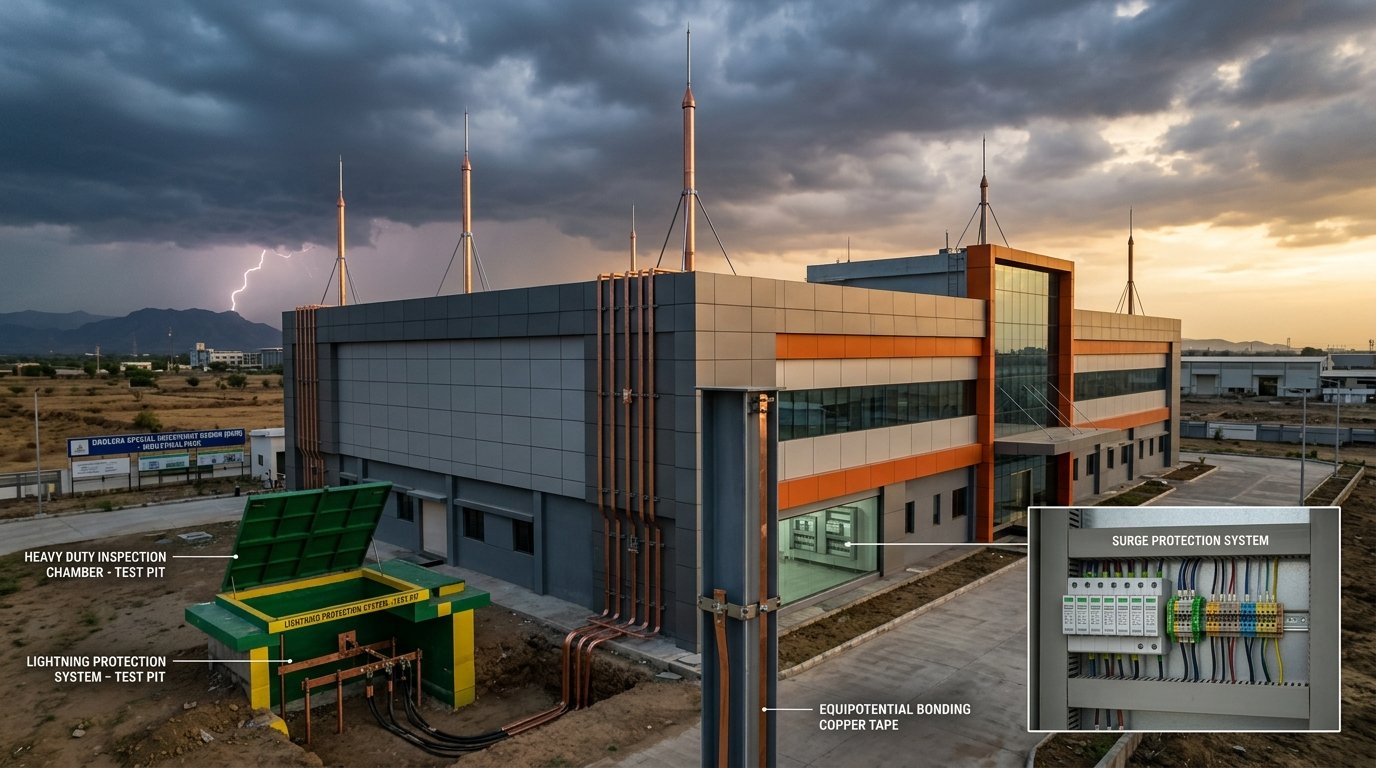
Dholera Special Investment Region (DSIR) lies in Gujarat’s Keraunic Level Zone 20–25 (thunderstorm days per year per IMD data), making lightning protection systems (LPS) a structural safety requirement — not an optional upgrade. The DSIRDA General Development Control Regulations (GDCR) 2023 Chapter 9 (Electrical Safety), NBC 2016 Part 8 Section 3, IS 2309:1969 (Protection of buildings against lightning), and IEC 62305 (Parts 1–4) collectively govern LPS design, installation, and inspection for all industrial, commercial, and institutional buildings in DSIR.
Failure to install a compliant LPS is a disqualifying deficiency during DSIRDA building completion certificate (BCC) inspection. Post-strike damage to unprotected structures in Dholera’s semiconductor and chemical processing zones can cause multi-crore losses.
1. Regulatory Framework
| Code / Standard | Scope |
|---|---|
| DSIRDA GDCR 2023 Chapter 9 | Lightning protection mandatory compliance |
| NBC 2016 Part 8 Section 3 | LPS design norms for Indian buildings |
| IS 2309:1969 | Protection of buildings against lightning |
| IEC 62305-1 | General principles of lightning protection |
| IEC 62305-2 | Risk management — LPS selection |
| IEC 62305-3 | Physical damage to structures |
| IEC 62305-4 | Electrical systems inside structures — SPD |
| IS 3043:1987 | Code of practice for earthing |
| NFPA 780 | Standard for installation of LPS (USA — reference for industrial) |
| IS 13947-1 | Surge protection devices (SPD) |
DSIRDA GDCR 2023 Clause 9.5.1 mandates that all buildings exceeding 15 m in height or exceeding 1000 m² roof plan area must have a complete LPS designed by a licensed electrical engineer (CEA certification) and verified by a DSIRDA-approved third-party inspection agency before BCC issuance.
2. Risk Assessment — Lightning Protection Level (LPL)
Per IEC 62305-2, the design LPL determines all dimensional requirements:
| LPL | Rolling Sphere Radius | Mesh Width | Peak Current (Positive) | Typical Structure |
|---|---|---|---|---|
| I (Highest) | 20 m | 5 m × 5 m | 200 kA | Explosive storage, fuel tanks |
| II | 30 m | 10 m × 10 m | 150 kA | Chemical plants, hospitals |
| III | 45 m | 15 m × 15 m | 100 kA | Commercial buildings > 20 m |
| IV (Minimum) | 60 m | 20 m × 20 m | 100 kA | Low-risk industrial |
Dholera Default: DSIRDA GDCR 2023 Clause 9.5.2 sets LPL III as the minimum for all industrial occupancies in DSIR, with LPL II required for: (a) buildings storing Class I or II flammable liquids, (b) explosive manufacturing zones, (c) data centres, (d) buildings with more than 1000 occupants.
3. Air Termination Network (External LPS — Zone 1)
3.1 Franklin Rod (Conventional Air Terminal)
| Parameter | Specification |
|---|---|
| Material | Solid copper minimum 50 mm² CSA, or stainless steel 78 mm² |
| Height above protected object | Minimum 300 mm above highest metallic projection |
| Fixing | Robust clamp to structural member — no adhesive-only fixing |
| Protection angle method | Per IEC 62305-3 Annex B — only for simple geometries |
3.2 Horizontal Conductor Mesh (Preferred for Flat Roofs)
| LPL | Mesh Size | Conductor Size | Material |
|---|---|---|---|
| I | 5 m × 5 m | Min 50 mm² Cu or 70 mm² Al | Copper/Aluminium |
| II | 10 m × 10 m | Min 50 mm² Cu or 70 mm² Al | Copper/Aluminium |
| III | 15 m × 15 m | Min 50 mm² Cu or 70 mm² Al | Copper/Aluminium |
| IV | 20 m × 20 m | Min 50 mm² Cu or 70 mm² Al | Copper/Aluminium |
Roof Edge Requirement: A continuous horizontal conductor must run along all roof edges at parapet level. Conductor must be fixed at ≤ 1 m intervals using UV-stable clamps.
3.3 Bonding of Roof Metalwork
All metallic items on the roof — HVAC units, exhaust fans, satellite dishes, antenna masts, cooling towers, pipe stacks — must be bonded to the air termination network with conductors of minimum 16 mm² copper. DSIRDA GDCR Clause 9.5.4 prohibits relying on metallic pipework alone as a down conductor without proper sizing verification.
4. Down Conductors (External LPS — Zone 2)
4.1 Number of Down Conductors
| Building Perimeter | Minimum Down Conductors |
|---|---|
| ≤ 40 m | 2 |
| 40–80 m | 4 |
| 80–120 m | 6 |
| > 120 m | One per 20 m of perimeter |
4.2 Routing and Separation
- Down conductors must follow the shortest practicable vertical route from air termination to earth termination
- Separation from doors, windows, and metallic services: minimum 600 mm (IS 2309)
- No sharp bends with radius < 200 mm (sharp bends increase impedance)
- No horizontal runs > 300 mm except at roof and ground level
4.3 Material and Size
| Material | Min CSA — Air Termination | Min CSA — Down Conductor |
|---|---|---|
| Copper (tinned or bare) | 50 mm² | 50 mm² |
| Aluminium | 70 mm² | 70 mm² |
| Copper-clad steel | 50 mm² | 50 mm² |
| Hot-dip galvanized steel | 78 mm² | 78 mm² |
DSIRDA Rule: For buildings in Dholera’s industrial coastal proximity (saline atmosphere classification C3 per ISO 12944), copper or hot-dip galvanized steel is preferred. Pure aluminium conductors require additional corrosion protection below 0.3 m above finished ground level.
5. Earth Termination Network
5.1 Types of Earth Electrodes
| Electrode Type | Typical Resistance | DSIRDA Suitability |
|---|---|---|
| Vertical rod (copper-clad, 3 m) | 5–50 Ω | General industrial |
| Horizontal strip (25 m ring) | 3–20 Ω | Large footprint buildings |
| Ring earth electrode (foundation) | 1–10 Ω | Preferred by DSIRDA for new construction |
| Foundation earth electrode | 1–5 Ω | Best option — embedded in concrete raft |
5.2 Target Earth Resistance Values
| LPL | Maximum Earth Resistance |
|---|---|
| I and II | ≤ 5 Ω (total LPS earthing) |
| III and IV | ≤ 10 Ω |
| DSIRDA GDCR minimum | ≤ 10 Ω for all LPL |
If natural soil resistivity in Dholera alluvial zone exceeds 300 Ω·m, bentonite enhancement (or chemical earth electrode gel) must be used to bring earth resistance below the limit.
5.3 Ring Earth (Foundation Electrode)
DSIRDA GDCR 2023 Clause 9.5.6 recommends the ring earth electrode as the primary termination for all new industrial buildings:
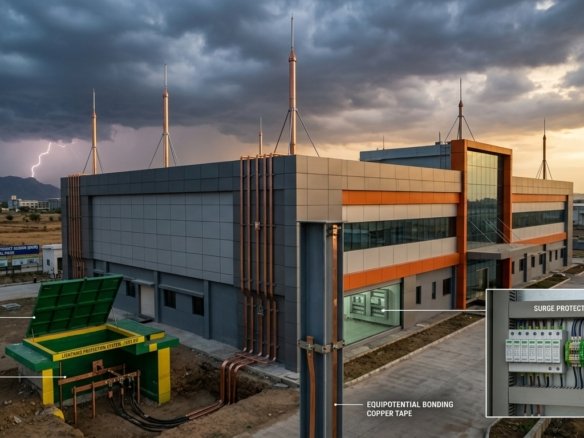
“` PLAN VIEW — Foundation Ring Earth ┌──────────────────────────────┐ │ ◄──── 25 mm² Cu strip ────► │ ← Foundation ring at depth ≥ 0.5 m │ │ │ ○ Test pit ○ Test pit │ ← Inspection chambers at corners │ │ └──────────────────────────────┘ ▲ Down conductor connections at each corner (minimum) “`
6. Equipotential Bonding — Internal LPS
6.1 Bonding Bar
A Main Lightning Equipotential Bonding Bar (MLEBB) must be installed: – Material: Copper flat bar minimum 40 mm × 4 mm – Location: At or near main electrical incoming switchboard – Connections: LPS earth, main power earth, metallic water/gas services, structural steel, IT racks
6.2 Separation Distance (Air Isolation)
If metallic services cannot be bonded at the MLEBB (due to operational constraints), a minimum air separation distance (s) must be maintained between LPS conductors and internal metallic systems:
$$s = k_i \times \frac{k_c}{k_m} \times l$$
Where: – ki = material factor (0.04 for steel, 0.06 for copper) – kc = lightning current sharing factor – km = electrical insulation factor (0.1 for air) – l = length of parallel run (m)
This calculation must be documented in the LPS design submission to DSIRDA.
7. Surge Protection Devices (SPD) — IEC 62305-4
All buildings in DSIR with electronic systems, PLC/SCADA, or data equipment must install SPDs at:
| Location | SPD Type | Category | Max Continuous Voltage |
|---|---|---|---|
| Incoming LV panel (MDB) | Type 1 (Class I) | T1 | Up to Uc rated |
| Sub-distribution boards | Type 2 (Class II) | T2 | Up to Uc rated |
| Equipment terminals (IT, instruments) | Type 3 (Class III) | T3 | Up to Uc rated |
Coordination: SPDs at each level must be coordinated — T1 handles partial lightning current; T2 handles switching surges; T3 handles fine protection. DSIRDA GDCR Clause 9.5.9 requires SPD coordination documentation from the manufacturer.
7.1 SPD Selection Parameters
| Parameter | Type 1 | Type 2 | Type 3 |
|---|---|---|---|
| Impulse current (Iimp) | ≥ 12.5 kA (10/350 µs) | N/A | N/A |
| Nominal discharge current (In) | N/A | ≥ 20 kA (8/20 µs) | ≥ 5 kA |
| Protection level (Up) | ≤ 2.5 kV | ≤ 1.5 kV | ≤ 1.0 kV |
| Standard | IEC 61643-11 | IEC 61643-11 | IEC 61643-11 |
8. Inspection and Testing Schedule
DSIRDA GDCR 2023 Clause 9.5.10 mandates:
| Inspection Type | Frequency | Requirement |
|---|---|---|
| Visual inspection | Annual | All conductors, clamps, bonds, SPDs |
| Earth resistance test | Annual | ≤ 10 Ω (or LPL-specific limit) |
| Continuity test | Every 2 years | All down conductor and earth connections |
| Full LPS certification | Every 5 years | By DSIRDA-approved inspection agency |
| Post-strike inspection | After each strike event | Full system check, replace sacrificed SPDs |
Test instruments: Earth tester (4-pole, IS 10810-compliant) for resistance measurement; Low-resistance ohmmeter (< 1 mΩ resolution) for continuity.
FAQ
Is a lightning protection system mandatory for all buildings in Dholera SIR?
DSIRDA GDCR 2023 Clause 9.5.1 mandates LPS for all buildings exceeding 15 m in height or 1000 m² in roof plan area. For buildings below these thresholds in high-risk occupancies (flammable storage, explosive manufacturing, data centres), DSIRDA can require LPS based on IEC 62305-2 risk assessment outcome.What is the minimum earth resistance required for LPS in Dholera industrial buildings?
DSIRDA GDCR 2023 requires a maximum earth resistance of **10 Ω** for all LPS installations. For LPL I and II structures (chemical plants, data centres), the maximum is 5 Ω per IEC 62305-3. Bentonite-enhanced earth electrodes are used where native soil resistivity is high.How many down conductors are required for a building with a 100 m perimeter in Dholera?
Per IEC 62305-3 (applied by DSIRDA GDCR 2023), a building with an 80–120 m perimeter requires a minimum of **6 down conductors**. For perimeters exceeding 120 m, one down conductor is required per 20 m of perimeter.What type of Surge Protection Device (SPD) is required at the main distribution board in Dholera?
A **Type 1 (Class I) SPD** with an impulse current (Iimp) ≥ 12.5 kA at 10/350 µs waveform is required at the incoming LV main distribution board (MDB) per IEC 62305-4 and DSIRDA GDCR 2023 Clause 9.5.9. Type 2 SPDs are additionally required at sub-distribution boards.How frequently must LPS installations in Dholera be inspected?
Visual inspections are required annually, earth resistance testing annually, full continuity testing every 2 years, and complete LPS certification by a DSIRDA-approved agency every 5 years. A post-strike inspection is mandatory after any lightning strike event.Download Dholera SIR 2026 Investor’s Kit
Get instant access to the official planning documents: Dholera Investment Handbook (PDF), 2026 Land Price List, TP Zone & Village Map, and the NRI Buying Guide.

Join The Discussion