

Executive Overview
Industrial floor coatings in Dholera Special Investment Region (DSIR) are governed by the DSIRDA General Development Control Regulations (GDCR) 2023 Chapter 11 (Industrial Building Finishes), NBC 2016 Part 6 Section 5 (Industrial floors), IS 15477 (epoxy floor topping), BS 8204 Part 6 (synthetic resin floor finishes), and NFPA 77 (where anti-static performance is required). Choosing the wrong coating system leads to delamination, chemical attack, and safety citation from DSIRDA’s building inspectorate.
Dholera’s industrial zones accommodate electronics fabs, pharmaceutical plants, auto-component factories, and chemical processing units — each with sharply different floor performance requirements. This guide maps each zone type to the correct coating specification.
1. Regulatory and Standards Framework
| Code / Standard | Scope |
|---|---|
| DSIRDA GDCR 2023 Chapter 11 | Industrial floor finishing norms |
| NBC 2016 Part 6 Section 5 | Floor loading and surface durability |
| IS 15477 | Epoxy resin floor topping specification |
| BS 8204 Part 6 | Synthetic resin floor finishes — specification |
| NFPA 77 | Recommended practice on static electricity |
| IS 5557 (1983) | Industrial floor surface hardness |
| GPCB Environment Management Guidelines | Chemical-resistant floor drains near processing |
| IS 3812 | Fly-ash for concrete substrate (affects bond adhesion) |
DSIRDA GDCR 2023 Clause 11.2.1 mandates that all floor coatings in industrial occupancies (use group I-2 and above) have a minimum compressive strength of 70 N/mm² for the substrate concrete before application. Coatings applied over inadequate substrates are a non-compliance finding that can block occupancy certificate issuance.
2. Substrate Preparation Requirements
2.1 Surface Preparation Grades
| Method | Standard | Profile Achieved | Required For |
|---|---|---|---|
| Diamond grinding | ICRI CSP 3 | 0.5–1.0 mm | Thin-film coatings (250–500 µm) |
| Shotblasting | ICRI CSP 5–6 | 1.0–2.0 mm | Self-levelling systems (2–4 mm) |
| Scarifying | ICRI CSP 7–8 | 2.0–4.0 mm | Heavy-duty mortar systems (4–6 mm) |
| Acid etching | ICRI CSP 2–3 | 0.3–0.5 mm | NOT permitted in DSIRDA zones (GPCB rule — acid effluent) |
DSIRDA Prohibition: Acid etching of concrete floors is prohibited in Dholera industrial zones under GPCB effluent management rule 2019 Clause 7.3. Mechanical preparation is mandatory.
2.2 Moisture Content Limit
Per IS 15477 and BS 8204-6: – Substrate RH (in-situ hygrometer probe test): ≤ 75% before solvent-free epoxy application – ≤ 85% for moisture-tolerant epoxy systems – Concrete age: minimum 28 days after casting (or 14 days if accelerated curing documented)
2.3 Crack Treatment
- Cracks > 0.3 mm width: Chase out to 12 mm × 12 mm V-notch, clean, fill with epoxy crack filler (minimum tensile strength 25 N/mm²)
- Dormant cracks: Rigid epoxy mortar fill
- Active/moving cracks: Polyurethane flexible sealant (Shore A 30–40) then over-band with 150 mm fibreglass mesh tape bedded in epoxy primer
3. Coating System Types and Selection Matrix
3.1 System Classification
| System | DFT | Application | DSIRDA Zone Suitability |
|---|---|---|---|
| Thin-film epoxy (solvent-based) | 200–400 µm | Dust-proof topping, light traffic | Warehouses, storage — Light Industrial |
| Self-levelling epoxy (solvent-free) | 2–4 mm | General manufacturing, clean rooms | Electronics, auto-components |
| Epoxy mortar topping | 4–9 mm | Heavy forklift traffic, impact zones | Heavy engineering, casting shops |
| Conductive/anti-static epoxy | 2–3 mm | ESD-controlled areas | Semiconductor, pharmaceutical |
| Polyurethane topcoat over epoxy | 50–75 µm | UV stability, outdoor zones | Covered external walkways |
| Chemical-resistant vinyl-ester | 3–6 mm | Acid/alkali splash areas | Chemical processing, battery assembly |
3.2 Selection Flowchart
“` Is area ESD-sensitive (electronics/pharma)? YES ──► Anti-static / conductive epoxy system (NFPA 77 compliant) NO ──► Assess forklift load
Is forklift load > 8 tonnes axle load? YES ──► Epoxy mortar 4–9 mm (DSIRDA heavy-duty class) NO ──► Is chemical splash risk present? YES ──► Vinyl-ester or chemical-resistant epoxy NO ──► Self-levelling epoxy 2–4 mm (standard) “`
4. Anti-Static and Conductive Floor Specifications
NFPA 77 and IEC 61340-5-1 govern electrostatic discharge (ESD) floor performance in semiconductor and pharmaceutical facilities, both of which are major tenants in Dholera SIR.
4.1 Electrical Resistance Requirements
| Classification | Point-to-Point Resistance | Resistance to Ground |
|---|---|---|
| Conductive floor | 2.5 × 10⁴ to 1.0 × 10⁶ Ω | < 1.0 × 10⁶ Ω |
| Dissipative (anti-static) floor | 1.0 × 10⁶ to 1.0 × 10⁹ Ω | < 1.0 × 10⁹ Ω |
| General industrial (non-ESD) | > 1.0 × 10⁹ Ω | No requirement |
4.2 Conductive Grid System
For conductive floors (Resistance < 10⁶ Ω): - Copper tape grid at 1.0 m × 1.0 m centres embedded in primer layer – Grid connected to dedicated earthing electrode at ≤ 5 Ω earth resistance (IS 3043) – Overlapping tape joints: minimum 50 mm lap, soldered
For dissipative floors (10⁶–10⁹ Ω): – Carbon-loaded topcoat without copper grid – Minimum 2 earth connection studs per 200 m² of floor area
5. Coating Layer Build-Up Specification
5.1 Standard Self-Levelling Epoxy System (2–3 mm DFT)
| Layer | Product Type | DFT | Application Method |
|---|---|---|---|
| 1. Epoxy primer | Solvent-free, low-viscosity | 100–150 µm | Roller, 2 coats |
| 2. Epoxy body coat | 100% solids, pigmented | 1.0–1.5 mm | Notched squeegee + roller |
| 3. Epoxy self-levelling top | 100% solids, coloured | 1.0–1.5 mm | Gauge rake + spike roller |
| 4. Polyurethane sealer (optional) | Aliphatic PU | 50–75 µm | Roller |
5.2 Heavy-Duty Epoxy Mortar System (6 mm DFT)
| Layer | Product Type | DFT | Application Method |
|---|---|---|---|
| 1. Epoxy primer | Penetrating, moisture-tolerant | 150–200 µm | Roller brush |
| 2. Epoxy mortar base | Epoxy + quartz aggregate | 4.0–5.0 mm | Trowel |
| 3. Epoxy seal coat | Clear/pigmented | 0.5–1.0 mm | Roller |
| 4. Anti-slip broadcast | Aluminium oxide grit No. 60 | Broadcast into wet seal | Hand broadcast |
Anti-slip requirement: DSIRDA GDCR 2023 Clause 11.3.4 mandates a minimum pendulum test value (PTV) of 36 (wet) for all floor areas in active production zones. Aluminium oxide broadcast achieves PTV 45–55.
6. Colour Coding and Safety Demarcation
DSIRDA GDCR 2023 Clause 11.4 and IS 9457 (safety colours for industrial use) prescribe:
| Zone / Marking | Colour | Pantone Reference |
|---|---|---|
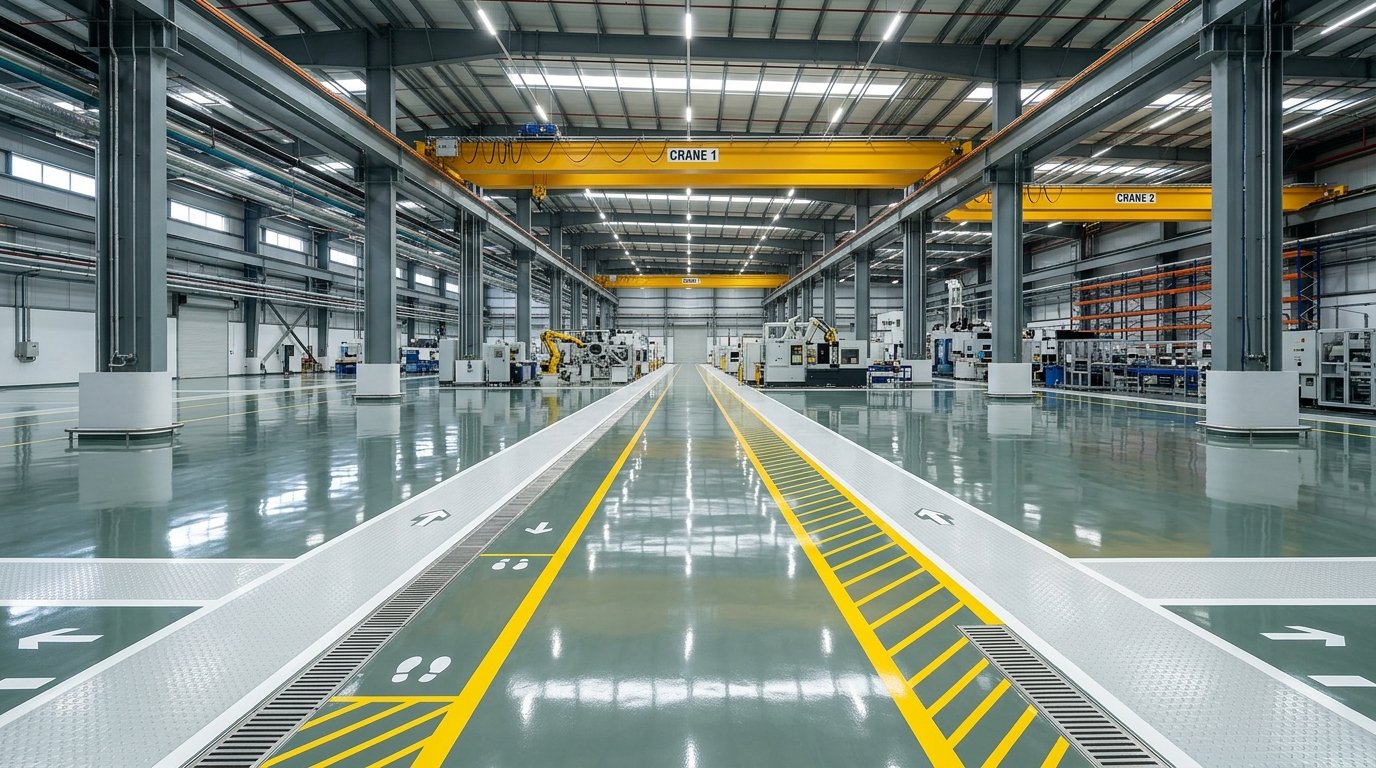
| Pedestrian walkway | Yellow | Pantone 109 C |
| Forklift traffic lane | Yellow striped | 150 mm stripes, 45° |
| Hazardous material storage boundary | Red | Pantone 485 C |
| First-aid station zone | Green | Pantone 362 C |
| Fire extinguisher standpoint | Red circle | 500 mm dia |
| Electrical panel clear zone | Yellow hatching | 900 mm clearance |
| Assembly/inspection area | Blue | Pantone 300 C |
| Production machine footprint | White outline | 50–75 mm line width |
Line widths: minimum 50 mm for pedestrian lanes, 75 mm for forklift lanes per DSIRDA rules.
7. Chemical Resistance Requirements
7.1 Chemical Splash Zones (GPCB Compliance)
Facilities handling acids, alkalis, or solvents must install chemical-resistant floor systems per GPCB Environment Management Guidelines 2019 in designated zones:
| Chemical Class | Coating Type | Min. DFT | Test Standard |
|---|---|---|---|
| Mineral acids (HCl, H₂SO₄ ≤ 30%) | Vinyl-ester | 4.5 mm | ASTM C267 |
| Alkalis (NaOH ≤ 50%) | Epoxy novolac | 3.0 mm | ASTM C267 |
| Organic solvents (IPA, acetone) | Coal-tar epoxy | 3.5 mm | ISO 2812-1 |
| Vegetable/mineral oils | Standard epoxy | 2.0 mm | ISO 2812-1 |
All chemical-resistant zones to include 100 mm coved skirting at the floor-wall junction to prevent liquid ingress under the coating.
8. Maintenance and Recoat Schedule
| Activity | Frequency | Product |
|---|---|---|
| Sweep/mop | Daily | pH-neutral cleaner |
| Deep scrub (single-disc machine) | Weekly | Manufacturer-approved cleaner |
| Inspect for delamination/cracks | Monthly | Visual + tap test |
| Apply sealer topcoat | Every 2–3 years | Aliphatic PU or epoxy sealer |
| Full recoat system | Every 8–12 years | Full system per original spec |
DSIRDA Requirement: A floor maintenance log must be available on-site for DSIRDA building inspection. Delaminated or heavily worn floors in active production zones are grounds for a stop-work notice under GDCR Clause 11.5.
FAQ
What is the minimum concrete strength before applying epoxy floor coating in Dholera industrial buildings?
DSIRDA GDCR 2023 Clause 11.2.1 mandates a minimum substrate concrete compressive strength of **70 N/mm²** before any epoxy coating is applied. Concrete must also be at least 28 days old (or 14 days with documented accelerated curing), and in-situ relative humidity must be ≤ 75% for standard solvent-free epoxy.Is acid etching of concrete floors permitted in Dholera SIR?
No. Acid etching is **prohibited** in Dholera industrial zones under GPCB effluent management rule 2019 Clause 7.3, which restricts acid effluent discharge. All substrate preparation must be done by mechanical methods: diamond grinding (CSP 3), shotblasting (CSP 5–6), or scarifying (CSP 7–8).What electrical resistance is required for an anti-static floor in a semiconductor facility in Dholera?
For ESD-dissipative floors per IEC 61340-5-1 and NFPA 77, the point-to-point resistance must be between **1.0 × 10⁶ Ω and 1.0 × 10⁹ Ω**. For fully conductive floors (higher risk areas), resistance must be **2.5 × 10⁴ to 1.0 × 10⁶ Ω** with a copper grid earthing system at ≤ 5 Ω earth resistance.What are the safety lane marking requirements for factory floors in Dholera?
DSIRDA GDCR 2023 Clause 11.4 requires yellow markings (Pantone 109 C) for pedestrian walkways (minimum 50 mm line width) and yellow-striped markings with 150 mm stripes at 45° for forklift lanes (minimum 75 mm line width). A pendulum test value (PTV) of ≥ 36 (wet) is mandatory for all active production zone floors.How often must industrial epoxy floors in Dholera be recoated?
Sealer topcoats should be reapplied every 2–3 years, and a full recoat system (all layers) is typically needed every 8–12 years depending on traffic intensity. DSIRDA requires a floor maintenance log to be maintained on-site and available during building inspections.Download Dholera SIR 2026 Investor’s Kit
Get instant access to the official planning documents: Dholera Investment Handbook (PDF), 2026 Land Price List, TP Zone & Village Map, and the NRI Buying Guide.

Join The Discussion