

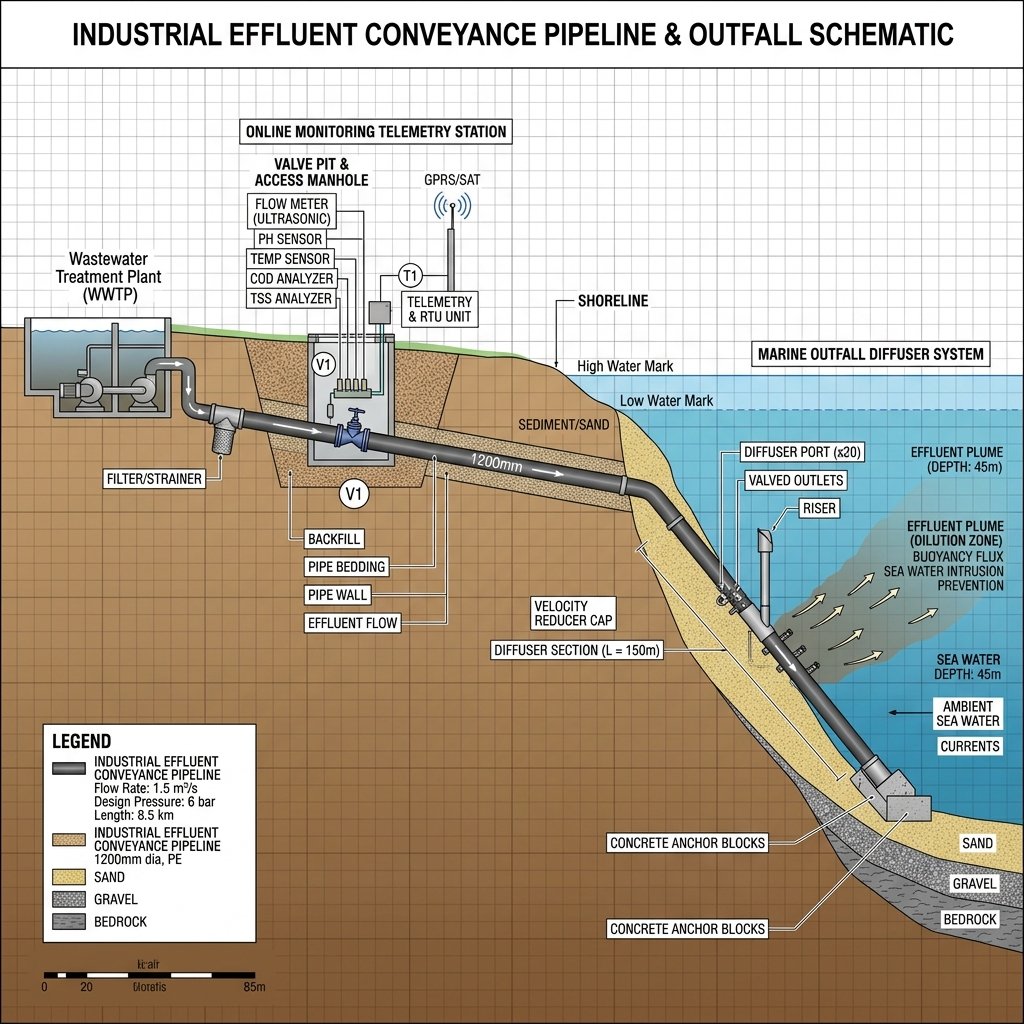
1. Pipe Material Grades & Pressure Standards
Because industrial trade effluent contains corrosive chemical ions, conventional RCC or mild steel pipes are prohibited for effluent conveyance:
- High-Density Polyethylene (HDPE 100 Grade): Underground industrial trunk lines must utilize PE 100 grade HDPE pipes (PN 10 or PN 16 pressure rating) joined via fusion butt-welding to ensure leak-free joints.
- Glass Reinforced Plastic (GRP / FRP): For high-diameter main outfalls ($> 800\text{mm}$ diameter), GRP pipes manufactured with vinyl ester resin liners are required to resist internal chemical corrosion and external saline soil degradation.
- 1.5× Working Pressure Hydro-Test: Prior to commissioning, effluent conveyance lines must undergo hydrostatic pressure testing at 1.5 times the maximum operational design pressure for 24 hours to prove zero joint leakage.
2. Deep-Sea Marine Outfall Diffuser Engineering
To ensure rapid dilution of treated effluent without impacting coastal ecosystems, final treated water is piped offshore into deep ocean waters:
- 2.5 Kilometer Offshore Outfall: The main treated effluent pipeline extends 2.5 kilometers offshore into the deep marine waters of the Gulf of Khambhat, terminating at a minimum water depth of 15 meters below low tide level.
- Multi-Port Diffuser Nozzles: The outfall pipe terminates in a multi-port risers diffuser manifold (featuring duckbill check valves) engineered to achieve an immediate 100:1 volumetric dilution ratio within the initial mixing zone.
- Non-Return Tide Protection: Diffuser ports are equipped with elastomeric duckbill valves that prevent seawater, silt, and marine organisms from entering the outfall pipeline during high tide cycles.
The table below outlines DICDL effluent discharge pipeline specifications:
| Conveyance Pipeline Section | Pipe Material Grade | Pressure Rating (PN) | Jointing Technology | Online Sensor Parameters | Discharge Point |
|---|---|---|---|---|---|
| **Factory Pre-Treatment Outlet** | HDPE PE100 (DN150) | PN 16 (16 Bar) | Butt Fusion Welded | pH, Temp, Flow Meter | Municipal Industrial Drain |
| **Zone CETP Trunk Line** | HDPE PE100 (DN400) | PN 10 (10 Bar) | Electrofusion Welded | pH, TDS, COD, TSS | Central CETP Plant |
| **Main Pumping Outfall Line** | GRP Vinyl Ester (DN1200) | PN 10 (10 Bar) | Bell & Spigot Double Socket | Full CEMS Telemetry Suite | Offshore Pumping Station |
| **Deep Marine Outfall Arm** | Heavy-Duty GRP (DN1200) | PN 12.5 (12.5 Bar) | Concrete Anchored Flange | Salinity & Flow Telemetry | 2.5 km Offshore Diffuser |
3. Online CEMS Telemetry & Emergency Isolation Valves
- 24/7 GPCB Telemetry Links: Outfall pumping stations must maintain continuous online monitoring systems measuring pH, Temperature, Total Dissolved Solids (TDS), Chemical Oxygen Demand (COD), and Total Suspended Solids (TSS). Data streams continuously to GPCB and DICDL servers.
- Automated Motorized Isolation Valves: If any effluent parameter exceeds GPCB discharge limits, SCADA controllers instantly close motorized shut-off valves and divert non-compliant water into emergency holding ponds ($50,000\text{ m}^3$ capacity) for re-treatment.
Frequently Asked Questions (FAQ)
#### What pipe materials are approved for industrial effluent conveyance in Dholera?
Under GPCB and DICDL codes, effluent pipelines must use PE100 grade HDPE or Vinyl Ester GRP (Glass Reinforced Plastic) pipes to resist chemical corrosion.
#### How far offshore is treated effluent discharged in Dholera SIR?
Final treated effluent is piped 2.5 kilometers offshore into the Gulf of Khambhat through multi-port diffusers at a minimum depth of 15 meters.
#### What happens if a factory’s effluent exceeds GPCB discharge limits?
Online CEMS sensors detect non-compliant parameters and trigger automated motorized valves to divert the water into emergency holding ponds, preventing illegal discharge into the outfall network.
Download Dholera SIR 2026 Investor’s Kit
Get instant access to the official planning documents: Dholera Investment Handbook (PDF), 2026 Land Price List, TP Zone & Village Map, and the NRI Buying Guide.

Join The Discussion