

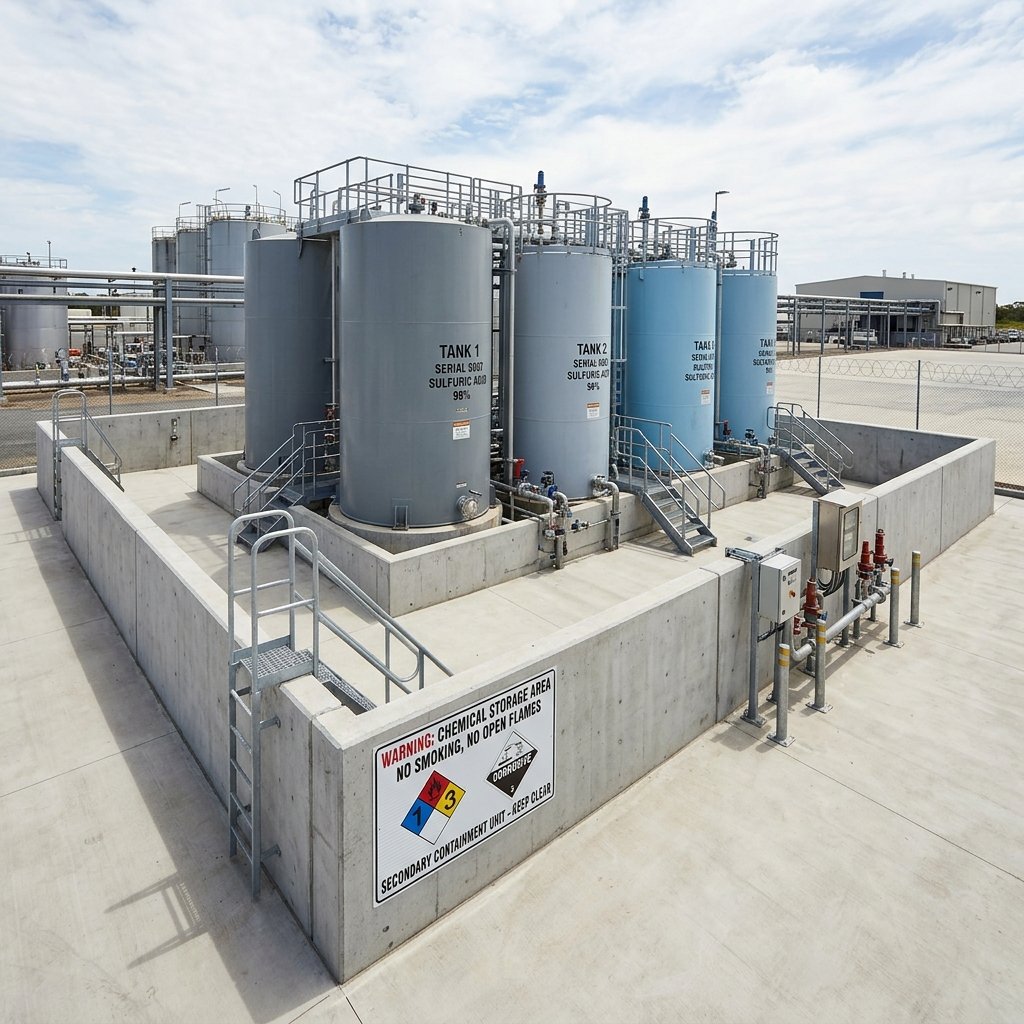
1. Safety Setback Buffers for Chemical Storage
To isolate hazardous storage from adjacent properties, industrial facilities must maintain dedicated safety setbacks:
- Flammable Solvents & Fuel Storage: Bulk storage tanks must be setback at least 15 meters to 25 meters from the property boundary line and from all occupied administration buildings.
- Toxic and Corrosive Chemicals (Acids & Alkalis): Must maintain a minimum buffer of 15 meters from the boundary wall, with dedicated loading and unloading aprons.
- Specialty Gas Yards (Hydrogen, Silane, Ammonia): Gas cylinder storage areas must be isolated in open-sided, roofed concrete yards setback at least 20 meters from main factory production floors.
- Separation from Green Buffers: Chemical yards must not directly border natural watercourses or DSIRDA green recreation zones without an intervening 30-meter utility road or buffer strip.
2. Secondary Containment Bund Walls and Sump Sizing
To prevent chemical leaks from contaminating Dholera’s groundwater or entering the central stormwater network, facilities must build secondary containment:
- The 110% Capacity Rule: All outdoor chemical and fuel storage tanks must be enclosed by an impermeable reinforced concrete bund wall. The net volume inside the bund must equal at least 110% of the volume of the largest tank enclosed, ensuring total containment in the event of a catastrophic tank failure.
- Chemical-Resistant Linings: The interior surfaces of concrete bunds must be coated with chemical-resistant epoxy or polyurea resin to resist acid and alkali corrosion.
- Isolation from Stormwater: Bund areas must not have open gravity drains leading to the storm network. Any collected rainwater must be tested and routed through an oil-water separator or sent to the central Effluent Treatment Plant (CETP).
The table below outlines chemical storage standards under DSIRDA GDCR:
| Material Classification | Min. Setback from Plot Boundary | Secondary Containment Mandate | Electrical Equipment Rating | Emergency Scrubbing Required? |
|---|---|---|---|---|
| **Flammable Liquids (Solvents, Fuels)** | 20 Meters | **110% Tank Volume Bund** | Flameproof (Ex-d / Zone 1) | Automatic Foam Deluge |
| **Corrosive Acids (H2SO4, HF, HNO3)** | 15 Meters | **110% Bund + Acid Tile** | Weatherproof IP65 / Anti-corrosive | Neutralization Pit |
| **Pyrophoric & Toxic Gases (Silane, NH3)** | 25 Meters | Gas Cylinder Bunkers | Intrinsically Safe (Ex-ia) | **Dual Dry/Wet Scrubbers** |
| **Compressed Inert Gases (N2, Ar, O2)** | 10 Meters | Cylinder Restraint Cages | Standard Industrial IP55 | Pressure Relief Vents |
3. Explosion-Proof Electrical and Gas Scrubbing Systems
- Explosion-Proof Electrical Fittings: Inside chemical storage warehouses and gas rooms, all lighting, junction boxes, switchgear, and exhaust fans must be certified Flameproof (Ex-d / ATEX / IECEx) to eliminate electrical sparks that could ignite flammable vapors.
- Automated Toxic Gas Scrubbers: Semiconductor cleanrooms and gas yards handling toxic compounds must install dual-redundant wet or dry scrubbers. These systems automatically neutralize leaking gases before venting clean, scrubbed air to the atmosphere.
- DICDL Telemetry Integration: Industrial facilities must connect their hazardous gas leak and fire alarm systems to the ABCD Command Center for real-time municipal emergency monitoring.
Frequently Asked Questions (FAQ)
#### What is the required capacity of a chemical containment bund in Dholera?
Under DSIRDA industrial safety codes, secondary containment bunds must be sized to hold at least 110% of the volume of the largest enclosed storage tank.
#### What is the minimum setback for storing flammable chemicals in Dholera SIR?
Flammable liquid storage tanks and chemical warehouses must maintain a minimum safety setback of 15 to 25 meters from the property boundary.
#### Are factories in Dholera allowed to drain rainwater from chemical bunds into stormwater canals?
No. Bund areas must remain isolated from the stormwater network. Any accumulated rainwater must be tested and treated before discharge.
Download Dholera SIR 2026 Investor’s Kit
Get instant access to the official planning documents: Dholera Investment Handbook (PDF), 2026 Land Price List, TP Zone & Village Map, and the NRI Buying Guide.

Join The Discussion