

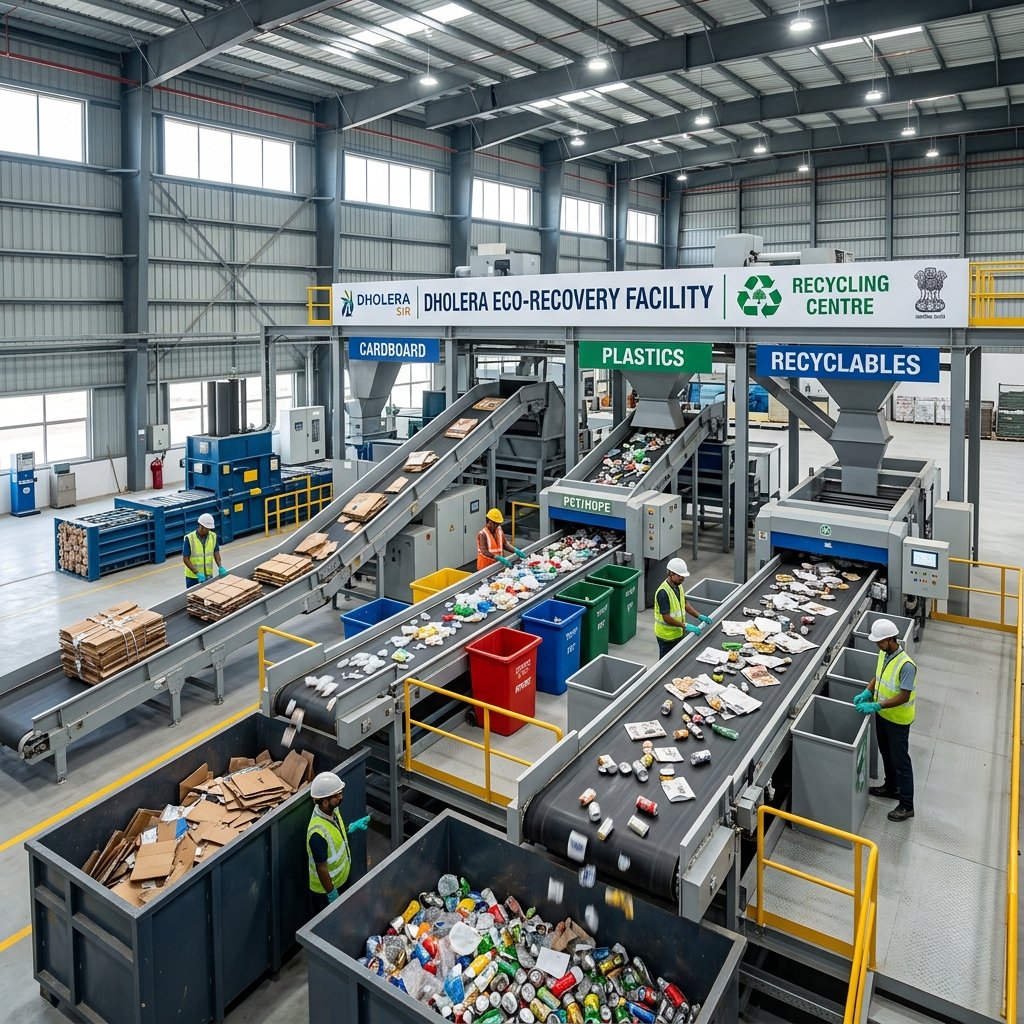
1. Mandatory Source Segregation & Smart Collection
Unlike traditional urban setups where garbage is collected as mixed waste, Dholera SIR enforces segregation at the property level. Residential communities, commercial plazas, and industrial plants must separate their waste into distinct bins:
- Wet Waste (Organic/Biodegradable): Leftover food, kitchen scraps, and horticultural waste.
- Dry Waste (Recyclable/Inorganic): Paper, cardboard, plastics, metals, glass, and dry wood.
- Hazardous Waste: Electronic waste (e-waste), chemical batteries, and medical items, which are collected separately for specialized disposal.
- Smart Refuse Collection Trucks: DICDL’s collection fleet is equipped with GPS navigation and RFID scanners. Bins are scanned upon collection to verify segregation compliance, with data logged directly at the central ABCD Command Center.
2. The Material Recovery Facility (MRF) and Circular Economy
All dry waste collected throughout Dholera is routed to a centralized Material Recovery Facility (MRF). This advanced facility uses sorting technologies to process recyclable material:
- Conveyor Sorting: Segregated materials pass along automated conveyor belts where magnetic separators extract ferrous metals, and optical scanners sort different polymer plastics (such as PET and HDPE).
- Baling and Recycling: Sorted cardboard, paper, and plastic are compacted into large blocks (bales) and sold directly to recycling industries, converting municipal waste into a revenue source.
- Organic Waste Composting: Wet organic waste is routed to a composting plant or anaerobic digester to produce high-grade bio-fertilizer used in the city’s green open spaces.
The table below details Dholera’s waste segregation and processing pipeline:
| Waste Stream | Bins / Sorting Color | Processing Method | End-Use Product |
|---|---|---|---|
| **Biodegradable Wet Waste** | Green Bin | Anaerobic digestion / Composting | Bio-fertilizer & biogas energy |
| **Recyclable Dry Waste** | Blue Bin | Optical & magnetic sorting at MRF | Reprocessed plastic, paper, and metals |
| **Combustible Non-Recyclable** | Black Bin | High-temperature incineration | Electricity (Waste-to-Energy grid) |
| **Hazardous / E-Waste** | Red Bin | Authorized chemical / Electronic recycling | Recovered heavy metals and parts |
3. Waste-to-Energy and Environmental Safeguards
For materials that cannot be recycled or composted (such as multi-layered packaging), Dholera routes waste to waste-to-energy plants:
- Incineration with Energy Recovery: Non-hazardous combustible waste is burned at high temperatures to generate steam, driving turbines that feed electricity back into the Torrent Power smart grid.
- Emission Control: The incinerator facilities are equipped with flue-gas scrubbers and electrostatic precipitators to capture particulates and acid gases, ensuring local air quality remains within safe pollution limits.
Frequently Asked Questions (FAQ)
#### How is garbage collected in Dholera Smart City?
Garbage is collected door-to-door using DICDL’s specialized collection trucks. Every property has distinct green, blue, and red bins. The trucks use GPS tracking and RFID readers to monitor collection routes and ensure source-segregation rules are followed.
#### What happens to dry waste in Dholera SIR?
All dry waste is transported to the Material Recovery Facility (MRF), where automated systems sort plastic, metal, glass, and paper. Sorted materials are compacted and sold to industrial partners for recycling.
#### Does Dholera Smart City have a landfill?
No. Dholera SIR operates under a zero-waste-to-landfill mandate. Waste is either composted, recycled at the MRF, or incinerated at waste-to-energy plants, leaving minimal residue and avoiding the need for traditional open landfills.
Download Dholera SIR 2026 Investor’s Kit
Get instant access to the official planning documents: Dholera Investment Handbook (PDF), 2026 Land Price List, TP Zone & Village Map, and the NRI Buying Guide.

Join The Discussion