

In India, the single most reliable pattern in real estate is this: land near major infrastructure appreciates fastest — and the biggest gains go to investors who enter before the infrastructure is complete.
Pune investors who bought near the Mumbai-Pune Expressway in the late 1990s saw values multiply 8–10x in a decade. Hyderabad investors who entered the Outer Ring Road belt before 2010 watched their land triple in five years. Bengaluru’s Whitefield was agricultural land until the IT corridor arrived.
Dholera SIR is at exactly that inflection point in 2026.
Where Dholera Land Prices Started — and Where They Are Now
To understand where Dholera is headed, start with where it came from.
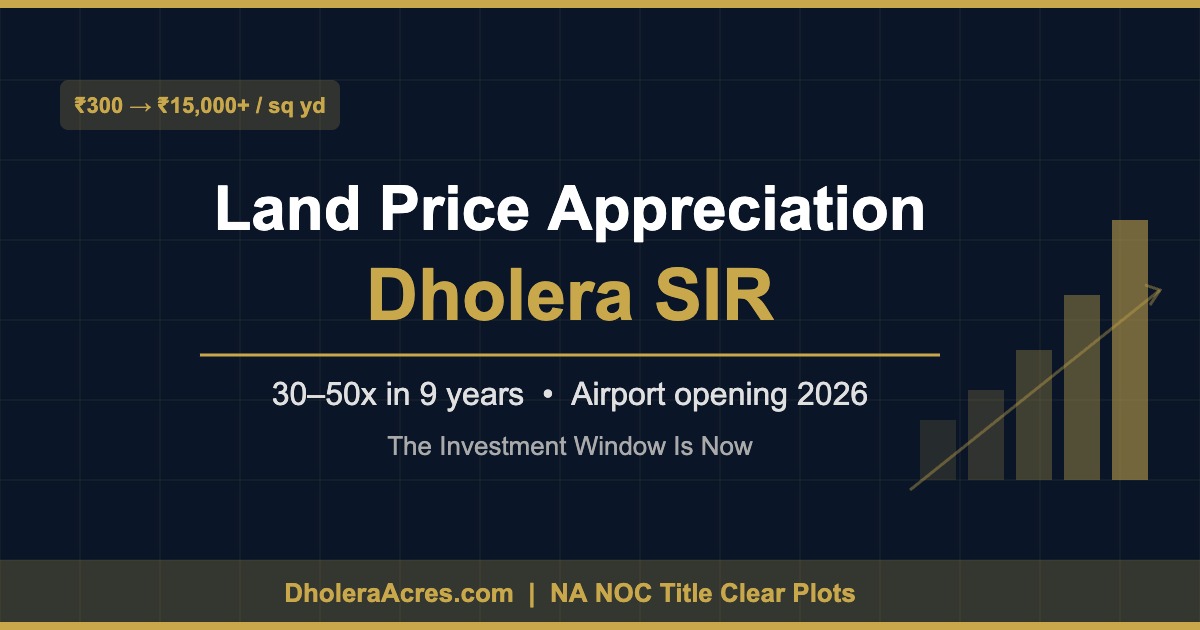
In 2016, agricultural land around Dholera was available for ₹300–₹500 per square yard. The region was largely unknown outside of government planning documents and a small group of early-mover investors. There were no roads, no expressway, no confirmed timelines.
By 2020, after the Ahmedabad–Dholera Expressway became operational and the Activation Area’s internal road network was built, prices had climbed to ₹1,500–₹3,000 per square yard in the primary zones. The infrastructure story was becoming real.
By 2024–2025, with the Dholera International Airport under active construction, the Tata Electronics semiconductor plant confirmed, and Phase 1 infrastructure 100% complete, prices in well-located zones inside the TP Scheme areas reached ₹8,000–₹15,000+ per square yard, with premium plots commanding even higher rates.
That is a 30–50x increase over nine years in the best-located zones — from ₹300 to ₹10,000+.
Even investors who entered as recently as 2020–2021 have seen 60–80% appreciation in four to five years.
The Infrastructure-Appreciation Pattern: Three Cities That Prove the Rule
Dholera’s trajectory is not unusual. It follows a pattern that has played out in every major Indian city that received a transformational infrastructure investment.
Hyderabad’s Outer Ring Road Belt
When Hyderabad announced the Outer Ring Road in the early 2000s, land in corridors like Shamshabad, Narsingi, and Kompally was inexpensive agricultural belt. As the ORR was built and the HITEC City tech corridor expanded, land values in these zones appreciated 3–5x over a decade. The announcement alone drove the first wave. Construction drove the second. Occupation and employment drove the third.
Pune’s Kharadi–Wagholi Belt
Pune’s eastern corridor was transformed by the announcement and construction of Pune Metro Phase 2. Land in Kharadi appreciated 18–22% in the year following the metro announcement alone — before a single train had run. As the IT park density increased and connectivity improved, the broader belt saw prices multiply over 6–8 years.
The DMIC Corridor (Rajasthan)
The Delhi–Mumbai Industrial Corridor (Dholera’s parent programme) itself has demonstrated price impact: land in DMIC zones has appreciated 45% over five years, with another 20–30% expected as manufacturing units begin operations. Dholera is the DMIC’s flagship node — the most planned, most invested, and most infrastructure-complete of all DMIC cities.
What Drives Price Appreciation in a Greenfield City
Three factors drive land values in a planned industrial city, and Dholera has all three converging at once.
1. Infrastructure Completion
The rule is simple: land appreciates as infrastructure moves from announcement to construction to completion. Dholera’s Phase 1 infrastructure — roads, utilities, power, water — is already complete. The airport moves from construction to operations in 2026. Each completion event resets the price floor upward.
2. Employment Generation
Land values follow jobs. Tata Electronics’ semiconductor fabrication plant in Dholera is one of India’s largest manufacturing investments. When it reaches operational capacity, it will directly and indirectly employ tens of thousands of people who will need housing, services, and support businesses nearby. Every major employer that follows Tata will amplify this effect.
3. Connectivity Upgrades
The Ahmedabad–Dholera Expressway already delivers 45-minute connectivity to one of India’s fastest-growing cities. The international airport — once operational — transforms Dholera from a regional city into a global logistics and business node. The planned 108 km metro corridor connecting Ahmedabad to Dholera will add the third layer.
Each connectivity upgrade has historically produced a price step-change — not just in Dholera, but in every comparable city before it.
The Airport Effect: What History Tells Us
International airports are the single most powerful driver of land value in any city. The data from India’s own market makes this clear.
Properties in the zones surrounding Hyderabad’s Rajiv Gandhi International Airport appreciated 3–5x in the decade following airport development. The same pattern played out near Chennai’s Anna International Airport, Bengaluru’s Kempegowda International Airport, and the Navi Mumbai airport corridor.
Dholera’s international airport — with two runways capable of handling wide-body aircraft and a passenger capacity of 30 million annually — is not a small regional hub. It is a full international gateway for western India, planned to eventually rival or complement Ahmedabad’s Sardar Vallabhbhai Patel International Airport.
The airport is expected to begin operations in 2026. Historically, the 12–24 months surrounding an airport’s first operational date represent the last window to enter before institutional and commercial capital reprices the surrounding land.
Current Price Zones: Where Dholera Stands in 2026
Prices in Dholera are not uniform. They vary based on zone, proximity to infrastructure, and legal status of the land.
Within the Activation Area — the core 22.54 sq km zone where all Phase 1 infrastructure is complete — well-documented plots with full legal clearances (NA converted, NOC from DSIRDA, title clear within the TP Scheme) are trading in the range of ₹8,000–₹15,000+ per square yard, depending on plot size and specific location.
Outside the Activation Area, in zones awaiting later-phase development, prices remain lower — but legal documentation is also less reliable and development timelines are less certain.
The appreciation story in Dholera is specifically about the documented zones within the TP Scheme, where infrastructure is present and legal standing is unambiguous.
What Analysts Project for 2027–2030
Industry analysts and market observers tracking Dholera have consistently projected 3x–5x appreciation over three to five years for well-located, legally clear plots within the active zones.
The basis for these projections:
- Airport commencement in 2026 creates an immediate demand signal for residential and commercial land
- Semiconductor plant operations will begin attracting tier-2 and tier-3 component manufacturers to locate nearby
- The national government’s continued investment in Dholera’s development removes political and policy risk
- Gujarat’s pro-investment governance track record reduces execution uncertainty
Even at the conservative end — 2x appreciation in four years — a plot purchased at ₹10,000 per square yard today would be worth ₹20,000 per square yard by 2029–2030. That is a return profile comparable to the mid-phase entry point in Hyderabad’s ORR corridor or Pune’s eastern belt.
The 2026 Entry Window: Why Timing Matters
Every major greenfield city has an entry window — the period after which infrastructure is confirmed and before the broader market has fully priced in the transformation.
Dholera is in that window right now.
The expressway is built. The internal roads are complete. The power and water infrastructure is operational. The semiconductor plant is under construction. The airport is opening.
This is not a bet on promises. This is an entry into a city whose infrastructure story is already written — but whose land prices have not yet caught up with the reality on the ground.
Investors who entered Hyderabad’s ORR belt after the road was built but before the IT firms arrived made the best returns. Investors who entered after the IT firms were established made decent returns. Investors who entered after the area was fully developed made ordinary returns.
Dholera in 2026 is still in the first category — but the window is closing.
Investing Safely: What Documentation Matters
Not all Dholera land is equal. The appreciation story applies specifically to legally verified plots within the approved TP Scheme zones:
- NA Converted: The land has been formally converted from agricultural to non-agricultural use, making it legally buildable
- NOC from DSIRDA: The Dholera Special Investment Region Development Authority has issued a No Objection Certificate confirming the plot is within the approved development zone
- Title Clear: The ownership chain is clean and unencumbered — no disputes, no litigation, no dual claims
Plots that lack any of these three elements carry legal risk that can eliminate or reverse the financial upside — regardless of how strong the broader market performs.
Invest Before the Reset
At Dholera Acres, we deal exclusively in NA NOC Title Clear plots within the approved TP Scheme zones of Dholera SIR. Every plot we present to you comes fully verified — so your investment captures the appreciation story without the legal risk that has caught out buyers of undocumented land in the region.
The price appreciation case for Dholera is well-established. What matters now is entering with the right documentation, in the right zone, before the airport’s opening drives the next price reset.
Ready to explore verified plots? Contact Dholera Acres for a free consultation and a current inventory overview.
Frequently Asked Questions About Dholera SIR Land Prices & Appreciation
1. What is the historical price growth trend in Dholera SIR?
Land prices in well-located TP schemes within Dholera SIR have grown dramatically. In 2016, agricultural land started at around ₹300 – ₹500 per sq yard. By 2020, as roads and connectivity developed, prices reached ₹1,500 – ₹3,000. Today, with major industrial anchors like Tata semiconductor and the airport opening in 2026, premium NA NOC Title Clear plots command ₹8,000 – ₹15,000+ per sq yard, representing a 30x to 50x appreciation over nine years.
2. Why are land prices projected to rise further in Dholera SIR?
Dholera land price appreciation is driven by three converging catalysts: infrastructure completion (including the 2026 international airport launch), employment generation (led by Tata Electronics’ semiconductor fab employing over 20,000 engineers), and direct expressway connectivity to Ahmedabad. Entering during this window, before these assets are fully occupied, represents the highest ROI window for investors.
Disclaimer: This article is published by the editorial team at Dholera Acres for informational purposes only. It does not constitute formal financial, legal, or investment advice. While every effort has been made to verify the town planning regulations, FSI rules, and infrastructure timelines with official DSIRDA and DICDL publications, land investments are subject to market risks. Readers are strongly advised to perform independent legal due diligence and consult certified property advisors before making any transaction in Dholera SIR.
Download Dholera SIR 2026 Investor’s Kit
Get instant access to the official planning documents: Dholera Investment Handbook (PDF), 2026 Land Price List, TP Zone & Village Map, and the NRI Buying Guide.

Join The Discussion