

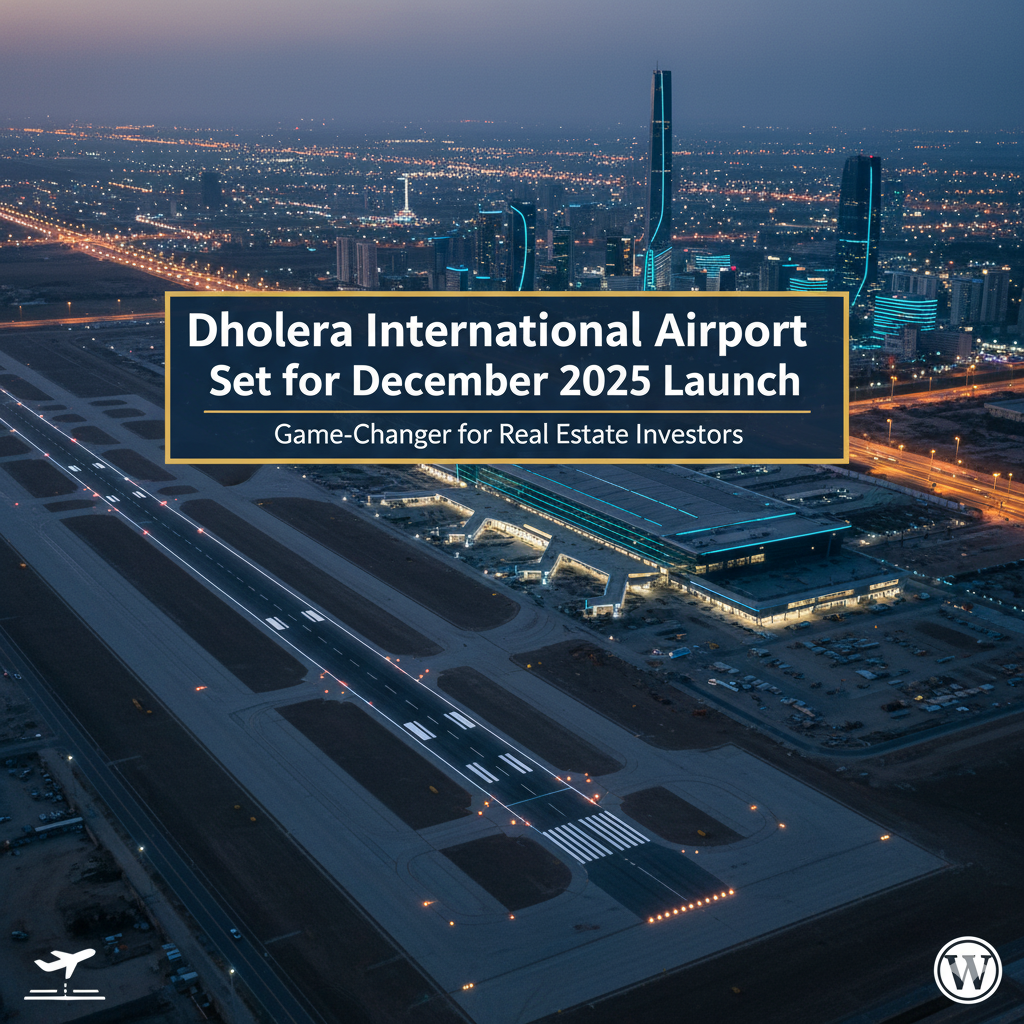
In a landmark development that will fundamentally reshape Gujarat’s aviation landscape and Dholera’s investment dynamics, the Dholera International Airport is on track for its December 2025 launch. This isn’t just another regional airport—it’s Gujarat’s largest aviation facility and a critical infrastructure catalyst that will accelerate Dholera’s transformation from a planned smart city into a fully operational global business destination.
The Airport That Changes Everything
The Dholera International Airport represents one of the most significant infrastructure investments in Gujarat’s recent history. With Phase 1 construction making consistent progress, the airport is expected to begin operations by December 2025, with cargo operations potentially commencing first, followed by passenger services in early 2026. This timeline places Dholera on the cusp of a connectivity revolution that will impact every aspect of real estate valuation and investment strategy.
The scale of this airport distinguishes it from typical regional facilities. As Gujarat’s largest airport, it’s designed to handle substantial cargo and passenger volumes, positioning Dholera as a logistics and business hub rather than merely a secondary airport serving overflow from Ahmedabad. The strategic importance of this distinction cannot be overstated—it means Dholera will function as a primary destination rather than a satellite city.
Infrastructure Integration and Multimodal Connectivity
What makes the Dholera Airport particularly transformative is its integration within a comprehensive multimodal transportation network. The airport will be connected to Ahmedabad through the 109-kilometer Ahmedabad-Dholera Expressway currently under construction, along with plans for a semi-high-speed rail line. This multi-layered connectivity approach ensures that the airport serves not just Dholera but the entire Gujarat region efficiently.
The Ahmedabad-Dholera Expressway deserves special attention. This high-speed corridor will reduce travel time between Gujarat’s commercial capital and Dholera to under an hour, effectively bringing Dholera within Ahmedabad’s commutable range. For real estate investors, this connectivity transformation is critical—it means professionals can realistically consider living in Dholera while maintaining business connections in Ahmedabad, or vice versa.
The expressway’s completion timeline aligns with the airport launch, creating a synchronized infrastructure activation that will amplify the impact of both projects. Real estate located along the expressway corridor, particularly near entry and exit points, stands to benefit from this strategic positioning between two major economic nodes.
Cargo Operations and Industrial Implications
The emphasis on cargo operations in the airport’s initial phase reflects Dholera’s industrial focus and particularly its emerging role as India’s semiconductor manufacturing hub. Semiconductor fabrication requires sophisticated global supply chains—silicon wafers, specialized chemicals, precision equipment, and countless components must be imported reliably and rapidly. Finished semiconductor chips, despite their small size, are extremely high-value products requiring secure, fast export capabilities.
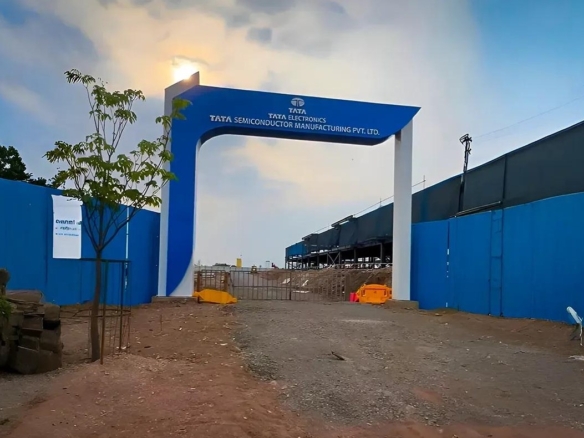
The December 2025 cargo operations commencement aligns strategically with semiconductor facility construction timelines. Tata Electronics, Micron Technology, and other semiconductor manufacturers establishing operations in Dholera will have direct air cargo access for their global supply chains. This logistical advantage makes Dholera competitive with established semiconductor manufacturing locations worldwide and reinforces investor confidence in the region’s industrial viability.
Beyond semiconductors, the airport will serve other industries establishing in Dholera. Electronics manufacturing, pharmaceutical production, aerospace components, and other high-value, time-sensitive industries benefit enormously from proximate international air cargo facilities. Each of these industries creates employment, which drives housing demand, which creates real estate investment opportunities.
Passenger Services and Economic Ecosystem Development
While cargo operations take priority initially, passenger services launching in early 2026 will be equally transformative for Dholera’s real estate dynamics. International passenger connectivity eliminates one of the major deterrents to establishing operations in emerging locations—the inconvenience of accessing global destinations.
For semiconductor industry professionals, many of whom maintain international business relationships or come from abroad as expatriate employees, direct international connectivity is crucial. The ability to fly directly to Singapore, Dubai, or other semiconductor industry hubs without transiting through Ahmedabad or Mumbai reduces friction and makes Dholera a more attractive working location.
Business tourism will emerge as a significant economic driver. As Dholera’s industrial operations scale up, the city will host increasing numbers of business visitors—potential investors, corporate executives, technical consultants, and industry delegations. These visitors require quality hotels, conference facilities, dining options, and transportation services. The hospitality and service sector development following the airport launch creates diverse real estate investment opportunities beyond residential properties.
Leisure tourism potential exists as well, though this will develop more gradually. Dholera’s proximity to Gujarat’s tourist attractions—the Rann of Kutch, Gir National Park, coastal destinations—combined with its modern infrastructure could position it as a tourism hub. International tourists flying into Dholera Airport could explore Gujarat’s attractions while staying in Dholera’s planned hospitality facilities.
Real Estate Impact Zones and Valuation Dynamics
The airport’s impact on real estate values won’t be uniform across Dholera—proximity and connectivity matter significantly. Several distinct impact zones can be identified, each with different investment characteristics and timing considerations.
The immediate airport vicinity, within a three to five kilometer radius, will see the most immediate and substantial impact. This zone is ideal for airport-related commercial development—cargo handling facilities, warehouses, logistics parks, and freight forwarding operations. Hotels serving business travelers, airport parking facilities, and car rental locations will cluster here. For investors, this zone offers opportunities in commercial and industrial real estate but may be less suitable for premium residential development due to aircraft noise.
The airport corridor extending along the expressway toward Ahmedabad represents a premium residential and commercial investment zone. This area combines airport accessibility with connectivity to Ahmedabad, making it ideal for business professionals requiring frequent travel. Mixed-use developments, business parks, and premium residential communities are optimal products for this corridor.
The central business district and commercial hub of Dholera, while not immediately adjacent to the airport, will benefit significantly from enhanced connectivity. Office space demand will increase as companies relocate or establish operations in Dholera, confident in the city’s accessibility. Retail and hospitality development will accelerate to serve the growing business community.
Industrial zones, particularly those hosting semiconductor and electronics manufacturing, gain substantial value from the airport’s logistics capabilities. Supporting industrial real estate—supplier facilities, testing laboratories, engineering services—will cluster near major manufacturing installations.
Investment Timing and Market Phases
The airport launch creates distinct investment phases, each with different risk-return profiles. Understanding these phases helps investors position strategically based on their risk tolerance and investment objectives.
The pre-operational phase—now through December 2025—represents the highest-risk but potentially highest-return investment period. Land prices reflect expectations rather than operational reality, creating opportunities for value investors willing to accept uncertainty. However, confirmed launch timelines and visible construction progress reduce speculation risk compared to earlier development phases.
The operational commencement phase—December 2025 through 2026—will likely see significant price appreciation as the airport transitions from promise to reality. This phase validates investment theses and attracts momentum investors who waited for operational confirmation. Liquidity may improve as more buyers enter the market with reduced risk perceptions.
The ecosystem maturation phase—2027 and beyond—represents a different investment dynamic. Prices will be higher, reflecting operational reality, but investment risks are lower. Returns come from rental income, gradual appreciation, and participation in economic growth rather than infrastructure-driven speculation.
Comparative Analysis with Other Airport-Driven Developments
Historical patterns from other airport-driven real estate markets provide instructive precedents. Bangalore’s Devanahalli area, where Kempegowda International Airport was established, saw substantial land appreciation and urban development following the airport’s 2008 opening. Properties within the airport influence area appreciated many times over, though the full impact took years to materialize.
Hyderabad’s Shamshabad area, home to Rajiv Gandhi International Airport, experienced similar patterns—initial rapid appreciation following airport opening, followed by sustained development as industrial and commercial ecosystems matured around airport connectivity. The IT sector’s reliance on international connectivity made the airport a catalyst for technology park development.
Dholera’s situation differs in important ways from these precedents. Unlike Bangalore and Hyderabad, where airports were built to serve existing cities, Dholera’s airport is part of integrated smart city planning from inception. The industrial anchors—semiconductor manufacturing—are confirmed before the airport opens, rather than emerging organically afterward. This planned, coordinated approach potentially accelerates benefits while reducing some development uncertainties.
Infrastructure Synergies and Multiplier Effects
The airport doesn’t exist in isolation—it’s part of a comprehensive infrastructure package that includes the expressway, metro rail connections, high-speed rail linkages, and internal road networks. These infrastructure elements interact synergistically, creating multiplier effects that exceed the sum of individual projects.
The expressway enables daily commuting between Ahmedabad and Dholera, while the airport enables global connectivity. Together, they position Dholera as simultaneously integrated with Gujarat’s existing economy and directly connected to global markets. This dual connectivity—regional and international—is rare and valuable.
Metro rail connections, while in planning stages, will further enhance internal mobility within Dholera and connectivity to surrounding regions. For real estate, metro station locations become development nodes attracting commercial and residential projects. Transit-oriented development principles suggest premium values for properties within walkable distance of metro stations.
Government Commitment and Project Delivery Confidence
The airport project’s progress reflects strong government commitment to Dholera’s success. Unlike some infrastructure projects that languish due to funding constraints or political changes, the Dholera Airport has maintained momentum through construction phases. Parliamentary updates confirming December 2025 completion targets demonstrate high-level government attention and accountability.
For investors, government commitment matters tremendously. It reduces political risk—the possibility that projects might be deprioritized or abandoned due to administrative changes. It increases funding confidence—the assurance that budgets will be allocated to complete projects. It signals strategic importance—when governments prioritize projects, private sector confidence follows.
The Gujarat government’s broader investment in Dholera infrastructure—roads, utilities, social amenities—reinforces confidence in the airport project specifically. Infrastructure operates as a system, and the coordinated development of multiple elements suggests serious commitment to making Dholera successful.
Sustainability and Future-Proofing
Modern airport development increasingly emphasizes sustainability and environmental responsibility. While specific sustainability features of Dholera Airport aren’t extensively detailed in current information, modern Indian aviation infrastructure typically incorporates solar power generation, rainwater harvesting, and energy-efficient terminal design.
For Dholera’s overall sustainability objectives, the airport represents both opportunity and challenge. Air travel is inherently carbon-intensive, creating tension with smart city environmental goals. However, economic development and global connectivity are crucial for attracting investment and talent. The balance between economic development and environmental responsibility will be ongoing.
Real estate near the airport should anticipate environmental regulations and sustainability requirements becoming stricter over time. Buildings incorporating green certifications, renewable energy, and sustainable design will be better positioned for long-term value retention than conventional construction.
Risks and Uncertainties
Despite strong progress, prospective investors should acknowledge remaining uncertainties. Construction project delays, while increasingly unlikely, remain possible due to technical challenges, contractor issues, or unforeseen circumstances. The December 2025 timeline, while official, could slip if complications arise.
Operational ramp-up may be gradual rather than immediate. Airlines need time to schedule flights, cargo operators establish facilities, and ground handling services scale up. The airport may operate below capacity initially while building operations gradually.
Global economic conditions affect air travel demand. Economic downturns, pandemics, or geopolitical tensions can suppress aviation activity. While Dholera’s cargo focus provides some insulation from passenger traffic volatility, it’s not immune to global trade cycles.
Strategic Investment Recommendations
For investors considering Dholera with the airport launch as a key catalyst, several strategies merit consideration based on different objectives and risk profiles.
Aggressive growth investors seeking maximum appreciation should focus on the immediate pre-launch phase—acquiring properties now before operational commencement validates valuations. This approach accepts current uncertainty in exchange for potential substantial gains if the airport launches successfully and drives expected development.
Balanced investors might allocate capital in phases—some immediate investment to capture pre-operational pricing, with additional capital reserved for post-launch deployment once operations are validated. This staged approach balances opportunity capture with risk management.
Conservative investors focused on capital preservation might wait for operational confirmation before investing, accepting higher entry prices in exchange for reduced uncertainty. This approach sacrifices maximum returns for greater confidence and reduced risk.
Product selection should align with investment strategies. Residential plots near the airport corridor suit long-term holders planning eventual construction or resale. Commercial land near the airport vicinity offers business development opportunities. Industrial land serves investors with specific business plans or partnerships with industrial tenants.
Conclusion: A Historic Infrastructure Milestone
The December 2025 launch of Dholera International Airport represents more than an aviation facility opening—it’s a historic milestone marking Dholera’s transition from ambitious vision to operational reality. For real estate investors, it validates the fundamental investment thesis that Dholera will become a major economic center and provides a concrete catalyst for value creation.
The airport’s impact will unfold over years, with immediate effects around logistics and cargo-related activities, medium-term impacts on business development and commercial real estate, and long-term effects on comprehensive urban ecosystem maturation. Investors with appropriate time horizons and realistic expectations are positioned to benefit from this transformative infrastructure.
As with all infrastructure-driven investments, success requires thorough due diligence, realistic pricing, patient capital, and understanding that infrastructure creates opportunity but doesn’t guarantee returns. The airport is a powerful enabler, but investment success ultimately depends on selecting the right locations, products, and strategies aligned with individual objectives and risk tolerances.
For those who invest wisely and patiently, the Dholera Airport launch may be remembered as a defining opportunity—the moment when one of India’s most ambitious smart city developments achieved critical mass and began its journey toward becoming a truly global economic hub.


Join The Discussion