

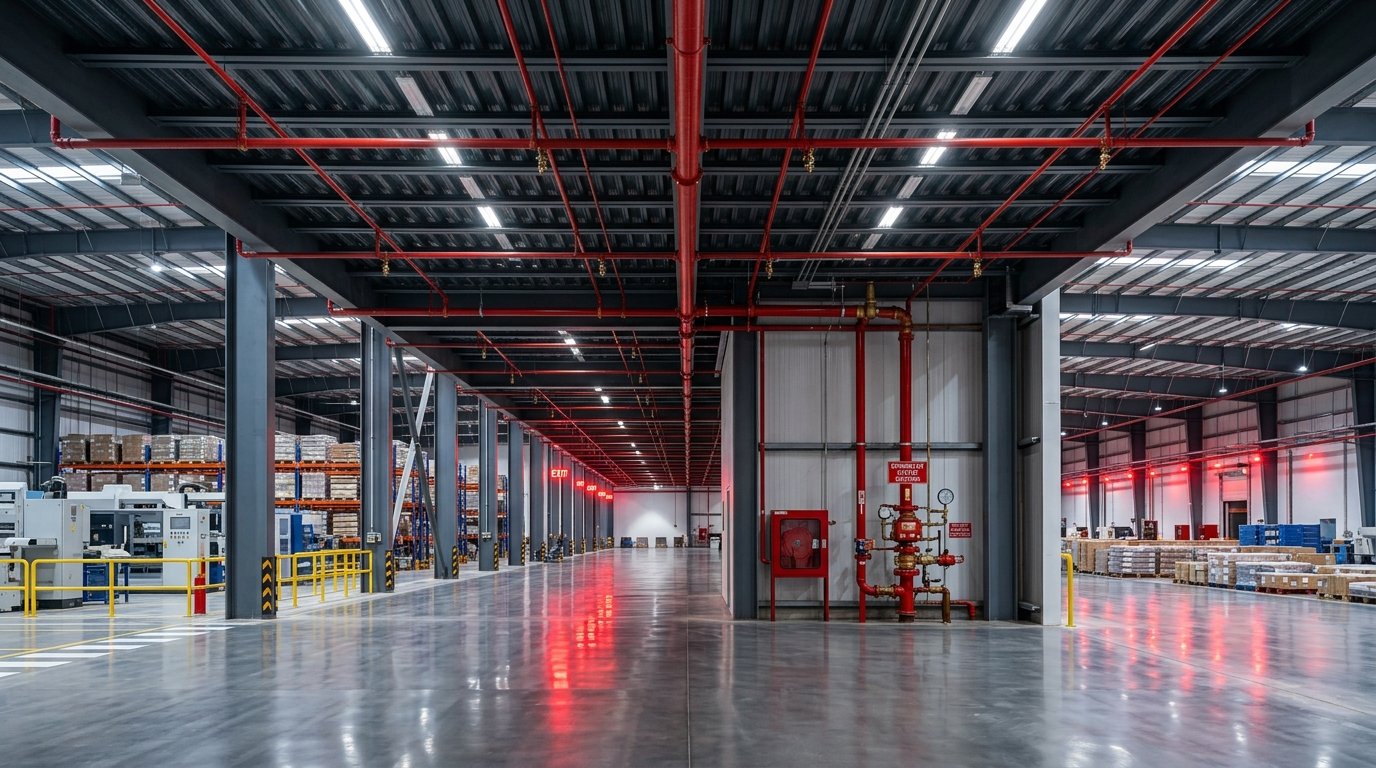
Executive Overview
Automatic fire sprinkler systems are mandatory in industrial buildings in Dholera Special Investment Region (DSIR) exceeding prescribed floor areas and hazard classifications under the DSIRDA General Development Control Regulations (GDCR) 2023 Chapter 10 (Fire Safety), NBC 2016 Part 4 (Fire and Life Safety), TAC (Tariff Advisory Committee) regulations, and NFPA 13:2022 (Standard for the Installation of Sprinkler Systems). Dholera’s industrial base includes automotive, chemical, pharmaceutical, and electronics manufacturing — each demanding a specific hazard class design.
An improperly designed sprinkler system — under-dense, using wrong K-factor heads, or with undersized pipe — will either activate uselessly or fail to control the design fire, triggering regulatory shutdown by DSIRDA’s fire safety compliance team.
1. Regulatory Framework
| Code / Standard | Scope |
|---|---|
| DSIRDA GDCR 2023 Chapter 10 | Fire safety mandatory requirements |
| NBC 2016 Part 4 | Sprinkler system classification and design |
| TAC Sprinkler Rules | Insurance-driven sprinkler specifications |
| NFPA 13:2022 | Design and installation of sprinkler systems |
| IS 15105:2002 | Design and installation of fixed automatic sprinkler fire extinguishing systems |
| IS 3844 | Code of practice for installation of internal fire hydrants |
| GFRS (Gujarat Fire and Emergency Services) | Fire NOC inspection criteria |
DSIRDA GDCR 2023 Clause 10.4.1 mandates automatic sprinklers in: – All industrial buildings > 500 m² in Group I-2 occupancy (hazardous manufacturing) – All warehouses and cold stores > 1000 m² – All high-rack storage > 7.5 m height regardless of area – All buildings with GPCB-classified flammable materials in Dholera special zones
2. Occupancy Hazard Classification (NFPA 13)
| Hazard Class | Description | Dholera Facility Examples |
|---|---|---|
| Light Hazard (LH) | Low quantity combustibles, slow-burning | Office areas, assembly spaces |
| Ordinary Hazard Group 1 (OH1) | Low-moderate combustibles, low-height storage | Auto-component sub-assembly, electronics |
| Ordinary Hazard Group 2 (OH2) | Moderate combustibles, higher-pile storage | General manufacturing, textile processing |
| Extra Hazard Group 1 (EH1) | High combustibles, low flammable liquids | Painting booths, woodworking |
| Extra Hazard Group 2 (EH2) | High-hazard, significant flammable liquids | Chemical plants, solvent storage, foam |
| High-Piled Storage (Commodity Class I–IV) | Rack storage > 3.7 m | Automotive warehouses, FMCG logistics |
3. Design Density and Area of Operation
3.1 Density/Area (D/A) Design Approach
The fundamental design parameter pair is discharge density (mm/min or L/min/m²) over an area of operation (m²):
| Hazard | Min Density (mm/min) | Area of Operation (m²) |
|---|---|---|
| Light Hazard | 4.1 | 139 |
| OH1 | 6.1 | 139 |
| OH2 | 8.2 | 139 |
| EH1 | 12.2 | 232 |
| EH2 | 16.3 | 232 |
| High-Piled (Class IV, 6 m) | 20.4 | 232+ |
DSIRDA GDCR 2023 Clause 10.4.3 adopts NFPA 13 D/A curves as the minimum standard. TAC may require higher densities for insurer approval in specific process zones.
3.2 Hydraulic Calculation — Basic Method
$$Q_{design} = D \times A$$
Where: – Q_design = total design flow rate (L/min) – D = design density (L/min/m²) – A = design area (m²)
Worked Example — OH2 Factory, Dholera: – D = 8.2 mm/min = 8.2 L/min/m² – A = 139 m² – Q_design = 8.2 × 139 = 1140 L/min (plus hose stream allowance of 1900 L/min for OH2) – Total demand = 1140 + 1900 = 3040 L/min
This total must be available at the system inlet at the residual pressure demanded by the hydraulically most remote sprinkler.
4. Sprinkler Head Selection
4.1 K-Factor Selection
| K-Factor | Orifice Size | Typical Application | Min Pressure for Flow |
|---|---|---|---|
| K-57 (5.6) | 10 mm | LH, OH1 standard applications | 0.5 bar |
| K-80 (8.0) | 13 mm | OH1, OH2 intermediate | 0.5 bar |
| K-115 (11.5) | 16 mm | EH1, EH2 / high-challenge fires | 0.5 bar |
| K-160 (16.0) | 20 mm | ESFR (in-rack), High-piled | 0.7 bar |
| K-200 (25.2) | 25 mm | ESFR ceiling — warehouse | 1.0 bar |
ESFR (Early Suppression Fast Response) sprinklers are required for high-piled rack storage > 7.5 m in Dholera warehouses per NFPA 13 Chapter 23 and DSIRDA Clause 10.4.5.
4.2 Sprinkler Spacing (NFPA 13 Table 10.2.5)
| Hazard | Max Area per Sprinkler | Max Spacing (S) | Min Spacing |
|---|---|---|---|
| Light Hazard | 20.9 m² | 4.6 m | 1.8 m |
| Ordinary Hazard | 12.1 m² | 3.7 m | 1.8 m |
| Extra Hazard | 9.3 m² | 3.0 m | 1.8 m |
| ESFR (ceiling) | 9.3 m² | 3.0 × 3.0 m | 2.4 m |
4.3 Sprinkler Types
| Type | Response Time Index (RTI) | Application |
|---|---|---|
| Standard Response (SR) | > 80 (m·s)^0.5 | General industrial |
| Quick Response (QR) | ≤ 50 (m·s)^0.5 | Light hazard, offices |
| Fast Response (FR) / ESFR | ≤ 28 (m·s)^0.5 | High-piled, NFPA 13 Ch. 23 |
| Standard Response Upright | — | Below beams/structure |
| Standard Response Pendent | — | Flush ceiling, standard |
| Sidewall | — | Narrow corridor, perimeter |
5. Pipe Sizing and System Types
5.1 System Type Selection
“` WET PIPE SYSTEM (most common in Dholera — ambient > 4°C always) Water-filled pipes → Immediate discharge on head activation Alarm check valve → Waterflow alarm to fire panel
DRY PIPE SYSTEM (cold storage < 4°C) Air/nitrogen pressurised → Trip valve → water fills on activation Slower response — add quick-opening device if area > 500 m²
PRE-ACTION SYSTEM (data centres, museums, IT rooms) Dry + detection signal required to open pre-action valve Double interlock for high-value assets
DELUGE SYSTEM (EH2, chemical/solvent areas, DSIRDA required for foam systems) All heads open simultaneously → activated by fire detection “`
5.2 Pipe Schedule (IS 15105 / NFPA 13 Schedule 10 Steel)
| Pipe Size (DN) | Max Sprinklers (LH) | Max Sprinklers (OH) | Max Sprinklers (EH) |
|---|---|---|---|
| DN25 (1″) | 2 | 2 | 1 |
| DN32 (1¼”) | 3 | 3 | 2 |
| DN40 (1½”) | 5 | 4 | 2 |
| DN50 (2″) | 10 | 8 | 5 |
| DN65 (2½”) | 30 | 18 | 8 |
| DN80 (3″) | 60 | 40 | 15 |
| DN100 (4″) | 100 | 65 | 27 |
| DN150 (6″) | 250+ | 150+ | 65+ |
DSIRDA GDCR 2023 Clause 10.4.6 requires Schedule 40 black steel pipe (IS 1239) for all sprinkler mains and branches. Galvanised steel permitted for branch lines in corrosive environments. Grooved mechanical couplings permitted for DN50 and above.
6. Water Supply Requirements
6.1 Tank and Pump Sizing
| Hazard Class | Min Tank Volume | Min Pump Flow | Min Residual Pressure |
|---|---|---|---|
| LH (small building) | 20,000 L | 750 L/min | 1.0 bar at most remote head |
| OH1–OH2 | 60,000 L | 1,900 L/min | 1.0 bar at most remote head |
| EH1–EH2 | 100,000 L | 3,800 L/min | 1.5 bar at most remote head |
| High-piled / ESFR | 200,000 L | 4,500+ L/min | 3.5 bar at ESFR head |
Duration: Minimum 60 minutes water supply for OH class; 90 minutes for EH and high-piled per NFPA 13 and DSIRDA Clause 10.4.7.
6.2 Fire Pump Requirements (IS 3844 / NFPA 20)
- Duty pump: Electric motor-driven centrifugal, rated at 100% design flow
- Standby pump: Diesel engine-driven, same rating — DSIRDA mandates diesel standby for all critical industrial facilities
- Jockey pump: Maintains system pressure to detect leaks; rated at 10–15% of duty pump flow
- Churn (shut-off) pressure: Not to exceed 140% of rated pressure (NFPA 20)
7. Alarm and Monitoring Provisions
DSIRDA GDCR 2023 Clause 10.4.9 mandates:
| Device | Requirement |
|---|---|
| Waterflow alarm switch | On each alarm check valve — triggers audible + panel |
| Tamper switch | On each control valve — supervised position |
| Pressure gauge | On supply and system sides of alarm valve |
| Inspector test valve | At hydraulically most remote point |
| Main drain valve | On riser — 50 mm full-bore |
| Fire panel integration | All alarms to addressable fire panel with 24/7 monitoring |
| GFRS connection | Remote monitoring hookup to Gujarat Fire Services |
8. Maintenance Schedule (DSIRDA Compliance)
| Task | Frequency | Standard |
|---|---|---|
| Visual inspection (heads, pipes, valves) | Weekly | NFPA 25 |
| Alarm valve test (waterflow) | Quarterly | NFPA 25 |
| Main drain flow test | Annually | NFPA 25 |
| Full system trip test (dry/pre-action) | Annually | NFPA 25 |
| Internal pipe inspection (corrosion) | Every 5 years | NFPA 25 |
| Head replacement (standard heads) | Every 50 years / after operation | NFPA 25 |
| GFRS/Fire NOC renewal | Annually | GFRS Gujarat |
FAQ
Is an automatic sprinkler system mandatory for all industrial buildings in Dholera SIR?
DSIRDA GDCR 2023 Clause 10.4.1 mandates automatic sprinklers for: all Group I-2 industrial buildings > 500 m², all warehouses > 1000 m², all high-rack storage > 7.5 m height (regardless of area), and all buildings with GPCB-classified flammable materials. NBC 2016 Part 4 provides the base requirement which DSIRDA Clause 10 augments.What hazard class applies to a chemical plant in Dholera SIR?
Chemical plants handling significant quantities of flammable liquids or solvents are classified as **Extra Hazard Group 2 (EH2)** under NFPA 13. This requires a design density of 16.3 mm/min over 232 m², a minimum K-115 or K-160 sprinkler head, and a dedicated deluge system in solvent storage areas per DSIRDA GDCR 2023 Clause 10.4.4.What is the minimum water supply duration for a sprinkler system in Dholera industrial facilities?
DSIRDA GDCR 2023 Clause 10.4.7 and NFPA 13 require a minimum 60-minute water supply for Ordinary Hazard (OH1/OH2) class facilities and 90 minutes for Extra Hazard (EH1/EH2) and high-piled storage. A diesel backup fire pump is mandatory for all critical industrial facilities.What pipe material is approved for sprinkler mains in Dholera industrial buildings?
DSIRDA GDCR 2023 Clause 10.4.6 requires Schedule 40 black steel pipe per IS 1239 for all sprinkler mains and branch lines. Galvanised steel is permitted for branches in corrosive environments. Grooved mechanical couplings (e.g., Victaulic type) are permitted for DN50 and above.Are ESFR sprinklers required for warehouse rack storage in Dholera SIR?
Yes. Early Suppression Fast Response (ESFR) ceiling sprinklers are required for high-piled rack storage exceeding 7.5 m in height per DSIRDA GDCR 2023 Clause 10.4.5 and NFPA 13 Chapter 23. ESFR heads (K-160 to K-360 at 1.0–3.5 bar) suppress fires at the ceiling level, eliminating the need for in-rack sprinklers in qualifying configurations.Download Dholera SIR 2026 Investor’s Kit
Get instant access to the official planning documents: Dholera Investment Handbook (PDF), 2026 Land Price List, TP Zone & Village Map, and the NRI Buying Guide.

Join The Discussion