

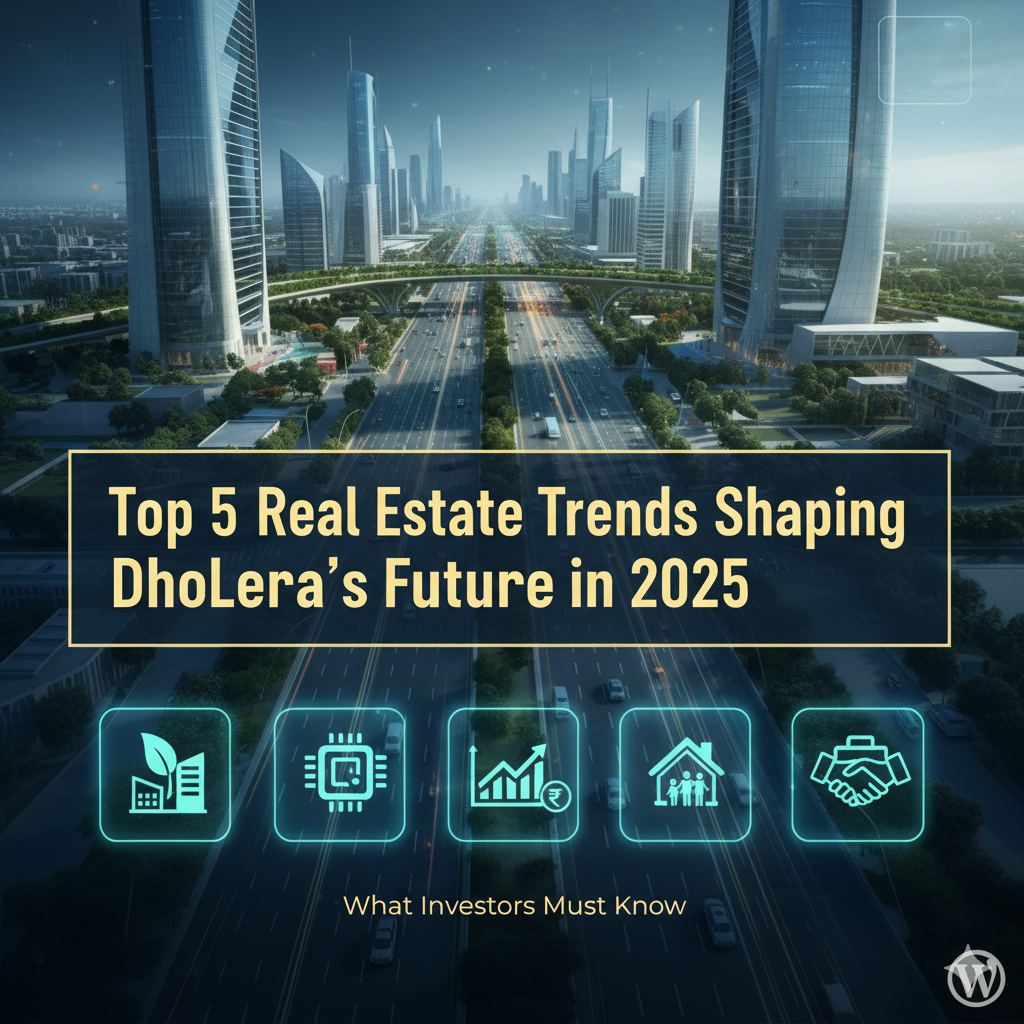
The real estate landscape in Dholera Special Investment Region is undergoing rapid transformation driven by technological advancement, policy initiatives, infrastructure development, and changing investor preferences. Understanding these emerging trends is crucial for investors seeking to position themselves advantageously in this dynamic market. This analysis examines five major trends shaping Dholera’s real estate future and their implications for investment strategies.
Trend 1: The Semiconductor Industry Catalyst Effect
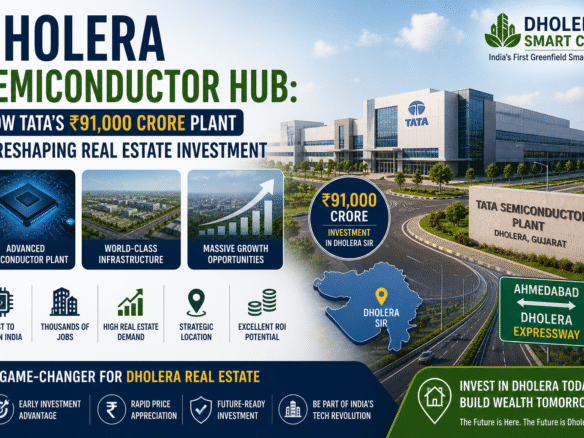
The most transformative trend in Dholera’s real estate market is the establishment of India’s semiconductor manufacturing hub in the region. With multiple fabrication facilities confirmed from Tata Electronics, Micron Technology, NextGen, and potentially others, Dholera is emerging as India’s silicon valley, fundamentally altering real estate dynamics.
This semiconductor concentration creates several real estate sub-trends. First, premium housing demand from high-income semiconductor professionals will drive development of upscale residential communities. Semiconductor engineers, managers, and technicians command significantly higher salaries than most industrial workers, translating into demand for quality housing with modern amenities, international schools, and lifestyle offerings.
Second, specialized real estate products are emerging to serve semiconductor industry needs. Serviced apartments for expatriate engineers, co-living facilities for young professionals, and corporate housing for companies relocating talent to Dholera represent new asset classes in the market. These products offer different risk-return profiles than traditional residential plots and may appeal to institutional investors.
Third, the semiconductor cluster is driving commercial real estate development. Office spaces for engineering design centers, research facilities, testing laboratories, and corporate headquarters are planned. Retail and hospitality development will follow employment concentration, creating opportunities in commercial real estate segments.
The timeline of semiconductor operations matters critically. While manufacturing facilities are under construction, full commercial production is expected by 2027-2028. This timeline creates different investment phases—current investments position ahead of operational commencement, while later investments will occur in a more mature, operational environment with different risk-return characteristics.
Geographically, semiconductor facilities are concentrated in specific sectors of Dholera, creating localized hotspots. Real estate within proximity to these facilities—close enough for convenient commuting but far enough to avoid industrial nuisances—represents a sweet spot for residential investment. Understanding micro-location dynamics becomes crucial for optimization of returns.
Trend 2: Smart Infrastructure Integration and Technology-Enabled Living
Dholera’s designation as India’s first Platinum Greenfield Smart City isn’t merely aspirational—it’s driving concrete infrastructure and technology deployment that differentiates the city from traditional urban developments. This smart infrastructure integration represents a fundamental trend shaping real estate values and buyer preferences.
Smart utility infrastructure includes intelligent water distribution systems with leak detection and consumption monitoring, smart electrical grids enabling demand response and renewable integration, and integrated waste management with sensor-based collection and processing. These systems improve service reliability and efficiency while reducing environmental impact and operating costs.
Mobility infrastructure is being designed for future technologies. Wide road corridors accommodate future mass transit systems, provisions for autonomous vehicle lanes and charging infrastructure, and integrated mobility hubs connecting different transport modes. Real estate near planned mass transit stations or mobility hubs will command premium values as the city matures.
Digital connectivity infrastructure establishes Dholera as India’s most connected city. Fiber-optic networks providing gigabit internet speeds, extensive public WiFi coverage in commercial and recreational areas, and smart city operations centers managing city services through data analytics enable both quality of life and business operations far superior to most Indian cities.
For real estate investors, smart infrastructure creates several implications. Properties in areas with advanced smart infrastructure deployment command premium pricing. Buildings incorporating smart technologies—automated lighting, climate control, security systems, energy management—appeal to tech-savvy buyers and tenants. Long-term operating cost reductions through smart utilities improve property economics.
The trend toward technology-enabled living extends to community design. Smart parking guidance systems, app-based civic services, digital payment systems for all services, and community engagement platforms create connected living experiences that appeal particularly to younger, urban professionals who comprise much of Dholera’s target demographic.
Trend 3: Sustainability and Green Development as Core Principles
Environmental sustainability has evolved from a nice-to-have feature to a core requirement in Dholera’s development paradigm. This trend reflects both regulatory mandates and market preferences, with significant implications for real estate investment and development strategies.
Renewable energy integration is central to Dholera’s sustainability vision. The adjacent 5 GW solar park provides clean power, and buildings increasingly incorporate rooftop solar. Net metering provisions allow excess power generation to offset consumption, improving building economics. For investors, energy-positive or energy-neutral buildings represent future-oriented assets with lower operating costs and higher tenant appeal.
Water conservation and management address Gujarat’s water scarcity challenges through rainwater harvesting mandates for most properties, treated wastewater reuse systems reducing freshwater demand, and water-efficient landscaping using drought-resistant native vegetation. Properties demonstrating water sustainability will differentiate themselves in a resource-constrained environment.
Green building certifications are becoming standard rather than exceptional. LEED-certified buildings receive favorable treatment in approvals, financing, and market positioning. While certification involves additional costs and compliance efforts, certified properties typically command rental premiums and exhibit stronger value retention.
Sustainable transportation infrastructure promotes non-motorized mobility through extensive cycling tracks and pedestrian pathways, electric vehicle charging infrastructure throughout the city, and compact, mixed-use development reducing travel distances. Real estate in walkable, bikeable neighborhoods with EV infrastructure will appreciate as transportation sustainability becomes more valued.
Climate resilience is being designed into infrastructure and building codes. Flood management through natural drainage systems and retention ponds, heat island mitigation through urban forestry and reflective surfaces, and disaster-resistant construction standards ensure long-term viability. Climate-resilient properties will prove more valuable as climate change impacts intensify.
For investors, the sustainability trend suggests several strategies. Early adoption of green building practices positions properties advantageously as standards tighten. Premium market segments increasingly demand sustainability credentials. Long-term holding value benefits from lower obsolescence risk and regulatory compliance. ESG-focused institutional investors preferentially seek sustainable real estate assets.
Trend 4: Institutional Investment and Real Estate Professionalization
Dholera’s real estate market is experiencing a significant trend toward institutional involvement and professionalization, contrasting with the informal, individual-dominated markets characteristic of many emerging Indian developments. This trend brings both opportunities and challenges for different investor categories.
Institutional investors including Real Estate Investment Trusts, pension funds, insurance companies, and sovereign wealth funds are evaluating and entering Dholera. These institutions bring substantial capital, professional management, and longer investment horizons. Their involvement validates Dholera’s investment thesis and brings market maturity.
Institutional involvement manifests in several ways. Large-scale land acquisitions for integrated township development, professional property management and development services, structured investment vehicles allowing retail investor participation through REITs or funds, and institutional-grade due diligence standards raising overall market transparency.
Professional real estate developers with national reputations are entering Dholera, replacing smaller local developers. These larger developers bring financial strength, construction quality, delivery reliability, and brand value. While their projects may have higher pricing, they offer greater security and typically achieve faster sales velocity.
Market transparency is improving as institutional involvement increases. Transparent pricing mechanisms replace opaque negotiations, standardized documentation reduces legal ambiguities, professional valuation services provide objective price discovery, and structured transactions replace informal dealings.
For individual investors, this professionalization trend creates a mixed impact. Entry barriers may increase as land prices appreciate and minimum investment sizes grow. However, investment quality improves through better-developed projects, clearer legal frameworks, and professional management. Opportunities exist for co-investment with institutions through structured vehicles, providing individual access to institutional-quality opportunities.
The trend also creates secondary market opportunities. As institutions develop properties, opportunities emerge in adjacent areas benefiting from spillover effects. Service businesses supporting institutional developments and institutional operators offer employment and business opportunities beyond direct property investment.
Trend 5: Demographic Shift and New Urban Lifestyle Preferences
Dholera’s development coincides with and capitalizes on fundamental demographic shifts in India’s workforce and changing lifestyle preferences among urban professionals. Understanding these demographic trends is crucial for anticipating real estate demand patterns and product requirements.
India’s demographic dividend manifests in a large, young, increasingly skilled workforce. Dholera targets this demographic through employment opportunities in semiconductors, technology, manufacturing, and services. These young professionals have distinct lifestyle preferences shaped by urban upbringing, global exposure through education and media, and different priorities than previous generations.
Work-life integration rather than separation characterizes modern professional preferences. Demand grows for mixed-use environments where working, living, and recreating occur in proximity rather than requiring long commutes. Dholera’s compact, mixed-use planning aligns with these preferences better than traditional Indian cities with separated residential and employment zones.
Quality of life factors increasingly drive location decisions alongside employment. Clean air and water, green spaces and recreational facilities, quality education and healthcare, cultural and entertainment options, and safe, walkable communities rank highly. Dholera’s master plan prioritizes these amenities, positioning the city attractively for talent attraction.
Technology integration in daily life is expected rather than novel for younger demographics. Smart home features, high-speed internet connectivity, digital service delivery, and app-based community engagement are baseline expectations. Real estate products failing to incorporate these features will struggle with this demographic.
Health and wellness focus among professionals drives demand for amenities supporting active lifestyles. Cycling and running tracks, fitness centers and sports facilities, organic food markets and healthy dining options, and wellness-oriented community design become important residential selection factors.
For real estate investors, these demographic preferences suggest specific strategies. Compact, well-designed smaller units appeal to young professionals more than large traditional homes. Amenity-rich developments with community spaces justify premium pricing. Locations enabling car-free or car-light lifestyles through walkability and transit access become preferred. Technology-forward buildings with smart features align with demographic expectations.
The demographic trend also suggests timing considerations. As Dholera’s industrial operations commence and employment materializes, demographic in-migration will accelerate. Investment ahead of this inflection point captures maximum appreciation, while investment during active migration satisfies immediate demand at operational pricing levels.
Convergence and Investment Implications
These five trends don’t operate independently—they interact and reinforce each other, creating complex dynamics that savvy investors must navigate. The semiconductor industry attracts skilled demographics preferring smart, sustainable living environments, which institutional developers are positioned to deliver at scale.
Understanding trend convergence enables sophisticated investment strategies. Residential properties near semiconductor facilities with smart infrastructure and sustainability features, positioned for the young professional demographic, represent optimal convergence. Mixed-use developments offering work-life integration in sustainable environments appeal to multiple trends simultaneously.
Timing strategies should account for trend evolution. Some trends like semiconductor development have clear timelines and phase-dependent strategies. Others like sustainability or demographics evolve continuously, rewarding early adoption and long-term positioning.
Geographic strategies benefit from trend analysis. Specific sectors within Dholera align better with different trends—semiconductor proximate areas for employment-driven demand, central areas for mixed-use lifestyle developments, specific corridors for transit-oriented development as mass transit materializes.
Product selection should align with trends. Residential plots for self-development suit investors with long horizons and development capability. Ready apartments from institutional developers suit those prioritizing convenience and amenities. Commercial properties capture business ecosystem development around semiconductor and smart city operations.
Monitoring and Adapting to Evolving Trends
Real estate investment horizons in Dholera span years or decades, during which trends will continue evolving. Successful investors build systematic trend monitoring into their investment approach, tracking industrial development progress and facility operational commencements, infrastructure completion milestones affecting connectivity and utilities, regulatory changes influencing development patterns and economics, and demographic shifts in actual migration and settlement patterns.
Flexibility in investment strategies allows adaptation to trend evolution. Staged investments allowing capital deployment as trends confirm reduces risk. Portfolio diversification across geographies and product types hedges against unexpected trend shifts. Exit strategy options provide liquidity if trends develop unfavorably.
Conclusion
The five major trends shaping Dholera’s real estate future—semiconductor industry catalysis, smart infrastructure integration, sustainability imperatives, institutional professionalization, and demographic shifts—create a dynamic, complex, but ultimately opportunity-rich investment environment. These trends distinguish Dholera from traditional real estate markets and explain the strong investor interest the region attracts.
For investors willing to understand these trends, their interactions, and their implications, Dholera offers opportunities to participate in India’s most forward-looking urban development. The convergence of industrial transformation, technological advancement, environmental consciousness, professional markets, and demographic evolution creates conditions for sustained value creation extending across decades.
The key to successful investment lies not just in recognizing these trends but in positioning strategically to benefit from their evolution. Early positioning ahead of trend maturity, product selection aligned with trend trajectories, geographic focus on trend convergence zones, and flexible strategies allowing adaptation comprise a robust approach to Dholera real estate investment in 2025 and beyond.

Join The Discussion