

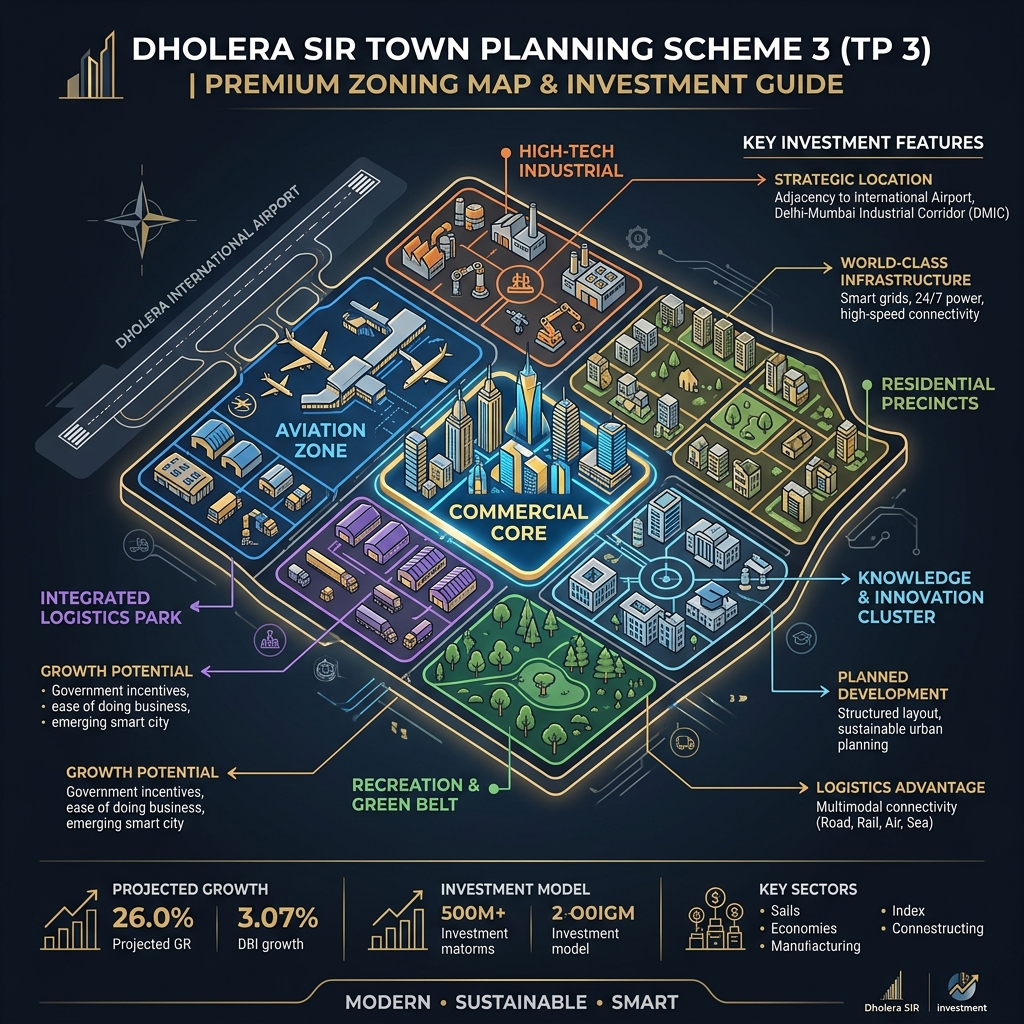
The Strategic Importance of the Airport Zone (TP 3)
The proximity of an international cargo and passenger hub transforms local land valuation through the well-documented “Aerotropolis” effect. In planned cities like Singapore (Changi) and Seoul (Incheon), land immediately bordering the airport corridor commands a premium due to logistics efficiency and commercial density. TP 3 is modeled on this exact planning philosophy.
The scheme covers a designated territory that directly interfaces with the airport’s boundary wall and the 9.56 km interchange connecting the Ahmedabad-Dholera Expressway directly to the airport passenger terminal.
Key Zoning Breakdown in TP 3
TP 3 is divided into several high-yield zoning sectors under the Dholera Special Investment Region Development Authority (DSIRDA) regulations:
- Aviation & Logistics Zone: Specifically reserved for air cargo handling, cold storage warehouses, supply chain packaging facilities, and customs clearances.
- Commercial Core & Hospitality: Designated for business hotels, transit lounges, corporate offices, and high-end retail malls catering to international travelers.
- High-density Residential Precincts: Multi-family apartments and co-living spaces designed to house airport personnel, cargo logistics staff, and manufacturing executives.
TP 3 Zoning and FSI Matrix
To help investors understand building capacities and zoning limits, we have compiled the legal zoning limits and Floor Space Index (FSI) allowances for TP 3 based on official DSIRDA guidelines:
| Zone Type | Reconstituted Plot Type | Permitted FSI | Max Height Limit | Min Access Road Width |
|---|---|---|---|---|
| Logistics & Warehousing | Industrial / Cargo | 1.8 (Base) / Up to 2.2 (Premium) | 18 Meters | 18 Meters |
| Commercial Core | Retail / Office / Hotel | 2.5 (Base) / Up to 3.0 (Premium) | 45 Meters | 24 – 30 Meters |
| High-Density Residential | Executive Apartments | 1.8 (Base) / Up to 2.5 (Premium) | 36 Meters | 12 – 18 Meters |
| Public & Semi-Public | Civic / Health / Education | 1.5 (Base) | 24 Meters | 15 Meters |
Growth Drivers for TP 3 Plots in 2026
Investors evaluating Dholera SIR TP 3 plots should focus on three primary capital appreciation catalysts:
- Direct Airport Gate Connectivity: Unlike peripheral Town Planning schemes, TP 3 land is directly connected to the passenger terminal access gates. High-access corridors experience faster commercial conversion.
- Multimodal Cargo Hub Integration: The airport is designed with a 3,200-meter runway capable of handling giant cargo planes. As manufacturing clusters (like the Tata Semiconductor Fab) begin exporting chips, the logistics demand in TP 3 will rise sharply.
- High FSI Limits: DSIRDA permits higher FSI limits in TP 3 compared to outer residential zones, allowing developers to build more built-up area per square yard of land, maximizing land utility and rental returns.
Legal Due Diligence Checklist for TP 3 Plot Buyers
Before finalizing any land deal in the Dholera Airport Zone, verify these critical legal safeguards through the Dholera Acres 3-Tier Filter:
- Verify the F-Form (Final Form): The F-Form matches the original agricultural survey number (Original Plot – OP) with the reconstituted Final Plot (FP) number. Confirm the FP boundaries do not overlap with the airport buffer zone.
- Check the NA Conversion Order: Ensure the collector has officially issued the Non-Agricultural (NA) order for the plot, ensuring construction legality.
- Validate the DSIRDA NOC: The development authority must issue a clear No Objection Certificate confirming the plot is free from zoning reservation claims or road expansion setbacks.
Disclaimer: This article is published by the editorial team at Dholera Acres for informational purposes only. It does not constitute formal financial, legal, or investment advice. While every effort has been made to verify the town planning regulations, FSI rules, and infrastructure timelines with official DSIRDA and DICDL publications, land investments are subject to market risks. Readers are strongly advised to perform independent legal due diligence and consult certified property advisors before making any transaction in Dholera SIR.
Frequently Asked Questions (FAQ)
When will Dholera International Airport be operational?
According to the Airport Authority of India (AAI) and DICDL project timelines, Phase 1 of the greenfield Dholera International Airport is scheduled to commence flight operations by the end of 2026. Terminal construction and primary runway paving are currently in advanced execution phases.
What is FSI and why does it matter in TP 3?
FSI (Floor Space Index) defines the ratio of the total built-up area of a building to the size of the plot it stands on. For example, an FSI of 2.0 on a 1,000 sq yard plot allows you to construct a total of 2,000 sq yards of floor area. TP 3 features high FSI limits (up to 3.0 for commercial plots), making it highly lucrative for multi-story hotel and office developments.
Is RERA compulsory for plots in TP 3?
No, under a policy shift by GujRERA and DSIRDA to curb speculative land trading, RERA registration is no longer issued for purely plot-only schemes. Instead, individual raw plots or reconstituted Final Plots (FPs) in Dholera SIR are developed under DSIRDA layout guidelines, and legal safety is guaranteed by verifying the approved layout plan, the NA conversion order, the title clearance certificate, and the DSIRDA NOC.
Which is better: TP 1, TP 2, or TP 3?
Your choice depends on your investment horizon. TP 1 is the Activation Core with fully active utilities, best for immediate housing development. TP 2 lies along the expressway, ideal for industrial supply chains. TP 3 is the Airport Zone, best for high-appreciating commercial, logistics, and premium hospitality land banking over a 3-to-5-year horizon.
Download Dholera SIR 2026 Investor’s Kit
Get instant access to the official planning documents: Dholera Investment Handbook (PDF), 2026 Land Price List, TP Zone & Village Map, and the NRI Buying Guide.

Join The Discussion