


The 4 Essential Digital Portals for Dholera Land Due Diligence
| Portal Name | Official Government Authority | Purpose & Key Documents Retrieved |
|---|---|---|
| **AnyROR Gujarat** (`anyror.gujarat.gov.in`) | Revenue Department of Gujarat | 7/12 Utara, 8A Khatedar details, Village Form 6 (Mutation Entries) |
| **Garvi Gujarat** (`garvi.gujarat.gov.in`) | Inspector General of Registration (IGR) | Registered Index-2 (Sale Deed history), Jantri rates, registered mortgages |
| **DSIRDA GIS Master Plan** (`dholera.gujarat.gov.in`) | Dholera SIR Development Authority | TP Scheme Final Plot (FP) location, zoning status, road widths, buffer zones |
| **E-Jameen Gujarat** (`revenuedepartment.gujarat.gov.in`) | Revenue Administration of Gujarat | Non-Agricultural (NA) order status, premium payment clearances |
Step 1: How to Download & Check 7/12 Utara Online on AnyROR
The 7/12 extract (Saat Baara) is the primary revenue document in Gujarat showing the physical identity of the land, survey number, landholder names, total acreage, and legal encumbrances.
“`mermaid flowchart TD A[“Visit anyror.gujarat.gov.in”] –> B[“Select ‘View Land Record – Rural'”] B –> C[“Select ‘VF-7 Survey No Details'”] C –> D[“Choose District: Ahmedabad | Taluka: Dhandhuka”] D –> E[“Select Specific Village (e.g., Sangasar, Navagam, Buranpur)”] E –> F[“Enter Survey Number / Block Number & Captcha”] F –> G[“Inspect Village Form 7 & Village Form 12 Extract Online”] “`
Turn-by-Turn Guide:
- Navigate to the official portal: `https://anyror.gujarat.gov.in/`.
- Click on the tab titled “View Land Record – Rural” (Dholera falls under the rural revenue administration of Dhandhuka Taluka).
- In the dropdown menu, select “VF-7 SURVEY NO. DETAILS” (Village Form 7).
- Fill in the administrative jurisdiction:
- Enter the Survey Number / Block Number provided by the seller or developer.
- Enter the visual Captcha code and click “Get Record Detail”.
What to Inspect on the 7/12 Document:
- Village Form 7 (Top Section):
- Khatedar (Owner) Name: Does the seller’s name or developer entity match the registered name on this form?
- Tenure Classification (Satta Prakar): It must state “Old Tenure” (Juni Sharat) or “Non-Agricultural” (Bin-Kheti / NA). If it states “New Tenure” (Navi Sharat) without government premium clearance, the land cannot be freely transferred without prior Collector permission.
- Restrictions & Encumbrances (Bojo / Itar Hakka): Check the right-hand column for any bank liens, private mortgages, tenancy restrictions under Section 73AA (tribal land protection), or government court injunctions.
- Village Form 12 (Bottom Section):
- Indicates land usage history. For NA plots, it will reflect non-agricultural residential/commercial status rather than ongoing seasonal crops.
Step 2: Checking Historical Ownership via Village Form 6 (Hakkar Patrak)
While the 7/12 extract shows the current owner, Village Form 6 (VF-6 Mutation Register) records the complete genetic lineage of every ownership transfer, family inheritance, sale deed, mortgage, and government order for the last 50+ years.
How to Check VF-6 on AnyROR:
- On the AnyROR Rural records page, choose “VF-6 ENTRY DETAILS”.
- Select District (Ahmedabad), Taluka (Dhandhuka), and your Village.
- Enter the specific Mutation Entry Number (Nodh Number) noted in the margin of the 7/12 extract.
- Key Verification: Ensure that every mutation entry is marked as “Pramanit” (Certified / Approved) by the Circle Officer or Mamlatdar. If an entry is marked as “Radd” (Cancelled) or “Pending Dispute,” do not proceed with the transaction.
Step 3: Verifying Town Planning (TP) & Final Plot (FP) Demarcation
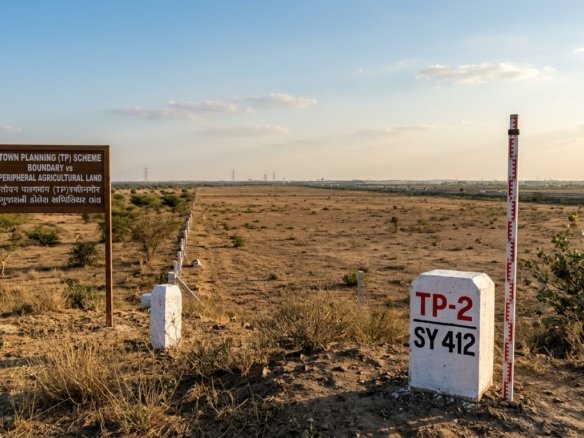
A common pitfall in Dholera is purchasing an Original Plot (OP) instead of a reconstituted Final Plot (FP) under the Town Planning scheme mechanism.
“` Original Plot (OP) ──► Raw agricultural land subject to 40% – 50% statutory land deduction. Final Plot (FP) ──► Fully titled, reconstituted freehold plot with dedicated road access. “`
How to Verify the FP Status Online:
- Access the DSIRDA Development Plan GIS Portal via `dholera.gujarat.gov.in`.
- Locate the Town Planning Scheme Map corresponding to your sector (TP-1, TP-2, TP-3, TP-4, TP-5, or TP-6).
- Look up the F-Form (Final Plot Reconstitution Register):
- Check our interactive geographic directory on Dholera SIR Boundary Map & Village Planning Layouts to inspect macro sector orientations.
Step 4: Checking Registered Transactions via Garvi Gujarat (Index-2)
The Garvi Gujarat Portal managed by the Inspector General of Registration (IGR) allows buyers to check historical registered transactions against a specific property to ensure it hasn’t been secretly sold or mortgaged to multiple parties.
- Visit `https://garvi.gujarat.gov.in/`.
- Select “Public Data Search” or “e-Search”.
- Input the registration office (Dhandhuka Sub-Registrar Office), property village, and survey/plot number.
- Download the Index-2 (Suchi-2) document:
Step 5: Validating the District Collector NA Order
Under Section 65 of the Gujarat Land Revenue Code, agricultural land cannot be utilized for residential or commercial construction without an official order from the District Collector.
What to Verify in the NA Sanction:
- Collector Signature & Order Number: Verify that the order is issued by the Collector of Ahmedabad District (or the competent delegated DSIRDA authority).
- Specific Use Classification: Confirm the land is converted to “Residential” or “Commercial” use. Industrial NA cannot be casually converted into residential sub-plots without fresh permissions.
- Condition Compliance: Check that all conditions—such as payment of conversion premiums, boundary preservation, and construction commencement timelines—are in full compliance.
7 Dangerous Red Flags to Avoid When Reviewing Land Records
“`mermaid graph TD Warning[“Red Flags in Dholera Land Records”] Warning –> F1[“‘Navi Sharat’ (New Tenure) without government premium paid”] Warning –> F2[“Section 73AA restriction noted (Tribal protected land)”] Warning –> F3[“Uncertified (Kacchi) mutation entries in Village Form 6”] Warning –> F4[“Sale based purely on Power of Attorney (PoA) without original owner presence”] Warning –> F5[“Plot sold as ‘Agricultural Share’ without individual FP demarcation”] Warning –> F6[“Mortgage lien registered with nationalized/cooperative banks on 7/12”] Warning –> F7[“Layout lacks official DSIRDA Chief Town Planner sanction stamp”] “`
- Red Flag 1: Selling Un-demarcated Undivided Shares (Bina-Vechani): If a seller offers a “100 sq. yard share” of a large 5-acre agricultural survey number without an approved sub-division or FP layout, you are purchasing undivided farmland with zero legal boundaries.
- Red Flag 2: Section 73AA Endorsements: Under the Gujarat Land Revenue Code, land belonging to Scheduled Tribes cannot be transferred to non-tribals without prior written sanction from the District Collector. Any transaction violating Section 73AA is legally void ab initio.
- Red Flag 3: Power of Attorney (PoA) Transactions: Avoid deals executed solely through unregistered or revocable Powers of Attorney. The registered titleholder must execute the Sale Deed directly or through a registered, irrevocable, stamped PoA verified at the Sub-Registrar office.
To inspect verified, legally vetted properties that have undergone complete 30-year due diligence, explore our active Properties and Plots Portal.
Frequently Asked Questions
Is the AnyROR portal in Gujarat legally valid in court?
AnyROR extracts are certified digital revenue records under the Information Technology Act, 2000, and provide prima facie evidence of land ownership. However, for formal court proceedings, bank mortgage creation, or registered conveyance, you should obtain a physical certified copy bearing the digital signature or seal of the Talati/Mamlatdar.What is the difference between Village Form 7, 8A, and 6?
* **Village Form 7 (VF-7):** Details survey numbers, acreage, owner names, land tenure (Old/New), and encumbrances. * **Village Form 8A (VF-8A):** Serves as the landowner’s tax ledger (Khata), listing all land parcels owned by that specific individual or family in that village. * **Village Form 6 (VF-6):** The mutation register documenting the chronologic history of every title change, sale deed, inheritance, and mortgage.Can an outstation non-farmer buy an NA plot in Dholera?
Yes. Once agricultural land has received an official District Collector Non-Agricultural (NA) Order, agricultural farmer status under Section 63 of the Gujarat Tenancy and Agricultural Lands Act is no longer required. Any Indian citizen or NRI can freely purchase and register NA land in Gujarat.How can I find the survey number of a Dholera plot if the seller only provides a plot number?
Ask the seller for the **DSIRDA Sanctioned Layout Plan**. The master layout sheet clearly specifies the original Revenue Survey Number(s) and Town Planning Final Plot (FP) number upon which the internal residential plot numbers are carved.Where is the Sub-Registrar office located for registering Dholera land?
Dholera SIR falls under the administrative jurisdiction of the **Sub-Registrar Office in Dhandhuka**, Ahmedabad District. All biometric registrations, stamp duty adjudications, and physical deed executions take place at this registry office.JSON-LD Schema Markup
Download Dholera SIR 2026 Investor’s Kit
Get instant access to the official planning documents: Dholera Investment Handbook (PDF), 2026 Land Price List, TP Zone & Village Map, and the NRI Buying Guide.



Join The Discussion