

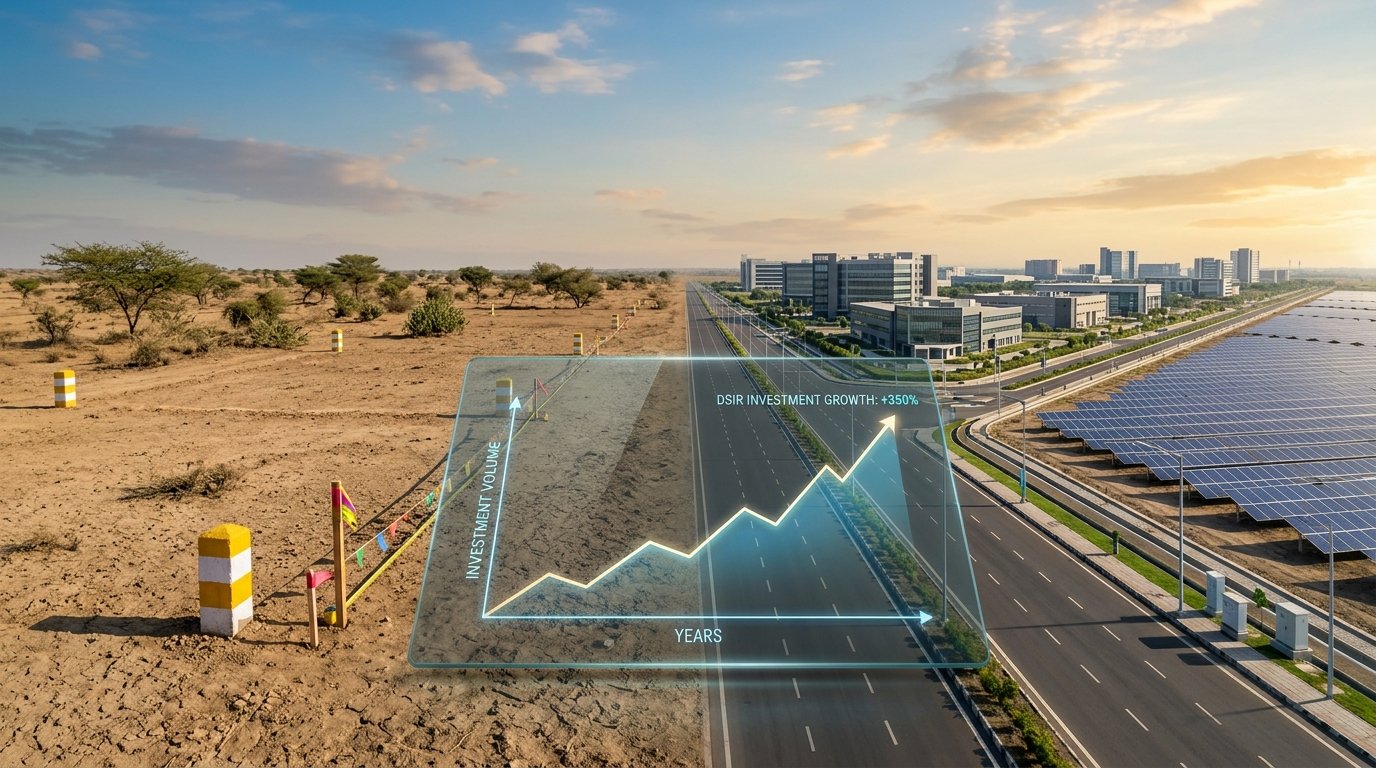
The 60-Second Summary: What the Data Says
| Factor | Assessment | Data Point |
|---|---|---|
| Government commitment | Very high | ₹1.06 lakh crore DMIC Phase 1 investment |
| Industrial demand | Growing | 100+ industrial units committed, DICDL allotments ongoing |
| Airport development | Active | Greenfield airport under development |
| Price appreciation (activation area) | Significant | ~8–15x rise from pre-2015 to 2026 in TP-1 |
| Infrastructure delivery speed | Moderate | Slower than original 2018 projections |
| Legal risk (wrong plots) | High | Agricultural/non-FP land is common |
| Liquidity | Low | Not a market you exit quickly — 5–12 year horizon |
| Verdict | **Positive for informed, patient investors** | — |
What Makes Dholera a Real Opportunity (Not Hype)
1. Central Government’s Largest Industrial Node
Dholera SIR is a Special Investment Region notified under the Government of Gujarat’s SIR Act, backed by the Delhi-Mumbai Industrial Corridor (DMIC) — a ₹1,00,000+ crore central government programme. This is not a private developer scheme. The land acquisition, trunk infrastructure and master planning are state and central government-led.
Unlike private townships that can stall or fail, the DMIC infrastructure is governed by a joint SPV (DMIC Development Corporation Ltd — DICDL) with both Government of India and Government of Gujarat equity.
2. Real Industrial Investment Is Arriving
Government announcements are one thing; actual ground-level investment is another. As of 2026:
| Company | Investment Committed | Type |
|---|---|---|
| Tata Electronics | ₹91,000 crore | Semiconductor wafer fab |
| Torrent Power | ₹5,000+ crore | Dedicated power grid / 24×7 supply |
| Multiple data centre players | Ongoing allotments | Data centres (Tier IV) |
| DICDL Plug-and-Play sheds | Operational | 50+ MSMEs and industrial units |
| Solar park developers | 4,000+ MW planned | Renewable energy |
When companies of this scale commit capital and begin construction, it signals that the infrastructure is genuinely progressing. Investors who bought near the activation area in 2020–2022 are already seeing 2–3x returns on paper.
3. Greenfield Airport Drives Long-Term Value
The Dholera International Airport is a greenfield project planned inside the SIR. Once operational, it will place Dholera on par with GIFT City in terms of direct global connectivity. Airport-adjacent zones (TP-3 and airport proximity corridor) historically command 20–40% premiums over equivalent non-airport zones.
Real Price Appreciation Data by Zone
| Zone | 2015 Price (₹/sqyd) | 2020 Price (₹/sqyd) | 2026 Price (₹/sqyd) | CAGR (2015–2026) |
|---|---|---|---|---|
| Activation Area (TP-1) | ₹600–1,000 | ₹3,000–5,000 | ₹8,000–15,000 | ~25–28% |
| TP-2 (Sangasar zone) | ₹400–700 | ₹1,500–3,000 | ₹3,000–6,500 | ~18–22% |
| TP-3 (Airport zone) | ₹800–1,200 | ₹2,500–4,500 | ₹5,000–9,000 | ~17–20% |
| TP-4/5 (Outer, Buranpur zone) | ₹200–400 | ₹800–1,500 | ₹2,000–4,500 | ~20–25% |
| Agricultural (no NA) | ₹100–200 | ₹400–800 | ₹800–1,800 | ~18–22% |
> These are blended indicative figures based on market transactions. Your actual return depends on your specific plot, documentation quality, and exit timing.
The Risks: What Can Go Wrong
Being honest about risks is more valuable than selling you a dream.
Risk 1: Buying Agricultural Land Without NA Order
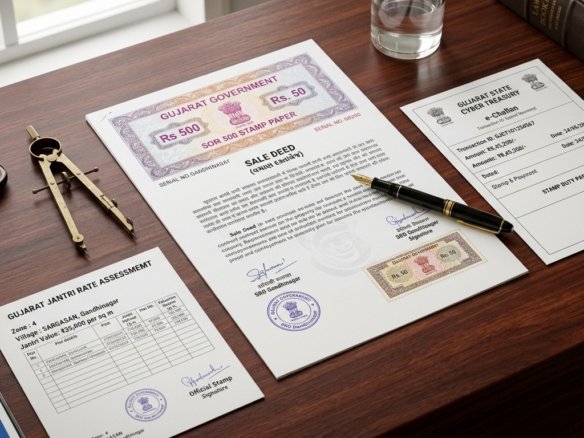
The most common mistake. Agricultural land (OP — Original Plot) inside or near Dholera SIR is not buildable, not legally transferable as a plot, and not protected by the TP scheme. Many sellers market OP land as “Dholera SIR land” because it is geographically within the SIR boundary. Price looks attractive. But without a Collector NA Order and DSIRDA-sanctioned layout, you essentially own farmland.
How to avoid: Insist on seeing the NA Order + FP (Final Plot) allotment certificate before paying any advance.
Risk 2: Infrastructure Delivery Delays
Original DMIC timelines projected significant infrastructure activation by 2018–2020. Delivery has been slower. The activation area is operational and growing, but outer zones (TP-4 through TP-6) are still years away from receiving full utility connections.
Impact: Plots in outer zones will appreciate, but the appreciation timeline is longer than initially projected — 8–15 years rather than 5–7.
Risk 3: Liquidity Is Low
Dholera is not a liquid market. You cannot easily sell your plot in 6–12 months if you need cash. The buyer pool is composed of long-term investors, not speculators. If you need capital flexibility, Dholera is a wrong investment.
Rule of thumb: Only invest money you can lock away for a minimum of 7 years.
Risk 4: Developer Failure / Fly-by-Night Operators
Some smaller developers operating in peri-Dholera areas have sold plots with weak documentation, fake DSIRDA approvals, and incorrect zoning claims. This is a real fraud risk.
How to avoid: Verify every document independently. Do not rely on the developer’s in-house legal team. Hire an independent Gujarat advocate for title clearance.
Risk 5: Regulatory Changes
SIR zones and master plans can be revised. Zoning changes can affect what you can build. DSIRDA has the authority to modify development norms.
Is Dholera Real or a Scam?
Dholera SIR is a legitimate, government-notified project. It is not a scam.
The scam risk lies in individual sellers and developers who exploit Dholera’s brand to sell undocumented agricultural land, misrepresent zoning, or fabricate approvals. The SIR itself — as a government infrastructure project — has verifiable progress: operational industrial sheds, functioning power infrastructure, ongoing airport development, and confirmed multi-billion-rupee private investments.
Quick verification checklist: – Visit the DSIRDA official website for sanctioned layout status – Check DICDL’s website for allotment data – Search the company/developer name in Gujarat’s RERA portal – Verify the plot on AnyROR Gujarat using the survey number from 7/12 Utara
Who Should Invest in Dholera in 2026?
| Investor Profile | Verdict | Recommended Zone |
|---|---|---|
| Long-term (10+ years), capital ₹20L+ | [Check] Strong fit | TP-1 / TP-2, near activation area |
| Medium-term (7–10 years), capital ₹10–20L | [Check] Good fit | TP-2 / TP-3, Sangasar area |
| Budget investor (₹5–15L), long-term patience | [Check] Possible | TP-4/5, Buranpur — strict doc verification |
| Looking for 3–5 year quick return | [X] Wrong market | N/A — avoid Dholera for short horizon |
| Needs liquidity / emergency fund backup | [X] Wrong market | N/A |
| Industrial use (factory/warehouse) | [Check] Excellent | Activation area / DICDL allotment |
Dholera vs Other Investments: Honest Comparison
| Investment | Expected Return (10yr) | Liquidity | Risk Level | Min Capital |
|---|---|---|---|---|
| Dholera SIR (TP-1/2, FP plot) | 3–5x | Low | Medium (with docs) | ₹20L+ |
| Dholera (TP-4/5, FP plot) | 2–4x | Low | Medium-High | ₹8L+ |
| Ahmedabad flat (outskirts) | 1.5–2.5x | Medium | Low-Medium | ₹30L+ |
| Mutual Fund (equity, large-cap) | 2–3x | High | Medium | Any |
| Fixed Deposit | 1.8–2.2x | Medium | Very Low | Any |
| Gold | 1.5–2.5x | High | Low | Any |
Dholera’s advantage: asymmetric upside tied to India’s manufacturing ambitions. Its disadvantage: low liquidity and documentation risk.
Frequently Asked Questions
Is Dholera SIR a good investment in 2026?
Yes, for patient long-term investors (7+ years) who buy properly documented Final Plots (FP) with NA Order and DSIRDA-sanctioned layout in TP-1 to TP-3 zones. The infrastructure is being delivered, real industrial investment is happening, and the government commitment is backed by central funds. Avoid agricultural land without documentation and outer zones (TP-5/6) if your horizon is under 10 years.Is Dholera SIR real or a scam?
Dholera SIR is a real, government-notified Special Investment Region with operational industrial infrastructure, confirmed corporate investments, and ongoing airport development. The scam risk is in individual sellers marketing undocumented agricultural land or fake approvals. Verify every document independently — NA Order, DSIRDA-sanctioned layout, FP certificate, 7/12 Utara, and title clearance.How much has Dholera land appreciated since 2015?
In the activation area (TP-1 and DICDL zones), prices have risen from approximately ₹600–1,000 per sq yard in 2015 to ₹8,000–15,000 per sq yard in 2026 — roughly 12–20x in 11 years. TP-2 and TP-3 zones have seen 8–12x appreciation. Outer zones (TP-4/5) have seen 8–12x as well from very low bases.What is the minimum investment for Dholera SIR?
Budget investors can find documented plots in TP-4/TP-5 zones (Buranpur area) starting from approximately ₹5–8 lakh for a 180–250 sq yard plot. TP-2 zone plots (Sangasar area) start from approximately ₹12–20 lakh. Activation area plots start from ₹20–30 lakh for smaller sizes. Always prioritise documentation quality over price.What are the risks of investing in Dholera SIR?
The main risks are: (1) buying agricultural land without NA Order — it is not legally buildable; (2) infrastructure delivery in outer zones being delayed by 5–10 years beyond projections; (3) low liquidity — you cannot exit quickly; (4) developer fraud using fake approvals; and (5) potential regulatory changes to zoning norms. All these risks are manageable with proper document verification and a long-term investment horizon.How long should I hold a Dholera plot before selling?
A minimum holding period of **7–10 years** is recommended for TP-1/TP-2 zone plots. For outer zone (TP-4/5) plots, plan for **10–15 years** to see meaningful appreciation tied to infrastructure delivery. Dholera is not suitable for short-term speculation.JSON-LD Schema Markup
Download Dholera SIR 2026 Investor’s Kit
Get instant access to the official planning documents: Dholera Investment Handbook (PDF), 2026 Land Price List, TP Zone & Village Map, and the NRI Buying Guide.

Join The Discussion