

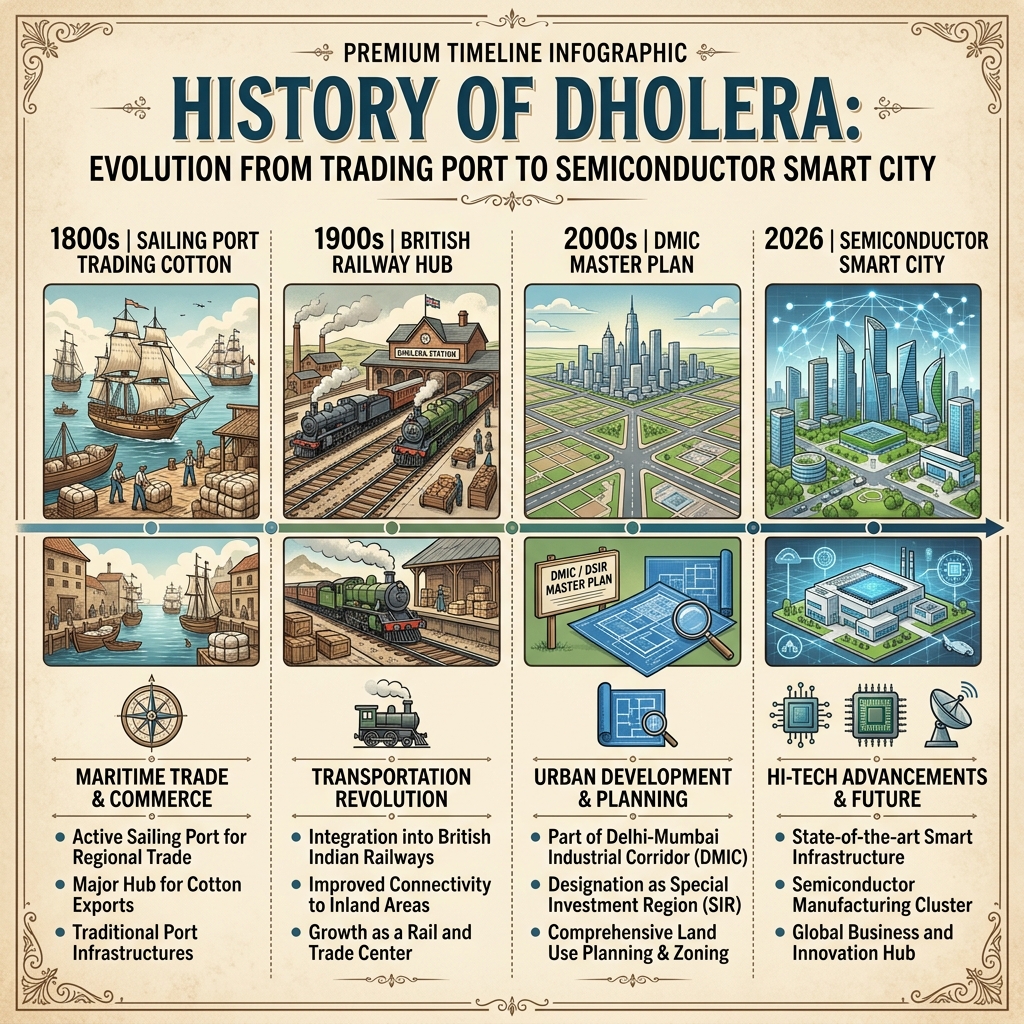

Key Eras in Dholera’s History
1. The Maritime Cotton Port Era (1802 – 1900s)
Originally ruled by the Gohel Rajputs of Lathi, Dholera was acquired by the British East India Company in 1802 through a treaty with local chieftains. * The Cotton Boom: The British developed Dholera as a primary collection point for raw cotton harvested in the Bhal region. The cotton exported from this port was of such high quality that it was traded internationally under the specific commodity brand name “Dholera Cotton” in Liverpool and Lancashire textile exchanges. * Bombay Presidency Hub: As a key port of the Bombay Presidency, Dholera featured active custom houses and mud wharves, facilitating massive cargo shipping across the Arabian Sea.
2. Consecration of Shri Swaminarayan Mandir (1826)
In May 1826 (Vikram Samvat 1882), Lord Swaminarayan personally visited Dholera to consecrate the Shri Swaminarayan Mandir (Madan Mohan Dev). * Direct Supervision: Lord Swaminarayan instructed his senior saints, Nishkulanand Swami and Adbhutanand Swami, to plan and oversee the construction. * Original Shrine: It is celebrated as one of the six original temples built during Lord Swaminarayan’s lifetime, serving as a spiritual anchor for the region for exactly two centuries.
3. Port Siltation and Decline (Early 20th Century)
By the early 1900s, Dholera’s maritime activity faced steep challenges: * Gulf Siltation: Natural siltation in the Gulf of Khambhat narrowed the shipping channels, making it impossible for larger steel-hulled steamships to anchor. * Infrastructure Shifts: The expansion of the railway network under the British administration redirected cargo shipments directly to the deep-water docks of Bombay, causing Dholera’s traditional maritime port to fall defunct.
4. Greenfield Smart City Evolution (2009 – Present)
Dholera’s revival began in 2009 with the enactment of the Gujarat Special Investment Region Act: * DMIC Integration: Dholera was designated as the pioneer node of the Delhi-Mumbai Industrial Corridor (DMIC). * Semiconductor Hub: In 2026, the historical town has transitioned into a 920 sq. km smart city containing completed smart utility corridors, the 5GW Solar Park, and the Tata Electronics semiconductor mega-fab.
Dholera’s Evolution: Key Milestones
| Time Period | Core Economic Engine | Shipping & Logistics Mode | Core Infrastructure Status | Real Estate Focus |
|---|---|---|---|---|
| 1800s – 1900s | “Dholera Cotton” export, regional trade | Sailing vessels, bullock carts, Custom Houses | Custom wharf, Swaminarayan Mandir (1826) | Port town trading plots |
| 1900s – 1950s | Local Bhal agriculture | Local cart tracks, small country craft | Defunct port, silted gulf channels | Traditional farming land |
| 2009 – 2020 | Government zoning & land pooling | State highways | DSIRDA master plan approvals, land pooling | Speculative industrial land purchases |
| 2021 – 2026 | Semiconductor fabrication & smart city | Expressway, international airport runway | Completed smart grids, ABCD building | Reconstituted NA plots with utility links |
Frequently Asked Questions (FAQ)
What is Dholera’s historical cotton trade significance?
During the 19th century under the Bombay Presidency, Dholera port was a major export node for premium raw cotton produced in the Bhal region, which was traded internationally under the name “Dholera Cotton.”
When was the Swaminarayan Temple in Dholera built?
The Shri Swaminarayan Mandir in Dholera was consecrated in May 1826 by Lord Swaminarayan himself, making it one of the six original temples constructed under his direct supervision.
Download Dholera SIR 2026 Investor’s Kit
Get instant access to the official planning documents: Dholera Investment Handbook (PDF), 2026 Land Price List, TP Zone & Village Map, and the NRI Buying Guide.

Join The Discussion